Employees protest stalled contract negotiations and working conditions, threatening production at key U.S. defence facilities starting August 4th, 2025.
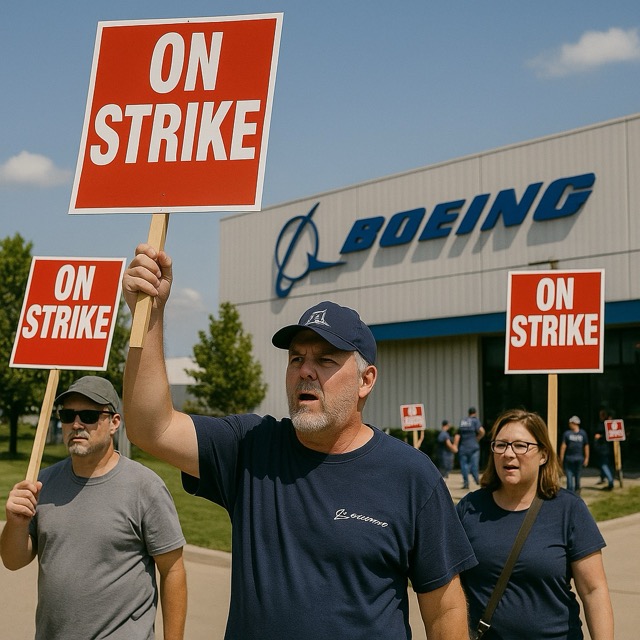
SEATTLE, August, 2025 — Several thousand Boeing defence workers across the United States are preparing to go on strike beginning August 4th, 2025, marking a significant escalation in ongoing labor disputes over pay, benefits, and working conditions. The strike threatens to disrupt operations at key military production facilities nationwide.
The planned walkout involves approximately 7,000 unionized workers, including machinists, engineers, and assembly line technicians based in Boeing’s defense units in Washington, Missouri, and California. Union representatives from the International Association of Machinists and Aerospace Workers (IAMAW) confirmed that workers voted overwhelmingly in favor of industrial action after months of fruitless negotiations.
Union leaders say the primary sticking points are pay increases, healthcare costs, and enhanced safety measures, which they argue Boeing has continually failed to adequately address. “We’ve reached a tipping point,” said Mark Collins, IAMAW union representative. “Workers have consistently voiced concerns about declining conditions and inadequate wages. Boeing’s unwillingness to negotiate fairly has forced our hand.”
Boeing, one of America’s largest aerospace and defense contractors, stated it is disappointed by the union’s decision, insisting it has made “fair and competitive offers” during the negotiation process. In a statement released Friday, the company said, “We remain committed to finding common ground. It is crucial to resolve these disputes without causing disruptions to our operations and commitments to national security.”
The strike comes at a critical time for Boeing, which is currently fulfilling several high-profile contracts with the U.S. military, including production of the F-15EX fighter jet and KC-46 tanker aircraft. Industry experts warn that a prolonged strike could lead to significant delays, impacting military readiness and Boeing’s broader operational performance.
Moreover, the timing of the strike coincides with growing geopolitical tensions, amplifying pressure on both the company and the U.S. government to swiftly address and resolve the labor dispute. Analysts note that any sustained disruption to Boeing’s production lines could negatively impact America’s defense capabilities, prompting the Pentagon to closely monitor developments.
The Biden administration has thus far refrained from direct involvement but has reportedly urged both sides to return to the bargaining table immediately. Pentagon spokesperson, Laura Kent, emphasized the importance of a timely resolution, saying, “We hope Boeing and its workers can quickly reach a fair agreement that maintains production continuity essential for national security.”
Meanwhile, local communities around Boeing’s facilities brace for economic impacts. “If this strike drags on, we’ll certainly feel the pinch,” noted Steven Reynolds, Mayor of Everett, Washington, home to one of Boeing’s largest plants. “Our local economy depends heavily on Boeing’s operations, and we’re urging swift resolution.”
As the countdown to the walkout continues, tensions remain high. Union leaders assert their resolve, while Boeing management scrambles to mitigate potential disruptions. The outcome of the forthcoming strike could set a significant precedent for labor relations across the entire U.S. defense sector.


 The Tower Post