Former Chancellor George Osborne lambasts UK’s slow crypto strategy in FT op-ed, targets Reeves and Bailey
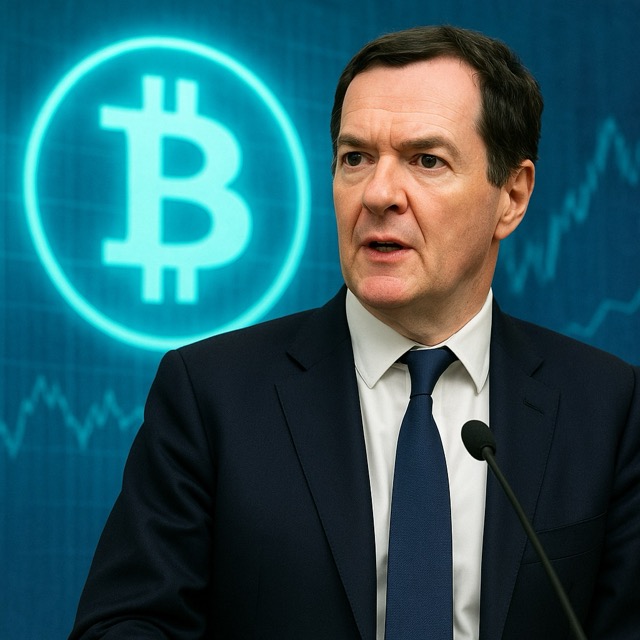
London – In a scathing opinion piece for the Financial Times published yesterday, George Osborne, the former Conservative chancellor and current member of the global advisory council at US-based Coinbase, launched a blistering critique of the Labour government’s handling of cryptocurrency regulation. Osborne accused Chancellor Rachel Reeves and Bank of England Governor Andrew Bailey of consigning Britain to the “slow lane” in the global race for digital finance innovation.
Osborne’s article comes at a critical juncture as the UK prepares to host the G20 summit later this year, where digital asset regulation is expected to be a key agenda item. In his op-ed, Osborne argued that the government’s cautious approach risked driving talent and capital overseas, undermining London’s status as a leading financial centre.
“By dragging their feet on sensible, pro-innovation regulation, Reeves and Bailey have effectively sidelined the UK,” Osborne wrote. “While our competitors in the US, EU, and Asia roll out clear frameworks to embrace blockchain technology, we remain stuck in endless consultations and vague pronouncements.”
The former chancellor praised countries such as Singapore and the United Arab Emirates for their “forward-leaning policies” that have attracted exchanges and start-ups, contrasting them with the UK’s “regulatory inertia.” He suggested that the Financial Services and Markets Bill, currently proceeding through Parliament, lacked the necessary provisions to address emerging digital assets securely and efficiently.
Osborne reserved particular ire for the Bank of England, alleging that Bailey’s reluctance to grant regulatory clarity for stablecoins and decentralized finance (DeFi) projects was “out of step with the real economy.” He contended that a more articulated policy on digital currencies would help integrate innovative payment systems into Britain’s financial plumbing, lowering costs and improving access for consumers and businesses.
The article has reignited debate over the government’s crypto policy, which until recently was touted as one of the most progressive among G7 nations. In March, Reeves announced a consultation on stablecoin regulation, followed by a paper in June outlining potential licensing regimes for crypto businesses. However, industry leaders say the process has been too slow, with many firms reportedly diverting investment to jurisdictions perceived as more welcoming.
Responding to Osborne’s critique, the Treasury emphasized that the government remained committed to a balanced approach. A spokesperson for Chancellor Reeves said: “We are determined to ensure that the UK capitalises on the benefits of crypto assets while maintaining the highest standards of consumer protection and financial stability.” The Bank of England declined to comment beyond noting its ongoing work in collaboration with the Treasury and the Financial Conduct Authority.
Analysts are divided over the implications of Osborne’s intervention. James Fairburn, a fintech analyst at Highland Capital, believes that the op-ed could spur the government to accelerate its timetable. “Public pressure from a senior figure like Osborne certainly raises the stakes,” he said. “It’s one thing to launch consultations; it’s another to implement a regulatory framework that gives businesses certainty.”
Yet some experts caution against hasty policy-making. Professor Helen Crawford of the London School of Economics warned that rapid deregulation could expose consumers to new risks. “We need robust safeguards,” she said. “Innovation should not come at the expense of financial integrity or investor protection.”
As the FT article circulates on social media and among parliamentary corridors, the spotlight is on Reeves and Bailey to demonstrate leadership. With the G20 looming and other economies advancing, the coming weeks may prove decisive in determining whether the UK can reclaim its foothold in the fast-evolving cryptocurrency landscape.
Tomorrow’s announcements on the Financial Services and Markets Bill’s next phase, as well as updates from the Bank’s digital currency working group, will be watched closely by industry and government alike. For now, Osborne’s broadside serves as a stark reminder that in the digital finance arena, speed and clarity may matter as much as caution.




 The Tower Post