City officials, survivors, and citizens gather amid renewed political debates to honor victims of the 1980 neo-fascist attack
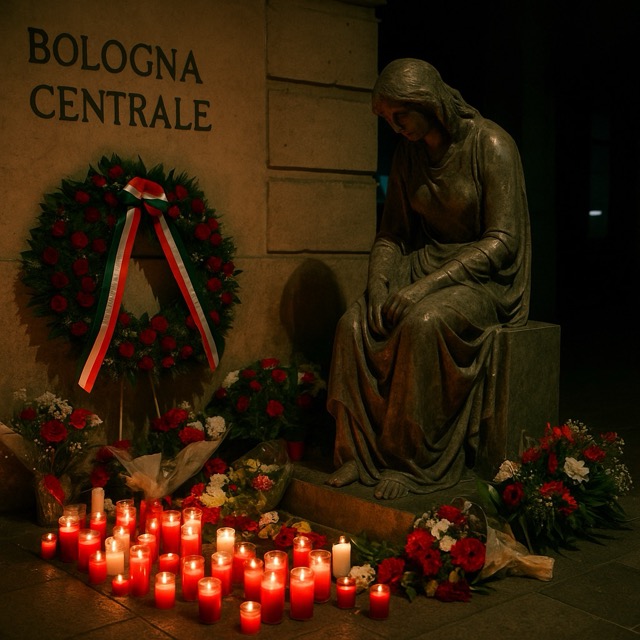
Under a scorching summer sky, Bologna paused today to commemorate the 45th anniversary of the tragic neo-fascist bombing at the city’s central railway station, an atrocity that claimed 85 lives and injured over 200 on August 2, 1980. As in years past, families of the victims, municipal authorities, and residents converged at the rebuilt station plaza for a solemn ceremony—this time shadowed by fresh controversies over historical memory and public discourse.
The morning began with a wreath-laying at the bronze statue representing solidarity and peace, adjacent to the spot where a suitcase bomb detonated, reducing walls to rubble and forever altering the city’s fabric. Survivors and descendants of those killed placed flowers and observed a minute of silence, their faces reflecting both sorrow and resilience.
Mayor Lucia De Santis presided over the official proceedings, delivering a speech that balanced remembrance with cautionary reflection. “We honor the 85 innocent souls and stand united against the forces of hatred that sought to divide us,” she said. “Yet we must remain vigilant in protecting democratic values and ensuring such violence can never be justified or forgotten.”
Traditionally, the commemoration has been apolitical, but this year’s event saw heightened tensions. A coalition of far-right groups staged a small protest on the city outskirts, framing their demonstration as a call for historical reinterpretation. Their presence prompted a strong counterresponse from left-leaning activists, who accused them of seeking to whitewash the bombing’s fascist motivations.
Violent clashes, however, were narrowly averted. Police erected barriers to separate rival demonstrators, and riot units stood by as a precaution. “Our priority is preserving the dignity of this day of remembrance,” stated Prefect Marco Bellini. “We will not tolerate any attempt to transform a memorial event into a political battleground.”
Inside the station, an exhibition organized by the city’s historical institute displayed photographs, personal testimonies, and recovered fragments of train carriages. Among the exhibits was a poignant letter from a nine-year-old girl who survived the blast, thanking rescuers for finding her brother. Visitors meandered through the displays with hushed reverence.
Scholars and historians have noted a resurgence of debate over how to teach the Bologna bombing in schools. In a heated session of Bologna’s city council last week, councillors sparred over proposed curriculum changes that would require students to analyze broader contexts of political violence in postwar Italy. Critics argued the amendments risked “equalizing all forms of violence,” potentially diluting the specific fascist intent behind the 1980 attack.
“This is not mere academic hair-splitting,” said Professor Elena Bianchi, a political historian at the University of Bologna. “Understanding the Bologna massacre within the continuum of political terrorism is essential to prevent revisionist narratives that seek to relativize its perpetrators.”
As afternoon shadows lengthened, attendees gathered for an interfaith prayer vigil in the Piazza Nettuno. Representatives of Christian, Jewish, Muslim, and secular communities spoke of unity and the moral imperative to combat extremism. One survivor, Paolo Rossi, addressed the crowd: “We are here not only to mourn, but to reaffirm that love and solidarity will always triumph over hate.”
The day concluded with a candlelight procession winding through the historic streets, the flame of each candle symbolizing a life lost. Though controversy and political provocations surfaced, the overarching mood remained one of collective resolve. Bologna’s 45th anniversary of its darkest hour reaffirmed the city’s commitment to memory and demonstrated that even amid discord, the act of remembrance can unite communities.
As night fell, the station’s facade was illuminated with the names of the victims, a final, poignant tribute. In a world where history’s lessons are often contested, Bologna’s annual remembrance endures as both a solemn act of mourning and a steadfast pledge to uphold democratic values against the ever-present shadows of extremism.


 The Tower Post