Meloni Government Frames Controversial Strait Crossing as NATO Commitment
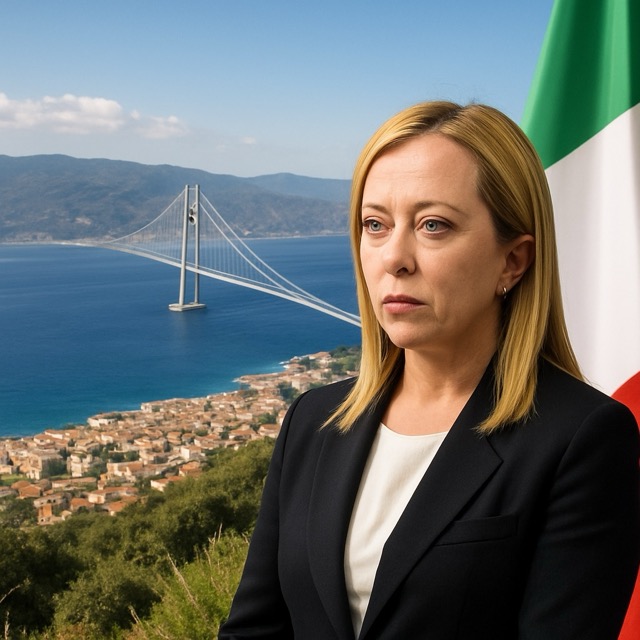
Rome. Prime Minister Giorgia Meloni’s government is poised to grant final approval today for the construction of a €13 billion bridge spanning the Strait of Messina, linking Sicily to the Italian mainland. Long championed as a means to stimulate economic growth in one of Italy’s most underserved regions, the project has been rebranded in recent weeks as essential to national security and fulfilling Italy’s NATO obligations.
Originally conceived in the 1960s and repeatedly stalled due to environmental, financial, and political objections, the bridge venture resurfaces under the banner of strategic infrastructure. Defence Minister Guido Crosetto asserted that the crossing will facilitate rapid military deployments between Sicily—home to key air and naval bases—and mainland command centers, thereby bolstering Italy’s response capabilities in the Mediterranean theatre.
Supporters argue the bridge will also modernize Sicily’s transport network, slashing travel times and potentially spurring tourism and commerce. “This is not merely an economic investment, but a dual-purpose asset that strengthens Italy’s defence posture,” said Marco Petrini, a senior official at the Ministry of Infrastructure. Critics, however, remain skeptical, pointing to persistent concerns over seismic risks and cost overruns.
Environmental groups have decried the revived plan, warning of irreversible damage to marine ecosystems and the surrounding Calabrian and Sicilian shorelines. Greenpeace Italia filed last-minute appeals to the Council of State, arguing that the rush to approval compromises thorough impact assessments. Meanwhile, local business councils in Sicily have rallied in favor, highlighting potential job creation for thousands of workers.
Financial projections estimate the bridge’s construction and maintenance costs at €13 billion over three decades, financed through a combination of state bonds, EU infrastructure funds, and private partnerships. Economists caution that the long-term debt burden may strain Italy’s public finances if projected revenue streams fail to materialize.
In the bond markets, Italy’s borrowing costs have ticked upward amid speculation over the bridge’s fiscal impact. The European Commission, assessing Italy’s 2026 budget plan, has signaled close scrutiny of public investment spending to ensure compliance with Stability and Growth Pact rules.
On the security front, NATO Secretary-General Jens Stoltenberg welcomed Italy’s initiative, noting that enhanced mobility across the Mediterranean benefits the alliance’s southern flank. “Interconnected infrastructure is critical for collective defence,” he stated in a televised address. “Italy’s leadership in this domain sets a strong example.”
Nevertheless, parliamentary opposition voices decried the process as lacking transparency. The Democratic Party and Five Star Movement criticized the expedited timetable, demanding extended debates on alternate transport and defence strategies. A vote in the Chamber of Deputies is expected by the end of the week, with final ratification in the Senate shortly thereafter.
Survey data indicate a divided public—polls show approximately 48% in favor of the project’s economic and security rationale, with 45% opposed and 7% undecided. Regional leaders in Sicily have expressed conditional support, requesting guarantees on local hiring quotas and environmental mitigation measures.
As Italy stands on the cusp of restarting this emblematic engineering challenge, the bridge’s fate hinges on balancing economic ambition, environmental stewardship, and military preparedness. The coming weeks will determine whether the Strait of Messina crossing becomes a symbol of Italian ingenuity or a cautionary tale of overreach.



 The Tower Post