Share Sale Discussions with Thrive Capital Could Crown ChatGPT Maker as World’s Most Valuable Private Tech Company
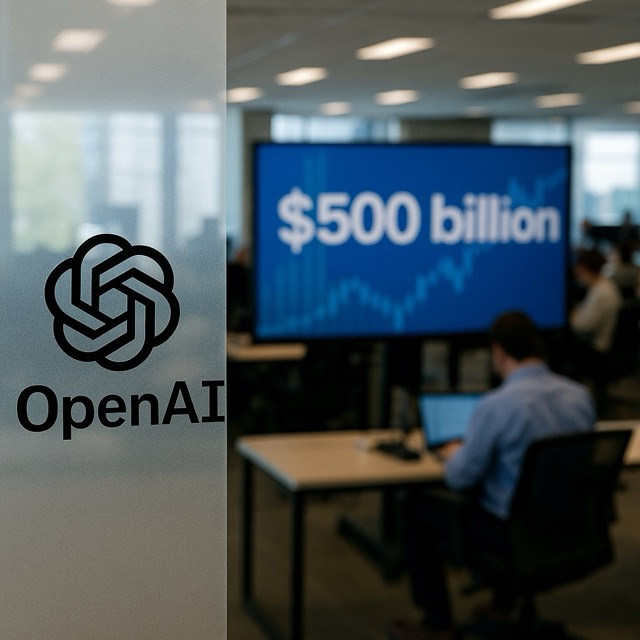
San Francisco. OpenAI, the creator of ChatGPT, is engaged in advanced discussions with a consortium of investors, including Thrive Capital, to raise new capital in a share sale that could value the company at an astonishing $500 billion, according to sources familiar with the matter.
If realized, this funding round would elevate OpenAI to the position of the most valuable private technology company globally, surpassing Elon Musk’s SpaceX, which most recently commanded a valuation near $150 billion. Such a leap underscores the growing investor appetite for artificial intelligence ventures and the dominant market position OpenAI has forged since the public debut of its generative AI models.
OpenAI’s proposed share sale involves both existing shareholders and new investors, with detailed terms still under negotiation. Thrive Capital, a leading venture firm with prior stakes in tech giants, is in talks to participate significantly, potentially acquiring a 1-2% stake at the proposed valuation. Other backers, including top-tier hedge funds and sovereign wealth funds, have also expressed interest.
The company, originally founded as a nonprofit in 2015 and later restructured as a capped-profit entity, has attracted substantial private funding rounds over the past two years. Its $10 billion investment from Microsoft in 2023 and subsequent $5 billion infusion in 2024 have been pivotal in scaling infrastructure and research capabilities.
Market analysts caution that while the proposed valuation reflects OpenAI’s extraordinary growth and strategic partnerships, it also sets a high bar for performance. “Investors are banking on AI transforming multiple industries,” said Monica Patel, a technology analyst at Redwood Research, “but at this scale, expectations for revenue generation and profitability become more demanding.”
OpenAI’s revenue model, primarily based on charging for API access and premium subscriptions to ChatGPT, generated an estimated $2 billion in annualized revenues by mid-2025, according to company estimates. The firm is exploring new enterprise products and specialized fine-tuning services that could further boost top-line growth.
Despite its commercial success, OpenAI faces regulatory scrutiny in multiple jurisdictions. U.S. and European authorities have initiated inquiries into data privacy and AI safety protocols. Company executives assert that robust governance frameworks and transparency measures are integral to their long-term strategy.
Comparisons to SpaceX are striking: while SpaceX’s valuation is underpinned by its rocket services and Starlink satellite network, OpenAI’s worth hinges on the rapid adoption of generative AI across sectors. SpaceX has successfully launched over 600 missions, but AI’s software-centric model allows for more immediate scalability and global penetration.
As OpenAI finalizes terms with Thrive Capital and other investors, insiders note that the deal structure may include secondary share purchases, enabling early employees and investors to monetize part of their holdings. This mechanism could align with broader market trends where private tech firms provide liquidity without public listings.
Looking ahead, attention will focus on the use of proceeds and governance implications. A fundraise of this magnitude could fuel further R&D in multimodal AI, robotics, and alignment research—areas that company co-founder Sam Altman has identified as crucial. For now, the prospect of a $500 billion valuation cements OpenAI’s status at the vanguard of the AI revolution.



 The Tower Post