Approval of Netanyahu’s plan raises the prospect of a renewed offensive and an open-ended Israeli presence in the enclave’s largest urban center
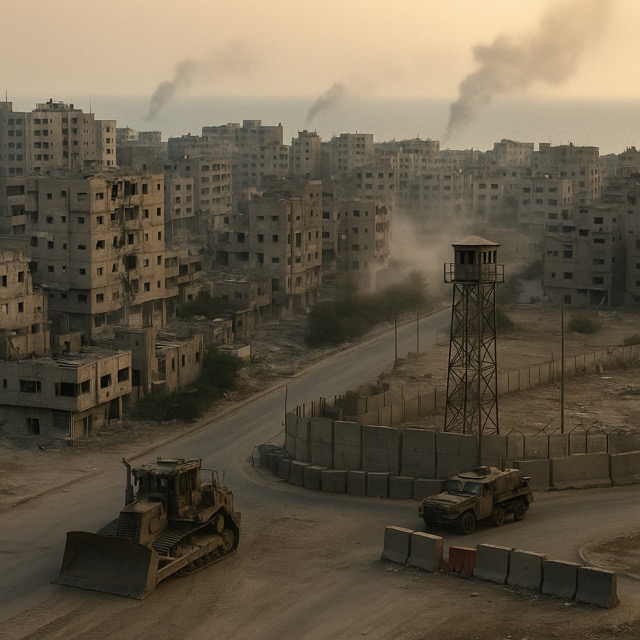
JERUSALEM/CAIRO — Israel’s political‑security cabinet has approved Prime Minister Benjamin Netanyahu’s plan to prepare the Israel Defense Forces (IDF) to take control of Gaza City, escalating a nearly two‑year war and setting the stage for the most consequential ground campaign since the earliest months of the conflict. The decision, announced overnight by the prime minister’s office, comes amid mounting international criticism and domestic unease over the fate of the remaining hostages and the humanitarian toll.
A statement from Netanyahu’s office said the military “will prepare to take control of Gaza City while providing humanitarian assistance to the civilian population outside the combat zones,” without specifying when forces would move. Israeli media and officials have described scenarios for a phased takeover that would begin with fresh evacuation warnings, followed by a tightening cordon and expanded ground operations.
Gaza City—home to an estimated 900,000 people after months of displacement northward—has been the focal point of repeated airstrikes and ground incursions. Israeli officials say Hamas’s most entrenched networks once operated in the city and nearby neighborhoods, though the extent of the group’s current footprint is unclear after the targeted killing of senior leaders and commanders. The government argues that a decisive campaign in the city is necessary to permanently degrade Hamas’s capabilities.
Netanyahu, who said this week that Israel “intends” to take military control of the entire Gaza Strip, has framed the Gaza City plan as a step toward establishing a new security order: a fortified perimeter under Israeli control and a post‑war civil administration run by unnamed Arab partners. He did not elaborate on which governments might participate, and several Arab capitals have publicly signaled they would back only arrangements endorsed by Palestinian institutions.
The prime minister’s far‑right allies have pressed for a sweeping occupation of Gaza, arguing that anything less would allow Hamas to reconstitute. Military leaders have cautioned that a citywide push could endanger the roughly 50 hostages believed to remain in the enclave—about 20 of whom are thought to be alive—by driving militants underground or prompting retaliatory killings. Relatives of captives took to the streets overnight, demanding a renewed cease‑fire-for‑hostages deal before any new offensive.
The cabinet approval caps days of fractious debate with Israel’s top brass and comes as attempts to mediate a cease‑fire have stalled. The UN’s human rights chief, Volker Türk, called for the plan to be halted immediately, warning that a fresh urban offensive would bring “more massive forced displacement, more killing, more unbearable suffering.”
International reactions were swift and sharp. Spain’s foreign minister condemned the decision, urging a permanent cease‑fire, unfettered humanitarian access and the release of hostages; other European governments voiced deep concern and called for restraint. Aid groups said any large‑scale operation in a city already hollowed by bombardment would be disastrous for civilians sheltering in makeshift camps and crowded apartments with scarce food, water and medical care.
Israeli officials insist the plan includes provisions to push civilians out of combat zones and to stage humanitarian relief at distribution points. But Gaza’s aid infrastructure has been repeatedly disrupted by fighting, checkpoints and the collapse of basic services. Relief agencies warn that additional displacement from Gaza City—potentially involving hundreds of thousands of people—would further strain southern areas already operating at or beyond capacity.
The move also resurrects a fraught question that has dogged Israeli policy since the 2005 disengagement: occupation. Netanyahu says Israel does not seek to “keep” Gaza, but rather to establish security control before handing administration to others. Critics inside and outside Israel say the lack of a credible, detailed governance plan risks creating an open‑ended military presence that could be costly to sustain, deepen international isolation, and leave a power vacuum ripe for insurgency.
Diplomatically, the approval lands at a precarious moment. Israel is facing intensifying scrutiny at the United Nations and in European capitals over civilian casualties and the blockade‑driven humanitarian crisis. Legal pressure is also mounting: the UN rights chief said the plan runs counter to International Court of Justice findings urging an end to occupation and to the realization of a two‑state solution. Washington has urged Israel to prioritize the release of hostages and to minimize harm to civilians, while avoiding direct endorsement of new territorial control.
Inside Israel, the political calculus is unforgiving. Netanyahu’s coalition relies on ultranationalist partners who oppose concessions to Hamas and demand a maximalist campaign. The military leadership, scarred by the brutal fighting of the past twenty‑two months, has warned against objectives it deems unattainable without unacceptable costs. That split has spilled into public view, fueling protests that blocked major arteries in Tel Aviv and noisy vigils outside the prime minister’s office.
Operationally, a Gaza City takeover would likely unfold in phases: expanded evacuation maps and text alerts; methodical entry and clearance of districts; and a siege of remaining militant redoubts, paired with aerial surveillance and targeted strikes. Urban combat in the dense warren of streets and tunnels would test the IDF’s manpower and logistics, while secondary fronts—including periodic rocket fire and border flare‑ups—risk stretching units thin. Commanders must also plan for holding and policing duties if the army remains in the city for weeks or months.
Much hinges on the hostage question. Previous cease‑fire negotiations faltered over sequencing—whether hostages would be freed before or after a halt in fighting and prisoner releases. A renewed offensive could both increase leverage and raise risks, depending on how Hamas calculates its options. Families of captives, whose anguish has become a defining element of Israeli politics, are pressing for a deal first.
For Gazans, the looming operation compounds a relentless ordeal. Nearly all of the territory’s population has been displaced at least once; many have moved multiple times. Hunger and disease stalk the encampments. If another wave of evacuations empties Gaza City, aid groups fear a crush of humanity into zones with little shelter, sanitation or security—fertile ground for lawlessness and trauma that will echo for years.
Netanyahu’s team frames the moment as a grim but necessary inflection point to prevent Hamas from dictating the terms of peace. Opponents counter that military control without a political horizon is a recipe for endless conflict. As the security cabinet’s green light shifts the war’s center of gravity back to the north, the coming days will reveal whether Israel can achieve its stated goals without triggering an even wider catastrophe—or whether Gaza City will become the emblem of a war entering its most dangerous phase yet.
Notes: Based on official statements and contemporaneous reporting on August 8, 2025. Key sources include Reuters dispatches and major international outlets’ coverage.


 The Tower Post