Radar satellite analysis of 150 sites across 37 companies shows factory building at triple peacetime rates—evidence that Europe’s long‑promised defence revival is materialising in ammunition and missile production.
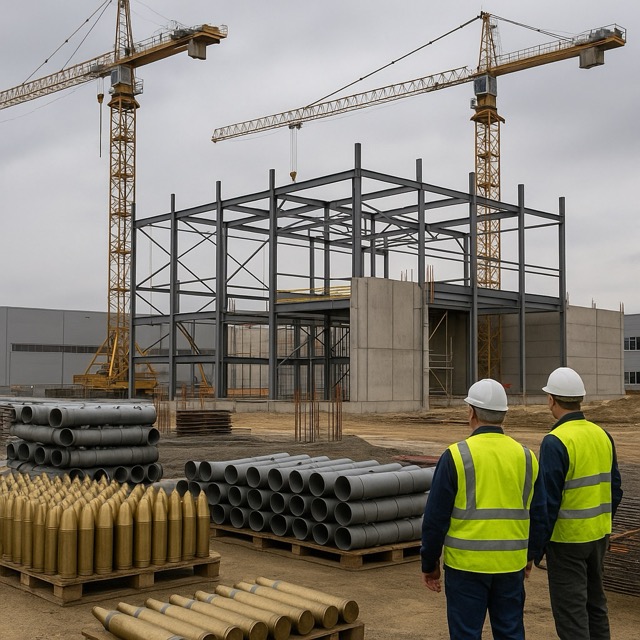
LONDON — Europe’s defence industrial base is no longer talking about a ramp‑up. It is pouring concrete. A Financial Times analysis of more than 1,000 radar satellite passes over 150 facilities tied to ammunition and missile production across 37 companies shows building activity since Russia’s 2022 full‑scale invasion of Ukraine running at roughly three times the peacetime rate. In total, more than seven million square metres of new industrial space has been added or is under construction—evidence of a generational shift away from just‑in‑time peacetime output toward a sustained war‑footing.
What we know
The surge is broad and visible from space. The FT’s dataset points to accelerated work at factories that make items Kyiv and NATO allies most urgently need: 155mm artillery shells, propellants and explosives; and missile airframes, seeker heads and rocket motors. Activity is widespread—from Germany and the Nordics to Spain and Italy—suggesting that the EU’s defence revival is migrating from policy speeches into steel frames and clean rooms.
Why it matters
For two years, western support for Ukraine has been constrained not by political will alone but by industrial bottlenecks. Ammunition and missile stocks ran down faster than factories could replenish them. The scale and spread of new construction hint that Europe is building an industrial base sized for a long haul: higher buffers, faster surge capacity and more sovereign control of critical components such as rocket motors and energetics.
Follow the money
Subsidies and procurement reform are pushing the build‑out. Brussels’ Act in Support of Ammunition Production (ASAP)—a €500 million package finalised in mid‑2023—has channelled grants to expand powder, casing, fuze and missile component lines. In 2024 the Commission unveiled the European Defence Industrial Strategy (EDIS) and proposed a €1.5 billion European Defence Industry Programme (EDIP) for 2025–27 to keep momentum and deepen co‑production with Ukraine. Alongside EU initiatives, national orders have multiplied, giving manufacturers multi‑year visibility that de‑risks new plants.
Inside the bottlenecks
The weakest links remain specialised components and energetics. Rocket‑motor producers in the Nordics and France are adding shifts and square footage, but capacity for propellants and explosive fillers still lags. Labour and permitting are persistent constraints, particularly for sites handling hazardous materials; several countries have introduced fast‑track approvals and priority access to energy and transport corridors to keep projects moving.
Company scorecard
The broad outlines of the ramp‑up are now public. Rheinmetall, Europe’s biggest shell maker, says it is on a trajectory toward producing up to 1.1 million 155mm rounds annually by 2027, underpinned by new capacity across the continent and long‑term contracts. In the UK, BAE Systems is expanding facilities at Glascoed and Washington that the government says will deliver an eight‑fold increase in sovereign shell output by mid‑decade. Missile house MBDA reports it has doubled overall missile production between 2023 and 2025 and is investing billions to sustain the pace. Nordic group Nammo has broken ground on additional ammunition and rocket‑motor capacity to ease a critical choke‑point for European air‑defence and strike weapons.
Politics and pressure
The build‑out comes as EU capitals argue over how to sustain deliveries to Kyiv while refilling their own magazines. Disputes over common procurement mechanisms continue even as member states quietly commit fresh money to extend ammunition subsidies beyond 2025. Hovering over the debate is uncertainty about the depth and duration of U.S. support—another reason why European leaders say they must anchor more production at home.
From peacetime efficiency to wartime resilience
For decades, Europe optimised defence manufacturing for efficiency: lean inventories, long vendor chains and single‑supplier specialisation within national champions. The new model prioritises resilience. That means duplicating lines in more than one country, stockpiling inputs such as nitrocellulose and casting powder, and designing missiles and artillery shells for easier multi‑source production. It also means tolerating less‑than‑perfect scale economies in exchange for strategic redundancy.
Evidence beyond rhetoric
The radar signature of expansion is hard to spin: new roofs, new foundations, new access roads. Construction is especially intense at sites flagged as recipients of ASAP grants, supporting the argument that targeted subsidies can unblock the slow, unfashionable parts of munitions manufacturing. Meanwhile, order books—many running to 2027 and beyond—give CFOs confidence to hire and invest.
The Ukrainian link
European producers are also exploring co‑production in Ukraine itself, betting that proximity to the front and a deep talent pool will speed repairs and replenishment. A landmark project announced this week sets a 2026 start for 155mm shell production inside Ukraine, with volumes ramping over two years—symbolism and supply chain all in one.
The risks
Not every project will pay off. Demand could dip if a ceasefire holds or if governments rebalance budgets toward social spending. There are also technology gaps—long‑range strike, hypersonics, advanced air‑defence—that Europe still largely fills via U.S. systems. Finally, the continent’s fragmented certification and export‑control regimes can slow cross‑border collaboration—the very glue the strategy seeks to strengthen.
What to watch next
Three markers will show whether this moment hardens into a durable industrial shift. First, delivery rates: do shells, missiles and propellants arrive at multiples of 2022 levels by 2026–27? Second, supply chains: do bottlenecks in rocket motors and energetics ease as new facilities come online? Third, policy: does EDIP pass at scale, and do member states lock in multi‑year procurement that lets CFOs amortise these new plants? If the answers are yes, Europe will have rebuilt not just stockpiles but also confidence that its factories can sustain a long war—or deter one.
Either way, the scaffolding tells its own story. Europe’s defence revival is no longer just a speech; it is a skyline.


 The Tower Post