Backlash to the Gaza campaign is rippling from airports to trading floors — spooking travellers and entrepreneurs and testing Israel’s place in the world

Israelis call it the “bubble” — the assumption that whatever rages beyond the borders will, sooner or later, leave the country’s cosmopolitan core to get on with business as usual. Nearly two years into the Gaza war that followed Hamas’s October 7, 2023 attack, that assumption looks threadbare. From airline timetables to venture–capital term sheets, and from European parliaments to international courts, signals are multiplying that Israel’s room for manoeuvre is shrinking. While staunch allies in Washington still provide military and diplomatic cover, a steady drumbeat of sanctions talk, travel warnings and legal jeopardy has many travellers and entrepreneurs asking whether Israel is drifting toward a status once reserved for the world’s untouchables.
Airports, Airspace and Anxiety
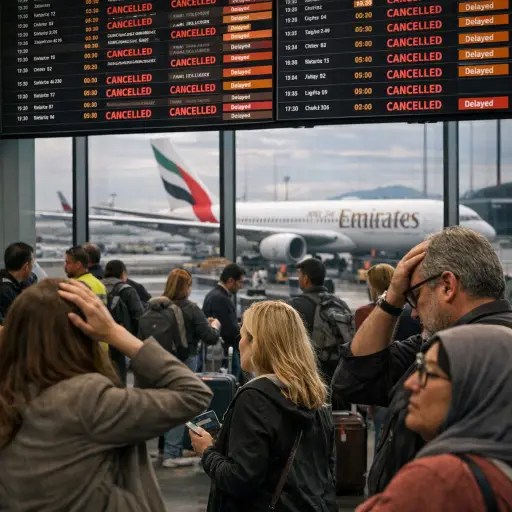
The most visible barometer has been in the skies. Major carriers have yo-yoed in and out of Tel Aviv since late 2023, with fresh suspensions this summer after regional flare‑ups and missile exchanges. By July, the European Union Aviation Safety Agency lifted its blanket warning on flights to Israel, but capacity remained patchy and volatile; U.S. airlines continued pauses on some routes through late August, and several European low‑cost carriers pushed full resumptions into the autumn. In June, a brief closure of Israeli airspace left tens of thousands of visitors stranded. Even when planes fly, travellers face abrupt advisories, insurance exclusions and airport shelter drills that have become part of the pre‑departure checklist.
A Tourism Slump Lingers
The hesitancy shows up in the numbers. Monthly tourist entries are a fraction of their pre‑pandemic peak: July 2025 saw roughly 85,000 tourists, compared with the hundreds of thousands who would typically arrive in mid‑summer. Industry bodies estimate inbound tourism hovering near one million for the year — far below the 4.9 million arrivals Israel welcomed in 2019. Tour operators speak of a ‘stop‑start’ market: every diplomatic crisis or exchange of rockets triggers cancellations, while price spikes and limited seat availability deter spontaneous trips.
From Demo Day to Domicile: Founders Hedge Their Bets
Israel’s tech engine — 20% of GDP and the backbone of exports — still hums, particularly in defense‑tech. Yet surveys by the Israel Innovation Authority point to a meaningful relocation of people and functions: over the past year, a notable share of startups shifted staff or incorporated abroad to protect access to customers, capital and talent. Thousands of high‑tech workers have left for at least a year, and venture investors report growing friction tied to Israel’s country risk — from higher insurance premia to limited travel for executives under reserve‑duty obligations. Entrepreneurs who once boasted of ‘building global from Tel Aviv’ now talk about dual headquarters and hiring sprees in Lisbon, London and the Gulf. The upside is resilience: a cluster of battle‑tested firms catering to NATO‑era procurement has attracted fresh money. The downside is a slow bleed of civilian tech activity and an erosion of Israel’s hard‑won brand as an easy place to do cross‑border business.
Diplomatic Chill, Legal Heat
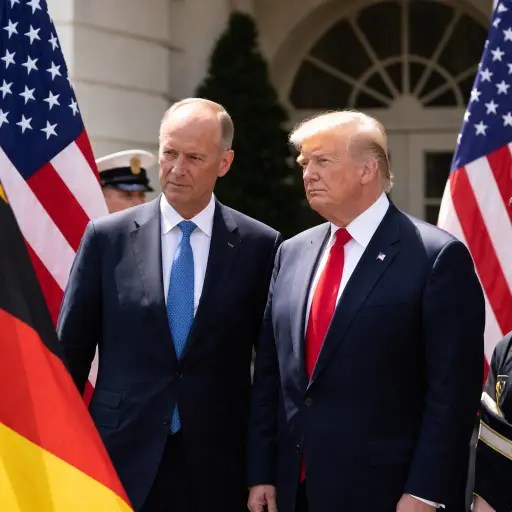
What truly worries many executives is not only war‑zone volatility but a shifting legal and diplomatic perimeter. In November 2024, the International Criminal Court issued arrest warrants for Prime Minister Benjamin Netanyahu and former defence minister Yoav Gallant over alleged crimes tied to the Gaza campaign. Last month, ICC judges rejected Israel’s bid to have those warrants withdrawn while challenges proceed. Separately, the International Court of Justice has ordered Israel to prevent genocide and facilitate humanitarian aid. Against this backdrop, Germany — Israel’s second‑largest arms supplier — announced in August it would halt military exports that could be used in Gaza, while Norway’s $2 trillion wealth fund began divesting from Israeli companies over West Bank and Gaza concerns. In Brussels, the European Commission recommended curbing Israel’s access to Horizon Europe research funds, a move closely watched by universities and labs that rely on EU money. Meanwhile, Washington remains rhetorically supportive under President Donald Trump, but political cross‑currents in Congress and among U.S. voters add uncertainty to the long‑standing strategic umbrella.
Recognition Momentum and a Reputation Gap
Symbolism matters in diplomacy. After Spain, Ireland and Norway recognized a Palestinian state in 2024, several more U.S. allies signalled they would join in at the United Nations this September. Even where governments stop short of sanctions, elite cues have shifted: city halls hosting protests, parliamentary hearings on arms exports, and municipal tenders that quietly screen out suppliers linked to settlement activity. For Israeli travellers and businesspeople, the risk is not a single ‘boycott button’ but a mosaic of frictions — from visa delays and conference disinvitations to counterparties inserting human‑rights clauses and termination rights into contracts.
Campuses, Culture — and Contracts
Universities and cultural institutions are becoming force multipliers of reputational risk. Some European campuses have suspended collaborations with Israeli institutions, and high‑profile festivals have faced boycott campaigns. Research funding and peer‑review networks — lifeblood for Israeli labs — are under scrutiny. While many leaders defend academic freedom and reject blanket boycotts, the trend line is clear: deals once signed on autopilot now invite due‑diligence questions about end‑use, complicity and safeguards for Palestinian partners.
On the Ground: The View from Ben Gurion to Rothschild Boulevard
In Tel Aviv, the dissonance is palpable. Cafés bustle and cranes dot the skyline, yet the airport loudspeakers run frequent shelter instructions; a meeting in Herzliya can be interrupted by a reserve‑duty call‑up. Founders whisper about travel routes that avoid ICC member states, general counsels update sanction checklists, and HR teams draft relocation playbooks for employees with young children. Tour guides, who pivoted to domestic clients during the pandemic, now juggle last‑minute cancellations from American church groups and European backpackers wary of insurance gaps.
What Would Reverse the Slide?
Three levers come up repeatedly in conversations with executives and risk analysts. First, a durable ceasefire paired with a credible political horizon for Palestinians would lower airline risk premia, stabilize supply chains and reopen regional talent pipelines. Second, a reset with Europe — including transparent guardrails on the use of force and meaningful steps to ease conditions in Gaza and the West Bank — could blunt the legal exposure now pushing institutions to distance themselves. Third, domestic governance: investors want predictable budgets, an end to constitutional brinkmanship and clear signals that Israel’s independent institutions will not be bent to wartime expediency. None of these are quick fixes, but together they would make it easier for partners to defend doing business in and with Israel.
The Bottom Line
Israel is not an international outcast — not yet. Trade continues, the shekel trades freely, and American security guarantees endure. But the circle is tightening in ways that travellers and entrepreneurs feel first: fewer flights, tougher insurance, pricklier procurement, and more lawyers in the room. The longer the war grinds on without a political off‑ramp and humanitarian relief, the more likely today’s patchwork of restrictions will congeal into something harder to unwind. For a country that built its prosperity on openness and exchange, the risk is not isolation as a headline — it is isolation as a habit.
Sources (selected)
– UK Foreign, Commonwealth & Development Office travel advice, updated July 3, 2025 (accessed Aug. 16, 2025).
– U.S. State Department Travel Advisory for Israel, the West Bank and Gaza, July 1, 2025.
– Reuters, July 16, 2025: ICC judges reject Israel’s request to withdraw arrest warrants for Israeli leaders while challenges proceed.
– International Criminal Court, Situation in the State of Palestine — official filings and updates, Aug. 12, 2025.
– Reuters, Aug. 8–10, 2025: Germany halts exports of military equipment that could be used in Gaza; Chancellor Merz comments on the decision.
– Reuters/Al Jazeera/Times of Israel, July–Aug. 2025: Airline suspensions and resumptions on Tel Aviv routes; Delta pause through Aug. 31; BA/Ryanair extended suspensions.
– Trading Economics / Israel CBS: Tourist arrivals ~85,000 in July 2025; inbound tourism near 1m for 2025 to date.
– Israel Innovation Authority (Jan–Apr 2025): High‑tech Employment Status Report; company surveys on relocations and workforce outflow.
– Reuters, July 28, 2025: European Commission recommends curbing Israeli access to Horizon Europe research funding.
– Washington Post, July 31, 2025: France, Canada, Malta, the UK and Australia signal plans to recognize Palestine at the UN General Assembly in Sept. 2025.


 The Tower Post