As MPs prepare to choose a path for the Palace of Westminster’s restoration, bungled mini‑projects—from a malfunctioning £9.6m front door to an £80,000 falcon relocation—fuel fears over governance and value for money.
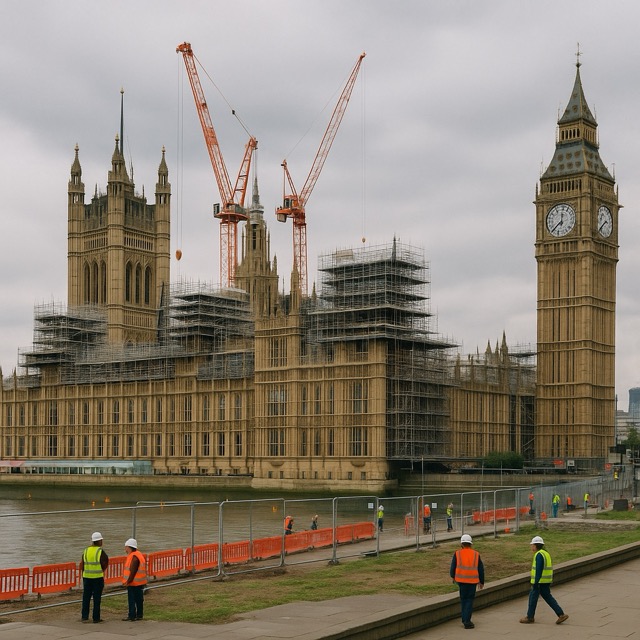
Senior parliamentarians are warning that plans to spend more than £10bn refurbishing the Palace of Westminster risk ending in financial disaster, as a drip‑feed of embarrassing cost overruns and design blunders undermines confidence in the project’s management. The Grade I‑listed, UNESCO world heritage complex is in urgent need of work after decades of neglect, but a series of smaller schemes has become a cautionary tale for how not to spend public money.
The flashpoint for public anger is a security refit at the House of Lords’ Peers’ Entrance—dubbed by MPs and peers as “one of the most expensive front doors in the world”. The upgrade, which ballooned to £9.6m, still does not function as intended; staff have been forced to stand by to press a button to open it, and a wheelchair user was reportedly trapped when the mechanism failed. The door has become a symbol of fears that larger works could succumb to the same mixture of optimistic budgeting, poor testing and weak oversight.
Another lightning rod is the decision to spend about £80,000 to relocate a pair of peregrine falcons nesting on the Victoria Tower while repair works proceed—an expense that, while small in the context of a £10bn programme, has become politically potent. Critics say such line‑items speak to a culture in which costs escalate without a clear explanation of the value delivered.
All this lands as MPs prepare for a pivotal vote later this year on the long‑delayed Restoration and Renewal programme. Parliament is expected to choose between three broad options: a full temporary decant of both Houses to allow an intensive overhaul; a hybrid approach that keeps one chamber on site while moving the other; or a rolling programme of maintenance that spreads disruption—and risk—over decades. Whichever route is chosen, officials now concede the price tag will run well into the tens of billions.
The case for acting is not in doubt. Surveys have catalogued fire hazards, leaky roofs, crumbling stonework, and widespread asbestos. There have been dozens of small fires in the past decade alone. Veteran parliamentarians routinely warn that, absent decisive action, Westminster could suffer its own Notre Dame moment. The question is whether the state can deliver a project of this sensitivity and scale without repeating the fiascos that have already dented trust.
The warning signs are there. The restoration of the Elizabeth Tower—better known as Big Ben—swelled from early estimates of around £29m to roughly £80m by completion, after a cascade of discoveries and scope changes. A separate conservation programme on the Victoria Tower has faced delays amid complaints of secrecy around costs. Individually, these are explainable in a 19th‑century complex riddled with hidden voids and protected fabric. Collectively, they add up to a credibility problem.
At the heart of the concern is governance. Parliament scrapped its original arm’s‑length Sponsor Body in 2022, bringing decision‑making closer to Westminster in the name of accountability. But veteran project managers say the current set‑up still lacks a single, visible point of accountability for scope, schedule and cost. Without it, budgets will continue to be treated as aspirations rather than commitments—and small failures will metastasize into big ones.
Senior MPs now talk openly about the risk of an HS2‑style spiral, in which numbers rise, confidence falls and ministers pull back just when sustained investment is needed. The front‑door debacle has become Exhibit A: a project commissioned for sound reasons—security and accessibility—but delivered with untested technology, inadequate prototyping and insufficient transparency. If that can happen at a doorway, what happens when the entire boiler plant, electrical systems and miles of cabling are opened up?
The least politically palatable answer may also be the most fiscally prudent. Independent assessments have repeatedly found that a full decant—moving both Houses out in one hit—is likely to be the cheapest, fastest way to do the job properly. Attempts to “patch and mend” while politicians remain in situ risk dragging the works out for decades and pushing costs well beyond today’s headline figures. Earlier modelling even suggested that insisting on staying put could see the programme stretch to many decades and totals that would eclipse the current £10bn‑plus debate.
That is not to say the decant is easy. The optics of spending billions on politicians’ workplace are toxic in an era of fiscal restraint. Finding and securing a temporary home that meets security and broadcast needs is also fraught. From time to time, eye‑catching ideas bubble up—most recently, a proposal for a purpose‑built, floating parliamentary chamber moored on the Thames. Such schemes underline the premium on imagination, but they are no substitute for clear decisions and disciplined execution.
What would “disciplined” look like? First, Parliament needs a published baseline for scope, cost and schedule; changes should be tightly controlled via formal stage‑gates and reported in real time. Second, procurement must be open‑book, with incentives aligned to delivery rather than churn. Third, independent cost assurance—by the National Audit Office and external experts—should have statutory teeth and the power to halt works pending redesign. And fourth, communication must improve: taxpayers should be able to see, line by line, what they are paying for and why.
There is also a cultural test. The Palace is not just a workplace but a national stage and a working museum—an awkward triad that tempts decision‑makers to chase perfection. The right standard is fitness for purpose and safety, not the most expensive possible preservation. If the project chases every last flourish while starving basics like fire safety and cabling, it will fail both history and the public.
For now, the signs are mixed. The immediate crises—the front door that won’t open, the falcons that had to be moved—have handed critics easy lines and generated hard questions. Yet they also offer an opportunity. If MPs can learn from these small indignities—prototype, test, be transparent—there is still time to turn a potential money pit into a model of public stewardship. If not, Britain may soon discover that the most expensive part of saving its Parliament was not the scaffolding but the indecision.



 The Tower Post