That has to stop, writes Peter Navarro, White House counsellor for trade and manufacturing
By Peter Navarro, White House Counsellor for Trade and Manufacturing August 2025
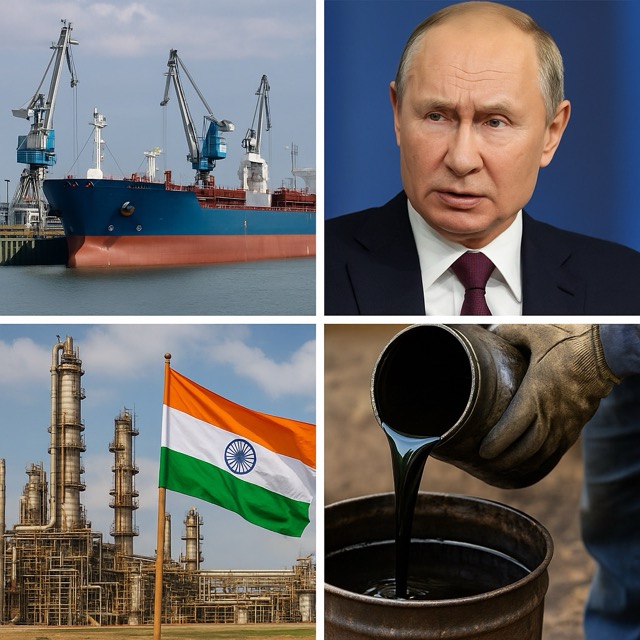
In the three and a half years since Russia’s full-scale invasion of Ukraine, the global oil market has been reshaped in ways few would have anticipated. Sanctions from the United States, the European Union, and other Western allies have curtailed Moscow’s ability to sell crude to traditional buyers. Yet the Kremlin has managed to keep its war chest filled, thanks in no small part to a flourishing trade route that runs thousands of miles south—to India.
India, now the world’s most populous nation and a rapidly expanding energy consumer, has emerged as the second-largest buyer of Russian crude after China. At bargain-basement prices, Indian refiners have been snapping up shipments that Europe once depended on, refining them, and in some cases re-exporting fuel products to international markets. This circumvention, while not technically illegal under current sanctions regimes, represents a moral and geopolitical failure. Every barrel of Russian crude processed in an Indian refinery indirectly funds Vladimir Putin’s brutal war machine in Ukraine.
The scale is staggering. According to data from international energy monitors, Indian imports of Russian crude surged from less than 1 percent of total supply in 2021 to more than 40 percent in mid-2025. This shift has freed up tens of billions of dollars annually for the Kremlin—resources Moscow has used to acquire drones from Iran, artillery from North Korea, and to sustain relentless offensives in Donetsk and Kharkiv.
Indian oil executives defend their purchases with claims of “national interest” and “energy security.” They argue that cheap Russian oil helps stabilize domestic fuel prices for India’s 1.4 billion citizens. But this line of reasoning is short-sighted. By subsidizing Moscow’s aggression, India risks not only undermining global security but also its own credibility as a democratic partner in the Indo-Pacific. A country that seeks to be a counterweight to China cannot simultaneously bankroll Russia’s authoritarian expansionism.
There are also domestic factors at play. India’s powerful oil lobby, which has grown increasingly influential under Prime Minister Narendra Modi’s administration, exerts immense pressure on policy makers to maintain access to discounted Russian supplies. Refiners, often state-backed, see record profits as they buy cheap and sell high on global markets. This profit motive, however, is directly at odds with the moral imperative of stopping a war that has claimed hundreds of thousands of lives.
The United States and its allies must send a clear message: such complicity cannot continue. Targeted secondary sanctions on Indian refiners dealing in Russian crude should be on the table. Washington must also work with energy partners in the Middle East and the Americas to ensure that India has access to alternative, affordable sources of oil. If the Modi government truly values its strategic partnership with the West, it must make a choice: stand with the free world, or stand with Putin.
History will judge nations not by the deals they cut in secret, but by the principles they upheld in times of crisis. India has the chance to stand on the right side of history. It must seize it.
 The Tower Post