The exclusive members-only club, once a niche haven for artists and entrepreneurs, is now the focus of a major buyout led by a US hotel giant.
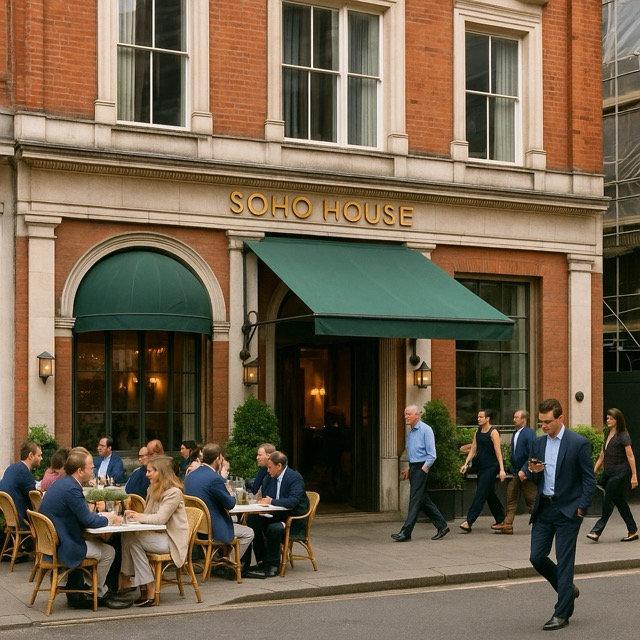
LONDON – What began in 1995 as a quirky club for actors, filmmakers, and creatives above a modest London restaurant is now at the center of one of the year’s largest hospitality transactions. Soho House, the private members’ club that defined a new era of exclusivity and lifestyle branding, is on the verge of being taken private in a $1.8 billion deal led by one of the United States’ biggest hotel owners.
The move comes after years of rapid expansion, soaring valuations, and mounting scrutiny over the financial sustainability of the Soho House model. Once synonymous with velvet-rope exclusivity and candle-lit lounges in Notting Hill, Soho House has transformed into a sprawling global empire of more than 40 locations across Europe, North America, Asia, and the Middle East. Each site boasts its own blend of rooftop pools, stylish workspaces, and celebrity-laden parties.
The bid, spearheaded by a US hotel conglomerate whose name has not yet been publicly disclosed, is expected to close by late September. The proposed transaction would end Soho House’s three-year stint on the New York Stock Exchange, where its parent company, Membership Collective Group (MCG), has struggled to impress investors. Shares have swung dramatically since the 2021 IPO, reflecting doubts over profitability even as membership numbers continued to rise.
Financial analysts suggest that the take-private move signals confidence in the long-term brand equity of Soho House, despite persistent concerns about debt levels and operational costs. “The Soho House brand remains uniquely aspirational,” said Rachel Murray, a hospitality sector analyst at Barclays. “Its ability to blend work, leisure, and social networking in one package is still unmatched. The problem has always been whether the business model can support the global scale it has pursued.”
Members themselves remain divided. Some see the expansion as diluting the intimate, bohemian spirit of the original Houses, while others welcome the increased accessibility and global reach. “When I first joined, it felt like a secret,” said James Fletcher, a London-based producer and long-time member. “Now I can walk into a House in Mumbai or Miami and know exactly what I’m getting. It’s comforting, but it’s no longer as rare.”
Despite critiques, Soho House’s membership growth has not slowed. The company recently reported more than 250,000 members worldwide, with waiting lists stretching into the tens of thousands. Its stronghold in cultural capitals – from New York’s Meatpacking District to Barcelona’s Gothic Quarter – has turned it into a lifestyle brand rather than just a club.
For the incoming US buyer, the appeal is clear: a ready-made, globally recognized brand with unparalleled cultural cachet. Industry insiders suggest that the new owners may streamline operations, increase efficiencies, and introduce tiered membership options to maximize revenue. However, some caution that too much commercialization could backfire. “Soho House thrives on perception,” said Murray. “If it begins to feel like just another hotel chain, it risks losing the very allure that makes it special.”
The $1.8bn deal underscores a broader trend in hospitality: the convergence of luxury, lifestyle, and exclusivity. Major hotel groups are increasingly seeking to capture millennial and Gen Z travelers who value curated experiences as much as – or even more than – traditional luxury. In this sense, Soho House offers a ready playbook.
As the ink dries on the deal, one question looms: Can Soho House remain both exclusive and global? Its story is a paradox of modern luxury – a brand built on intimacy that became a multinational corporation. What happens next will determine not just the future of Soho House, but perhaps the direction of the entire lifestyle-hospitality sector.


 The Tower Post