From the Meeting di Rimini, Francesco Bei reports on Javier Cercas’s call to reclaim reality in an age of post‑truth and platform power.
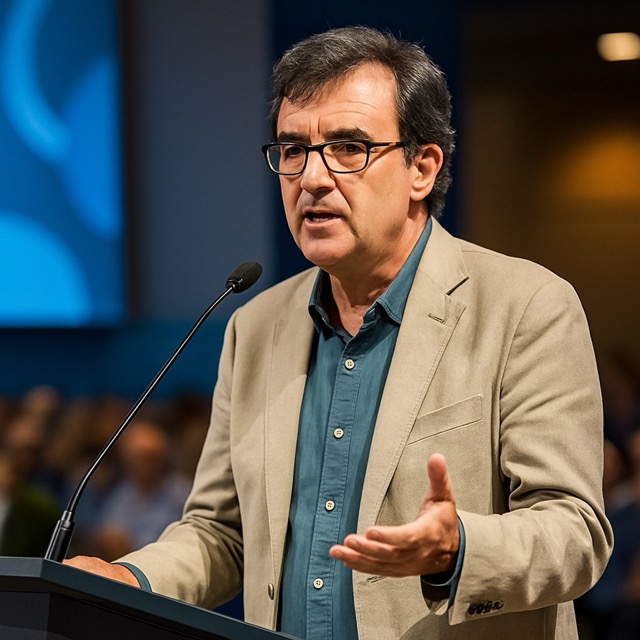
RIMINI — On a late‑August morning at the Rimini Expo Centre, when the aisles smell faintly of print and espresso and the volunteer ushers still move with first‑day zeal, Spanish novelist Javier Cercas stepped onto the stage and offered what sounded like an unassuming remedy to a world battered by information wars. “We must return to the simplest thing: telling the truth,” he said. The line, plain as a wooden bench, landed with weight in a hall where the Meeting di Rimini’s theme this year — “In the deserted places we will build with new bricks” — asks whether anything solid can still be raised on ground scoured by cynicism and panic.
The scene belonged to the panel “Communication that Builds Communion,” where Cercas sat alongside Irish writer Colum McCann and Paolo Ruffini, Prefect of the Holy See’s Dicastery for Communication. But it could have been any newsroom conference table, any kitchen where families argue over headlines. Cercas’s point was not that truth is a magic wand. It was that truth is a practice — slow, stubborn, and verifiable — and that the habit of seeking it has been crowded out by the dopamine of outrage and the industrial scale of manipulation on social platforms.
“In the Trumpian era of post‑truth,” he observed, “fake news descends from on high every day; power itself floods our feeds to bend minds.” The phrase is blunt, and in Rimini it sounded less like a political slogan than an account of the mechanical way disinformation now operates. The aim is not always to persuade, he argued, but to wear us out — to make citizens retreat into private certainties, to accept that public reality is simply a matter of taste.
What, then, can a novelist do? Cercas’s answer is to reclaim the narrative of the real. Literature, he said, is a laboratory for complexity, a place where motives are mixed and outcomes rarely neat. In that sense it is allied to journalism at its best: both ask for patience; both teach readers how to weigh a claim against evidence; both can make room for contradiction without sacrificing judgment. “Stop chasing lies,” he urged, “and take back the story of reality.”
It was not a call for naïveté. If anything, it was a demand for more strenuous standards. The craft of reporting — source, verify, explain — now meets an adversary with near‑infinite reach. The supply chain of falsehood is fast and cheap; the supply chain of truth is artisanal. Reporters at this Meeting describe losing hours to tracking down a video’s provenance, only to find the clip originated on a parody account optimized for maximum virality and minimum liability. By the time the correction lands, the meme has mutated three times and moved on.
Cercas did not come to Rimini merely as a polemicist. His latest book, a portrait of Pope Francis that follows the pontiff through Mongolia, has made him an unusual witness to the ways public figures become projection screens. Reverence and resentment, he suggested, are both shortcuts — different paths to the same refusal to look. The task for writers is not to adore or to demolish but to observe with fidelity. That posture, he conceded, can feel unfashionable. It requires an appetite for nuance and the courage to publish conclusions that are neither viral nor neat.
The discussion turned, inevitably, to platforms. If a handful of privately governed systems have become the plumbing of public speech, what, practically, can creators and citizens do? Cercas’s proposals were disarmingly concrete: resist the adrenaline loop; read slowly; check claims outside the feed before repeating them inside it; and rebuild small institutions of trust — local papers, book clubs, classrooms — that train people to disagree without dehumanizing.
Ruffini, for his part, took the long view, reminding the audience that the Church’s communication tradition is older than any algorithm and that communion begins with listening. McCann described his creative discipline as a way of stepping out of the algorithm’s stream: long walks without a phone; drafts written far from notifications; the insistence on characters who cannot be reduced to their most clickable trait. None of this is glamorous, McCann smiled, but then neither is democracy.
Outside the auditorium the Meeting’s Book Corner was busy with readers queuing for signatures, a reminder that attention still gathers around paper and pens as well as pixels. Twice over the weekend Cercas met readers there to talk about craft, faith and doubt. The questions were practical rather than devotional: How does one write a true scene when everyone involved remembers it differently? How do you handle facts that threaten your premise? He answered with working methods: interview twice, transcribe once; keep a second notebook for things you didn’t see; flag every inference. “The truth is not a cudgel,” he said. “It’s a compass.”
That conviction dovetailed with the Meeting’s overarching motto this year, borrowed from T.S. Eliot: to build in the deserted places with new bricks. The deserted places, several speakers suggested, are not just war zones and depopulated towns. They are the blank spaces inside conversations where bad faith has driven out trust. New bricks are the modest practices that allow reality to be shared again: slow reading, careful sourcing, admissions of uncertainty, the willingness to revise in public.
Cercas’s warning was sharpest when he described the damage of permanent irony. The reflex to mock — to assume every claim is a hustle — looks like sophistication but often masks surrender. If nothing is true, nothing matters; and if nothing matters, whoever shouts loudest wins. The antidote is not credulity but a renewed social contract around facts, one that holds power to account and refuses to launder partisan wishes as data. “Truth does not need to be pretty to be shared,” he said. “It needs to be checkable.”
There were moments of levity. Asked whether novelists have any special license to invent when writing about real people, Cercas shrugged: invention is a tool, not an alibi. “Reality is already radical,” he quipped. “Our job is to look hard enough.” That realism — unsentimental, interested in conflict without being addicted to it — may be why a literary voice carried so clearly in a week crowded with policy pronouncements. In a season of declarations, he offered a method.
A final exchange traced the ethics of amplification: when a falsehood is popular, should journalists repeat it to debunk it? The panel agreed on a rule of thumb: show your work, but do not do the propagandist’s distribution for them. Name the mechanism, not the meme. Point readers to primary material. And when a correction is required, publish it with the same prominence as the original — a principle too often honored in the breach.
As the crowd spilled back into the corridors, the practical takeaway sounded almost boring, which was precisely its strength: build or rebuild one credible institution within reach. Subscribe to a local paper. Attend a city council session. Teach a teenager how to verify a source. Read a novel that resists your preferred narrative. None of this can be delegated to an algorithm, and none of it goes viral. But without such bricks the common house will not stand.
In Rimini, where the Meeting has long served as a crossroads for politics, faith and civic life, the appeal to truth felt less like a sermon than a public‑spirited housekeeping list. It is not a romanticism for a vanished media age. It is a wager that reality, patiently described, still commands loyalty. If the post‑truth machine seeks to dazzle and exhaust, the counter‑strategy may indeed be to do the simplest, hardest thing: tell the truth, and keep telling it until the noise loses interest.



 The Tower Post