As swarms of low-cost drones expose a brutal cost imbalance, venture capital firms from Lakestar to Accel are pouring money into European start‑ups building interceptor drones, sensors and AI for layered, ‘Iron Dome’-style air defence.
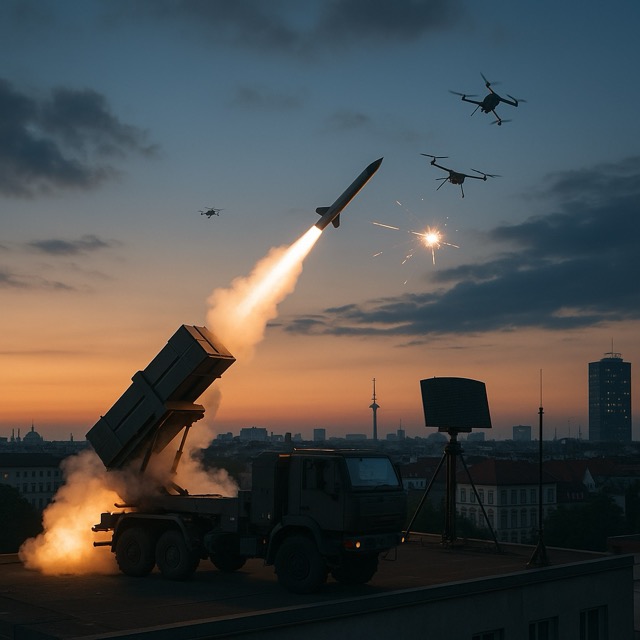
Europe’s defence establishment has spent two years learning a hard lesson from Ukraine: using million‑dollar missiles to shoot down drones that cost a fraction of that is a losing game. Now venture capitalists are piling into European “Iron Dome”‑type technologies— cheap, scalable tools to spot, track and swat massed drones—on the logic that economics, not just engineering, will decide the next air war.
The money is arriving at speed. In the first half of 2025 alone, venture investors put roughly €946m into European defence start‑ups, up 26% year‑on‑year, according to Sifted’s analysis of Dealroom data. That momentum sits atop new public capital: NATO’s €1bn Innovation Fund (NIF) and its DIANA accelerator have become reference points for dual‑use founders, while national budgets are reshaping procurement around layered air defence—short‑range guns and interceptors, medium‑range missiles and, increasingly, directed‑energy systems. The result is a pipeline of customers and an investable pathway for young companies once shunned by European LPs.
This summer produced the sector’s landmark deal. Munich‑based Helsing, long branded an “AI for defence” software company, closed a €600m Series D led by Daniel Ek’s Prima Materia, with Accel and General Catalyst among backers. The raise—at a reported €12bn valuation—cements Helsing as Europe’s most valuable defence tech start‑up and signals that investors now see autonomy, AI targeting and sensor fusion as the brains of Europe’s future air shield. Helsing has branched into hardware too, from strike drones delivered to Ukraine to an autonomous undersea system—evidence that software‑defined defence increasingly ships in physical form.
For investors focused squarely on the drone threat, the more immediate opportunity is at the very short range. That’s where swarms of Shahed‑style loitering munitions and DIY quadcopters are exhausting stockpiles and budgets. The unit economics are stark: Iran‑designed Shahed‑136 drones have been estimated at around $50,000 a unit in open‑source analyses; a Patriot PAC‑3 MSE interceptor can cost about $4m. Laser weapons promise sub‑$20 shots in clear weather, and European gunnery systems firing air‑burst rounds offer another low‑cost layer. Start‑ups building fast, attritable interceptors and the AI to cue them are the bridge between today’s missile‑heavy posture and a more sustainable defence.
One of the most talked‑about newcomers is Cambridge Aerospace, a nine‑month‑old British company that has raised about $100m at a circa $400m valuation to develop low‑cost interceptors designed to smack down drones and even cruise missiles. Its first product, Skyhammer, has been tested at sub‑scale; a follow‑on dubbed Starhammer is in the works. The company’s profile surged after former UK defence secretary Grant Shapps was cleared this month to become its chair—a move that drew criticism from transparency groups but also underlined how fast defence innovation has shifted from the margins to the mainstream of the British tech scene. Silicon Valley names like Lux Capital and Accel are said to be among the backers alongside Europe’s Lakestar.
On the continent, Germany’s TYTAN Technologies typifies a different bet: agile, inexpensive interceptors that can be mass‑produced and flown by minimally trained crews. TYTAN’s drone—tested by Ukraine’s Brave1 programme—reportedly reaches around 300 km/h and 20 km range, with onboard machine vision to home in on targets. Think of it as an aerial goalkeeper designed to smash incoming Shaheds without bankrupting the defence budget. Investors like the concept because it aligns with government doctrine: saturate the lowest tier with cheap effectors, reserve costly missiles for what truly warrants them.
The big contractors are adjusting as well—often by partnering with start‑ups. Rheinmetall and Anduril inked a deal to co‑produce layered counter‑UAS systems for European customers, pairing Rheinmetall’s Skyranger guns and Skynex command‑and‑control with Anduril’s software and autonomy. Meanwhile, the UK is pushing its DragonFire laser towards frontline use, seeking to equip Royal Navy ships later this decade after a series of successful tests. Both developments play to the venture thesis: that the winning stack will be modular and software‑defined, with young companies owning key slices of the kill chain.
Policy is amplifying the pull of private capital. Germany’s European Sky Shield Initiative (ESSI) has rallied two dozen states behind a common air‑and‑missile‑defence architecture, with Switzerland this summer signing for five IRIS‑T SLM systems and Romania signalling plans to buy Israel’s Iron Dome for its own short‑range layer. Whatever the politics, the message to founders is clear: Europe is budgeting for mass, and governments will buy credible, affordable systems quickly if they work.
For VCs, the market map is filling in. On the sensing side, European teams are spinning up 3D radars, passive RF detection and edge‑compute camera arrays that can be mounted on rooftops or pickup trucks. In command‑and‑control, a clutch of start‑ups are pitching “single pane of glass” software that fuses radar, electro‑optical and EW feeds and recommends the cheapest available effector. On the effector side, founders are split between interceptor drones (cheap, fast, disposable), gun‑based systems firing programmable air‑burst rounds, and high‑energy lasers and microwaves—each with a well‑defined niche depending on weather, engagement geometry and rules of engagement.
The backers writing cheques span the spectrum. Lakestar has publicly targeted more than €100m for European defence tech to boost resilience. General Catalyst, Accel and Lightspeed have all appeared on major cap tables. NIF, the NATO Innovation Fund, is also investing directly and through smaller specialist funds, even if internal politics have occasionally spilled into the press. Specialist European managers—from deep‑tech vehicles in the Baltics to defence‑focused seed funds in the UK, France and the Nordics—have cropped up to capture early dealflow.
Not everything scales at Silicon Valley speed. Export controls, ITAR entanglements, and multi‑sovereign certification can slow rollouts. Procurement remains balkanised, and some governments still shy away from buying from pre‑Series B companies for mission‑critical kit. The ESG debate has cooled but not vanished, particularly for LPs with blanket policies against weapons. And the technology itself faces hard limits: lasers degrade in fog and dust; guns struggle with very small, fast targets; interceptor drones must wrestle with deconfliction and fratricide in cluttered airspace. Investors who have done well so far tend to underwrite teams that integrate across the stack and design for austere, mixed‑signal battlefields, not demo‑day ranges.
Still, the direction of travel is unmistakable. The war in Ukraine continues to throw up brutal A/B tests every week as Russia experiments with new flight profiles and decoy mixes for its Shahed‑derived drones. Ukraine and its supporters respond with novel sensors, smarter tasking and cheaper interceptors. European capitals are watching closely because it is the closest thing to a live laboratory for what an ‘Iron Dome for Europe’ must look like—layered, networked and affordable at scale.
For founders, that adds up to a playbook: prove you can close the cost curve; show you can interoperate with existing radars and command systems; ship fast to a theatre where your kit will be used. For VCs, the opportunity is not just to fund a single “dome,” but to assemble portfolios that stitch together the pieces—sensing, command, autonomy and effectors—into a defence mesh that Europe can afford to run every night. If the past six months are any guide, that mesh is exactly where the capital is headed.
Sources / Further reading
• Sifted: “European defence tech is booming as funding jumps…” (Jul 21, 2025).
• Financial Times: “Spotify’s Daniel Ek leads €600mn investment in Helsing” (Jun 17, 2025) and Reuters coverage the same day.
• Reuters: “PAC‑3 MSE missiles cost about $4m each,” contract coverage (Jun 29, 2024).
• The War Zone: “What Does a Shahed‑136 Really Cost?” (Feb 8, 2024).
• Breaking Defense / Defense News: UK ‘DragonFire’ laser test success (Jan 19, 2024).
• Bloomberg/Upstarts Media: Cambridge Aerospace raises about $100m; Skyhammer interceptor (Jul 2025).
• The Guardian: Watchdog clears ex‑defence secretary to chair Cambridge Aerospace (Aug 18, 2025).
• Defence‑Industry.eu: Romania to acquire Iron Dome (Jul 12, 2025).
• Swiss Federal Government: Switzerland contracts IRIS‑T SLM within ESSI (Jul 22, 2025).
• The Economist: “Can interceptor drones stop Russia’s terror bombing?” (Jul 29, 2025).
• The Defense Post: Rheinmetall and Anduril to partner on layered C‑UAS for Europe (Jun 24, 2024).
• NATO Innovation Fund (nif.fund): About and 2025 investing updates; DIANA challenge calls (Jun–Jul 2025).



 The Tower Post