The German logistics giant insists artificial intelligence is augmenting, not replacing, human labor as it tackles workforce shortages
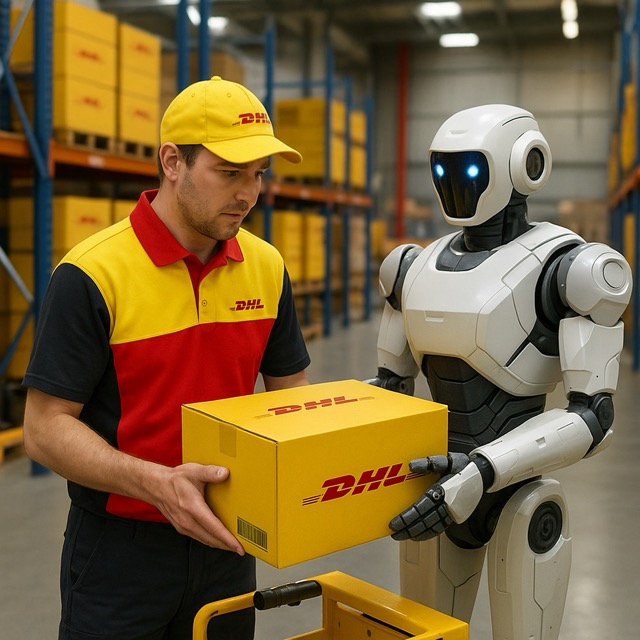
In an era when debates about artificial intelligence often focus on automation displacing workers, DHL, the global leader in logistics and delivery services, is making a different argument: AI is not taking jobs away, it is filling in the gaps left by a workforce stretched to its limits.
The German delivery giant has rolled out a sweeping AI upgrade across its European and North American operations this summer. From predictive routing algorithms to robotic assistance in warehouses, the company says the new systems are designed not to replace employees, but to relieve them from repetitive tasks and support recruitment challenges.
Meeting demand in a labor-scarce market
For years, DHL has faced difficulties in hiring enough drivers and warehouse staff, particularly during peak seasons. Labor shortages, combined with rising e-commerce demand, have strained its operations. In Germany alone, the logistics sector reports nearly 70,000 unfilled positions, according to the Bundesverband Spedition und Logistik.
“Artificial intelligence is helping us stabilize operations where human resources are simply not available,” said Anna Schneider, DHL’s Chief Technology Officer, in a press briefing in Bonn. “We are not cutting jobs—we are preventing bottlenecks. In fact, we are hiring more people than ever.”
AI systems now handle tasks such as package sorting, demand forecasting, and dynamic delivery scheduling. For instance, DHL has deployed machine vision in warehouses that can instantly recognize mislabeled parcels and redirect them, reducing human error. Delivery routes are optimized in real time to account for weather, traffic, and package priority, cutting average delivery times by nearly 12 percent.
Worker augmentation, not replacement
Employee representatives have cautiously welcomed the changes. The German trade union ver.di has long criticized automation for eroding labor protections, but its leadership now acknowledges DHL’s approach appears different. Instead of replacing drivers with autonomous vehicles, DHL has focused on using AI to assist humans.
“Drivers still drive, sorters still sort,” explained Michael Berger, a union spokesperson. “The difference is that many of the hardest and most monotonous parts of the job—like scanning endless barcodes or planning complex delivery routes—are handled by AI. Our members are less exhausted, and efficiency has improved.”
Warehouse workers, for example, are equipped with AI-guided handheld devices that suggest optimal picking paths and predict supply shortages before they happen. DHL says productivity has risen by double digits while workplace accidents linked to fatigue have dropped.
A European model for AI adoption?
DHL’s AI integration comes at a time when European policymakers are urging companies to adopt technology responsibly. The European Union’s Artificial Intelligence Act, passed earlier this year, requires firms to prove that automation does not undermine labor rights. DHL executives say their strategy aligns with these requirements, emphasizing transparency and oversight.
Unlike some of its American competitors, DHL has resisted the temptation to experiment with fully autonomous delivery fleets. “We believe in a hybrid model,” Schneider explained. “AI can drive enormous efficiency, but people remain at the heart of logistics. Human judgment is irreplaceable when dealing with customers and unexpected events.”
Customer experience and sustainability
The company argues that AI is not just a tool for internal efficiency but also improves the customer experience. Early pilot programs show that predictive algorithms can reduce missed deliveries by 20 percent by automatically adjusting to recipients’ schedules. DHL has also tied AI integration to its environmental targets. Smarter routing has reduced fuel consumption, cutting CO₂ emissions significantly across several major European cities.
Customers, for their part, seem more satisfied. In a recent survey conducted in Germany, 78 percent of DHL customers said deliveries had become more reliable in 2025 compared to two years earlier.
The bigger picture: jobs of the future
Still, experts caution that AI adoption in logistics must be carefully managed. “DHL is demonstrating a cooperative model, but the long-term picture depends on how widely autonomous systems are rolled out,” said Professor Elena Rossi, a labor economist at the University of Milan. “It is possible that some jobs will eventually disappear, but at the same time, entirely new ones—like AI systems supervisors or data logistics managers—are being created.”
Indeed, DHL says it has already hired hundreds of AI engineers, systems trainers, and digital logistics analysts to maintain and expand its new infrastructure. The company is even offering reskilling programs for warehouse employees interested in transitioning into tech-oriented roles.
Looking ahead
The logistics industry has long been a bellwether for the future of work. With AI now deeply integrated into DHL’s daily operations, the world is watching to see whether this “augmentation, not replacement” approach will hold as technology advances.
For DHL, the message is clear: artificial intelligence is not about cutting costs at the expense of people, but about ensuring the packages keep moving in a world where human labor alone cannot keep pace with demand.
As Schneider summed it up, “The question is not man versus machine. It’s man and machine, working together to deliver.”



 The Tower Post