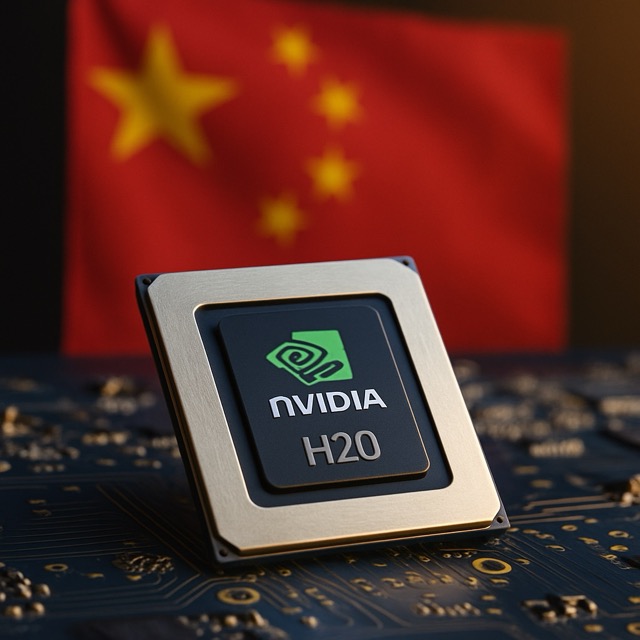
Regulators quietly move against H20 processors as tensions rise over technology, trade, and national pride

In a striking escalation of the U.S.-China technology rivalry, Chinese regulators have in recent weeks begun discouraging major domestic tech companies from purchasing Nvidia’s H20 chip—the artificial intelligence processor designed specifically for the Chinese market. The move, insiders say, was triggered not just by commercial considerations but by political outrage: remarks made by U.S. Commerce Secretary Howard Lutnick, described by Beijing officials as “insulting,” reportedly tipped the balance toward retaliation.
A Calculated Snub
According to executives at two leading Chinese cloud providers, officials from the Ministry of Industry and Information Technology (MIIT) delivered private guidance urging firms to “reassess” their reliance on Nvidia’s China-only hardware. The H20, introduced earlier this year as a downgraded alternative to the banned A100 and H100 models, had been marketed as a compromise solution—advanced enough for corporate AI applications, but limited to comply with U.S. export restrictions.
But the product never shook its stigma as a “hand-me-down” chip, a symbol of Washington’s technology chokehold. Lutnick’s recent comments, made during a trade forum in Washington, appear to have cemented Chinese policymakers’ resolve. In a pointed aside, he referred to the H20 as “good enough for them, since they can’t have the real thing.”
Chinese state media quickly seized on the remark, portraying it as an affront not just to industry, but to national dignity. One editorial in the Global Times described the statement as “a reminder that Washington views Chinese innovation through a lens of superiority and containment.”
Market Shockwaves
For Nvidia, the repercussions could be severe. The company’s China revenues, once accounting for roughly a quarter of global sales, had already taken a hit following U.S. export controls. The H20 was designed to preserve market share, but with Beijing now signaling disfavor, demand is expected to collapse.
Shares of Nvidia fell sharply in Hong Kong and New York trading last week after reports of the Chinese regulatory push began circulating. Analysts at Nomura estimate that Nvidia could lose as much as $5 billion in projected China sales for 2025.
“This is a double blow for Nvidia,” said Edward Kim, a semiconductor analyst at Mirae Asset Securities. “They were already constrained by U.S. policy. Now they face active discouragement from their largest overseas market. It’s difficult to see how the H20 can survive commercially.”
Domestic Alternatives in the Spotlight
Chinese regulators are not only punishing Nvidia; they are also boosting local champions. Officials have been urging companies to pivot toward chips produced by Huawei’s Ascend line and startups like Biren Technology. While these processors still lag behind Nvidia’s cutting-edge performance, they are rapidly improving thanks to state-backed investment and the vast domestic AI ecosystem.
Industry insiders describe a coordinated strategy: regulators quietly erect barriers for U.S. hardware while increasing subsidies, procurement contracts, and technical support for Chinese firms. “This is import substitution in real time,” said one Beijing-based consultant. “Lutnick’s comment just accelerated the shift.”
A Diplomatic Flashpoint
The fallout has already spilled into diplomatic channels. U.S. officials privately downplayed Lutnick’s remark, framing it as an offhand comment rather than formal policy. But Chinese officials appear unwilling to let the slight go unanswered.
“This was not just about one sentence,” said Professor Zhao Yiming of Tsinghua University. “It was the culmination of years of pressure. The insult became the spark, but the fuel was already there.”
The episode underscores the sensitivity of technology as a front in the broader U.S.-China rivalry. Semiconductors are no longer just components; they are strategic assets, central to economic security and geopolitical influence. For Beijing, dependence on American chips—especially after being belittled publicly—was politically untenable.
The Road Ahead
Looking forward, industry experts expect a rapid acceleration of China’s efforts to achieve semiconductor self-sufficiency. While it will take years to close the performance gap with U.S. leaders like Nvidia and AMD, Chinese firms may now enjoy regulatory protection and a captive domestic market.
Meanwhile, multinational companies operating in China face mounting uncertainty. Many tech firms relied on Nvidia’s solutions for AI training and cloud infrastructure, but now must scramble to reconfigure their supply chains.
For Nvidia, the reputational damage may be just as costly as the financial loss. What was intended as a diplomatic compromise—the H20—has instead become a political lightning rod. And for Washington, Lutnick’s gaffe may go down as a turning point: a reminder that in the delicate world of high-stakes technology diplomacy, even a few words can shift billions in trade and accelerate the fracture of global markets.
As of August 2025, one thing is clear: the battle over chips is no longer just about technology—it is about pride, power, and the future of international order.