Historic price rally lures criminals and paramilitaries into illicit mining from the Amazon to Sudan
August 2025 — Global Report
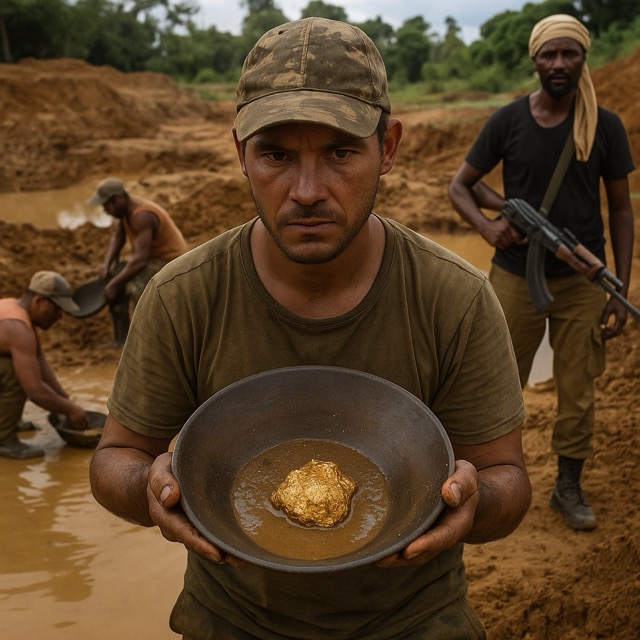
The shimmering allure of gold has once again set off a global frenzy, but this time it is not prospectors with pickaxes who are flocking to riverbeds and jungles. Instead, it is a shadowy network of organized crime groups, paramilitary factions, and desperate local miners who are fueling what experts call the most widespread illegal gold rush of the 21st century.
Driven by historic price rallies—gold touched a record $3,200 per ounce this summer—the scramble for the precious metal is spreading from the deep forests of the Amazon Basin to the war-scarred plains of Sudan. Analysts warn that the consequences extend far beyond environmental degradation: illegal gold mining is now financing insurgencies, undermining fragile governments, and rewriting the geopolitics of resource extraction.
From Amazon Rainforests to African Deserts
In Brazil and Venezuela, aerial images reveal vast scars where pristine rainforest once stood. Informal mining camps, often controlled by armed gangs, operate deep in indigenous territories. Mercury contamination has poisoned rivers, threatening entire communities. Local activists say violence has become routine, with miners and militias clashing with indigenous defenders who resist encroachment.
Across the Atlantic, Sudan has emerged as a new epicenter. Since the eruption of civil conflict in 2023, rival paramilitary factions have seized control of artisanal gold fields, smuggling bullion across porous borders into Egypt and the Gulf. The United Nations estimates that nearly $1.5 billion worth of Sudanese gold vanished from official records last year alone, fueling both the war economy and regional instability.
West Africa is no exception. In Mali, Burkina Faso, and Niger, extremist groups affiliated with al-Qaeda and Islamic State have turned to illicit gold as a vital funding source. Gold, unlike oil or diamonds, is easy to smuggle: a few suitcases of dust or nuggets can be laundered through Dubai, Istanbul, or Hong Kong and emerge as “legitimate” bullion.
A Perfect Storm of Global Pressures
Several factors have converged to create today’s illicit bonanza. Economic uncertainty, inflationary pressures, and geopolitical tensions—including the ongoing trade standoff between the U.S. and China—have driven investors toward gold as a “safe haven.” Meanwhile, the technological ease of small-scale extraction, combined with weak governance in resource-rich regions, has opened the door to criminal syndicates.
“We are witnessing a perfect storm,” said Dr. Marisa Leclerc, a resource economist at the University of Geneva. “Gold prices are soaring, governance in many producer nations is fragile, and global supply chains are desperate for bullion. It’s a recipe for chaos.”
Illegal networks exploit weak customs enforcement and lax certification schemes. Even with international initiatives like the OECD’s conflict-mineral guidelines, tracing the origin of gold remains notoriously difficult. As a result, illicit metal blends seamlessly with legitimate production, eventually ending up in jewelry shops in Paris, electronics factories in Shenzhen, or vaults in New York.
Human and Environmental Costs
The toll of this new gold rush is stark. In the Amazon, mercury used to separate gold from ore seeps into water systems, contaminating fish and endangering indigenous populations. In Africa, the human cost is equally severe: child labor, dangerous working conditions, and violent clashes over territory have become tragically common.
“The international community focuses on the glamour of gold prices,” said Juan Carlos Anaya, an environmental activist in Peru’s Madre de Dios region. “But on the ground, it’s blood, sweat, and poison.”
A Shadow Economy That Rivals Oil
The scale of the illicit trade is staggering. Experts suggest that up to 25% of global gold flows may now be linked to unregulated or illegal mining. At current prices, that represents tens of billions of dollars annually—enough to rival the revenues of some OPEC nations.
The shadow economy has also sparked geopolitical rivalries. Russia, already under heavy sanctions, has been accused of turning to gold smuggling through African intermediaries to bolster its reserves. Meanwhile, Gulf states, key trading hubs for gold, face mounting pressure to tighten controls.
The Road Ahead
International bodies are scrambling to respond. The European Union has proposed a new blockchain-based system to certify gold origins, while the African Union has launched joint security patrols in key mining corridors. Yet experts warn that enforcement will remain an uphill battle.
“Gold is compact, valuable, and liquid. As long as there is demand, criminals will find a way,” said Leclerc. “Unless consumer nations take responsibility, the illegal gold rush will only deepen.”
For now, the global hunger for gold shows no sign of waning. In villages from the Amazon to Sudan, men and women continue to dig, sift, and pan, risking their lives in pursuit of the metal that has fascinated humanity for millennia. But behind the glitter lies a dark truth: the new El Dorado is not a land of riches, but a theater of conflict, corruption, and irreversible environmental loss.


 The Tower Post