Brazil’s largest Indigenous tribe, long defenders of the rainforest, now confronts drug cartels using drones and hidden cocaine stashes in their ancestral lands.
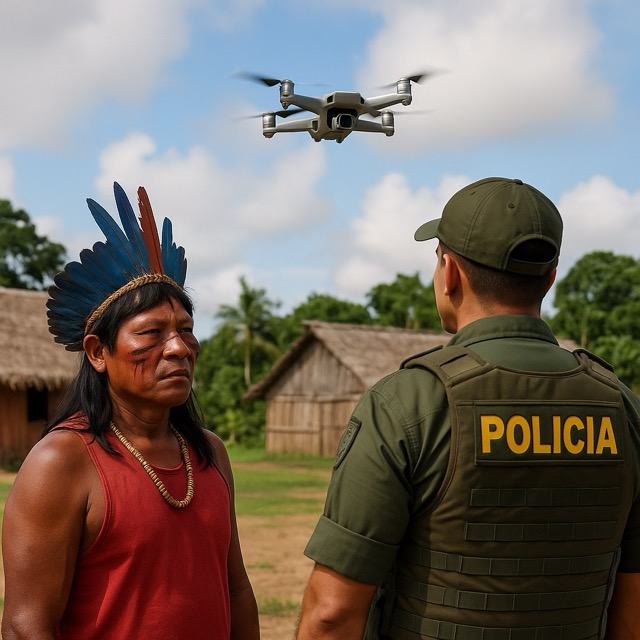
In the far western Amazon, deep within a labyrinth of rivers and forest canopy, the Ticuna people have stood firm against waves of intrusion for more than a century. Known as the largest Indigenous tribe in Brazil, with a population spread across Brazil, Colombia, and Peru, they have endured loggers, gold miners, and land grabbers who sought to strip their territory of its riches. Yet, today, they face a menace unlike anything they have ever encountered: organized crime armed with high technology.
“Our ancestors fought with bows and arrows; today, our enemy flies drones,” says Major Jonatas Soares, the regional military police commander stationed near the village of Ourique, roughly 1,100 kilometers west of Manaus. He recalls reports of unmanned aircraft buzzing over Ticuna villages last year. “Drug traffickers were stopping off there, storing their cocaine, and then putting drones up to check what was going on before continuing their journey.”
According to informants, as much as 200 kilos of cocaine were hidden in the area, ready for shipment along clandestine river routes that snake across borders. The police, however, were unable to seize the cache. The episode underscores the growing challenge of policing a region the size of Western Europe, where rivers are highways and thick forest provides cover for illicit trade.
A Vulnerable Homeland
The Ticuna have always lived in remote and difficult-to-access areas, a strategy that historically protected them from colonial violence and waves of disease. Today, however, remoteness has turned into a liability. The porous borders of the Amazon, where Brazil meets Colombia and Peru, are increasingly exploited by traffickers moving cocaine out of the Andean heartlands.
“These criminal groups are sophisticated and well-funded,” says Adriana Ramos, an Indigenous rights advocate with the NGO Instituto Socioambiental (ISA). “They are using drones, GPS, and satellite phones, while the state presence is minimal. Indigenous people are left on the front lines of a war they did not choose.”
The Ticuna’s territory, dotted with villages accessible only by boat, lies along the upper reaches of the Solimões River. Once isolated, these waterways now serve as corridors for cocaine shipments destined for Brazil’s cities and beyond. The traffickers often offer villagers money, fuel, or even weapons in exchange for silence—or worse, collaboration.
An Unfolding Crisis
The situation is not only a law enforcement concern but also a humanitarian one. Elders warn that the infiltration of criminal groups threatens the very fabric of Ticuna culture. “Young people are tempted by quick cash and motorcycles,” explains community leader Maria da Silva. “But what is lost is greater—our traditions, our language, our way of living with the forest.”
In July, Brazilian authorities increased patrols in the region, deploying riverine police units and military helicopters to monitor trafficking routes. Yet many observers argue that such operations are temporary fixes. “Without sustained presence and partnership with Indigenous communities, traffickers will always find a way back,” warns Soares.
The Ticuna’s Response
Despite the threats, the Ticuna are not passive. Community patrols organized by tribal leaders keep watch for suspicious activities, and alliances with other Indigenous groups are strengthening cross-border networks of resistance. The Ticuna also work with NGOs to document incursions, often sending reports to authorities in Manaus or Brasília. But fear persists. Drones buzzing overhead symbolize not just surveillance but a violation of sacred land.
International observers worry that without stronger state intervention, Indigenous groups could be caught between traffickers and security forces, both bringing risks of violence. Human rights organizations have urged the Brazilian government to treat the Ticuna not merely as beneficiaries of protection but as active partners in safeguarding the Amazon.
A Global Stake
The Ticuna’s struggle is emblematic of a broader Amazonian dilemma. As cocaine routes shift under international pressure, criminal groups adapt, finding new frontiers in regions with fragile governance. Meanwhile, Indigenous peoples, whose stewardship has kept the forest among the most biodiverse on Earth, bear the brunt of the confrontation.
“The forest is not only ours,” insists Maria da Silva. “It is the world’s lungs. If we fall, the forest falls. And if the forest falls, the world will feel it.”
The clash unfolding in Ticuna territory is not just a local story. It is a warning: as technology enables organized crime to penetrate even the most remote corners of the planet, Indigenous defenders of the land are more vulnerable than ever. Whether Brazil and the international community will act decisively may determine not only the future of the Ticuna, but of the Amazon itself.

 The Tower Post