Half a Million Face Starvation Amid Israeli Blockades, While Tel Aviv Rejects Allegations as ‘Absolute Lies’
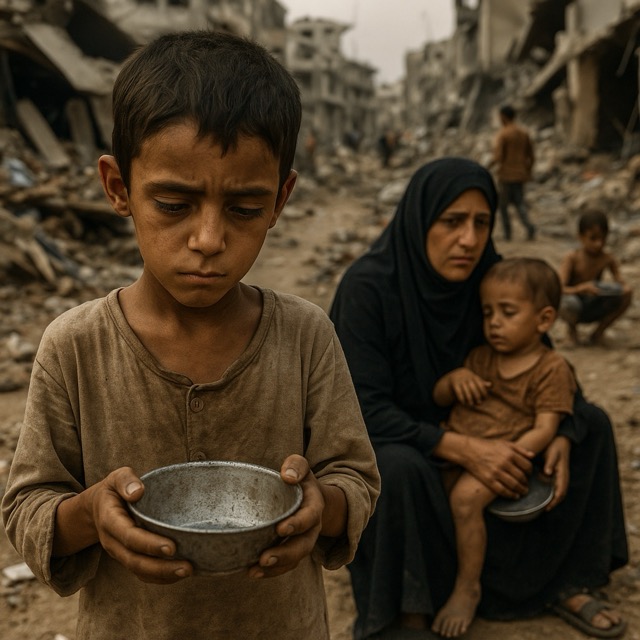
The United Nations has formally declared that a famine is underway in the Gaza Strip, marking one of the gravest humanitarian crises in the region’s recent history. According to the latest report presented this week in New York, nearly half a million people are currently facing death from starvation, with food insecurity reaching what experts describe as “the maximum level of severity.”
The assessment, which follows months of warnings from humanitarian organizations, paints a dire picture: children collapsing from hunger, hospitals overwhelmed with malnutrition cases, and entire families surviving on scraps of bread and contaminated water. The report unequivocally places responsibility on Israel’s tight restrictions on aid and essential goods, accusing Tel Aviv of deliberately obstructing supplies of food, medicine, and fuel into Gaza.
UN Findings: ‘Beyond Emergency’
The report, compiled by the UN Office for the Coordination of Humanitarian Affairs (OCHA) and endorsed by the World Food Programme, uses a five-phase classification system to measure food insecurity. Gaza, according to the document, has reached Phase 5: Catastrophe/Famine. This phase is characterized by extreme hunger, acute malnutrition rates exceeding 30%, and daily death tolls rising beyond what relief agencies can manage.
“It is not simply an emergency,” said UN humanitarian chief Martin Griffiths during a press briefing. “This is famine. And it is man-made.”
Satellite imagery has shown long queues outside bakeries, many of which have shut down due to shortages of flour and fuel. Aid convoys, when permitted, are often delayed for days at Israeli checkpoints, and relief workers report widespread looting as desperate families fight over dwindling supplies.
Israel’s Firm Denial
Israeli officials, however, have strongly rejected the UN’s conclusions. In a statement issued by the Israeli Foreign Ministry, Tel Aviv described the findings as “politically motivated fabrications aimed at delegitimizing Israel.”
“Israel does not and will not use hunger as a weapon,” the statement read. “We have facilitated hundreds of aid trucks into Gaza every week. Any claim of famine is an absolute lie, crafted to smear our government and distract from Hamas’s exploitation of civilians.”
Officials further accused Hamas of siphoning off aid for military purposes, arguing that shortages are the result of internal mismanagement rather than external restrictions.
Humanitarian Voices on the Ground
For aid workers inside Gaza, however, the UN’s assessment only confirms what they have witnessed for months. Médecins Sans Frontières has reported severe cases of kwashiorkor and marasmus—two deadly forms of malnutrition—among children under five. Doctors describe scenes of infants with distended stomachs, skeletal frames, and weakened immune systems unable to fight off basic infections.
“Every day we bury children who should have been saved with something as simple as food,” said Dr. Lina Khalil, a pediatrician in Gaza City. “We are beyond words. This is not a crisis; it is a collapse.”
Local families recount desperate measures: grinding animal feed into flour, selling personal belongings for sacks of rice, and bartering clothes for vegetables. “We have nothing left,” said Um Ahmad, a mother of six. “If the world is watching, why are we still starving?”
Political Stalemate, Human Cost
International reactions have been mixed. Several European governments have echoed the UN’s findings, calling for urgent humanitarian corridors into Gaza. The United States, while expressing “deep concern,” has stopped short of endorsing the famine declaration, citing the need for further verification.
Meanwhile, Arab states have intensified their criticism of Israel, with Egypt and Jordan warning that regional stability could collapse under the weight of Gaza’s humanitarian disaster.
Diplomatic attempts to ease the blockade remain stalled. Israel maintains its restrictions are essential to prevent weapons smuggling, while humanitarian advocates argue that the current policy amounts to collective punishment in violation of international law.
The Road Ahead
For Gaza’s residents, the debate in New York and Tel Aviv means little against the daily reality of empty plates. With no immediate breakthrough on the horizon, aid organizations warn that the death toll could rise sharply in the coming weeks.
As the UN Secretary-General António Guterres noted in his remarks, “This is not about politics, but about human survival. We are staring at the preventable death of hundreds of thousands. History will judge how we respond.”
For now, the people of Gaza wait—hungry, exhausted, and uncertain whether the world’s attention will translate into action before it is too late.


 The Tower Post