Billions have been poured into a desert ski resort meant to showcase the Kingdom’s global ambitions, but insiders say Saudi Arabia may be forced to hand hosting duties to another country.
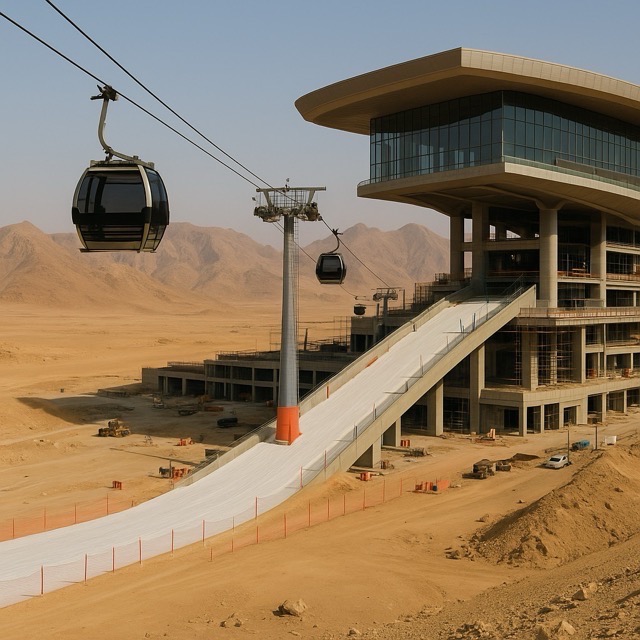
August 2025 — When Saudi Arabia won the bid to host the 2029 Asian Winter Games, it was heralded as a milestone in the Kingdom’s audacious plan to reinvent itself as a hub of global sport and tourism. The event was to take place at Trojena, a futuristic ski resort planned in the mountains of the NEOM megacity — a $500 billion project designed to symbolize the country’s break with its oil-dominated past.
But three years into preparation, the dream appears to be unraveling. Insiders familiar with the project told The Global Chronicle that Saudi authorities are struggling to deliver the massive infrastructure needed for the Games and are quietly exploring options to relocate the event to another Asian nation.
A Desert-Defying Promise
At the heart of the plan was Trojena, a resort advertised as an alpine-style paradise in the desert, complete with ski slopes, artificial lakes, and high-end chalets. Crown Prince Mohammed bin Salman pitched it as proof that “nothing is impossible” for Saudi Arabia’s Vision 2030 strategy.
Construction began in 2022, with contractors promising high-speed gondolas, luxury hotels, and year-round snow generated by advanced technology. The Games were expected to draw thousands of athletes and visitors from across Asia, putting Saudi Arabia at the center of global attention.
Delays, Costs, and Reality
Yet progress has lagged. Sources close to the project cite ballooning costs, logistical nightmares, and engineering hurdles in creating a winter environment in one of the hottest climates on earth. One senior consultant described the task as “a moonshot built on sand.”
Satellite imagery and leaked contractor reports suggest that much of Trojena remains in early construction stages, far behind the timeline required to stage an international event. Key facilities, including the main ski slope and athlete villages, are years from completion.
“Deadlines are being missed, and the scale of investment required to catch up is astronomical,” says a Gulf-based infrastructure analyst. “Even with unlimited money, physics and climate are not on Saudi Arabia’s side.”
Image Versus Reality
The difficulties raise questions about the broader strategy of sportswashing — Riyadh’s use of sporting events to project a modern, global image. Over the past five years, Saudi Arabia has spent billions acquiring stakes in football clubs, hosting Formula One races, and signing high-profile boxing matches.
But the Winter Games were meant to be different: a statement of technological prowess and environmental mastery. Instead, the project risks becoming a symbol of overreach.
“Sports investments are easy when you can buy a football club or sponsor a tournament abroad,” says Maya Tanaka, a Tokyo-based sports economist. “Hosting a complex event in your own backyard — especially one so out of sync with your environment — is another matter entirely.”
Considering a Plan B
According to insiders, Saudi officials have begun discreet discussions with the Olympic Council of Asia about contingency plans. Options under review include co-hosting arrangements with established winter sports nations such as Japan, South Korea, or Kazakhstan, or even transferring the Games entirely.
While no official statement has been made, postponement or relocation would mark a major embarrassment for Riyadh and a setback for Vision 2030. It could also test Saudi Arabia’s credibility as a future host for other mega-events, including the much-rumored bid for the 2034 FIFA World Cup.
A Broader Reckoning
The fate of the Asian Winter Games highlights the limits of Saudi Arabia’s rapid transformation agenda. Vision 2030 has spurred extraordinary projects, but critics argue that ambition often outpaces feasibility. NEOM itself — a futuristic city promised to be powered entirely by renewable energy — has been dogged by delays, funding questions, and doubts about its viability.
“The Winter Games were meant to showcase Saudi innovation and determination,” says Tanaka. “If they collapse, it will underscore that not everything can be bought or built overnight.”
For now, the official line remains optimistic. NEOM representatives insist Trojena will be ready on time, with advanced construction techniques and international expertise ensuring delivery. But in private, skepticism is growing.
The Road Ahead
With less than four years to go, the clock is ticking. If Saudi Arabia cannot meet its commitments, it may have to choose between scaling down the Games, sharing the spotlight with another host, or withdrawing altogether.
For a Kingdom intent on reshaping its global image, the stakes are high. Success would cement its reputation as a bold innovator. Failure could leave a lasting mark on its credibility — and on the legacy of Vision 2030 itself.
 The Tower Post