The lawsuit claims that Apple’s integration of ChatGPT into iPhones creates an unfair monopoly, escalating tensions in the AI race.
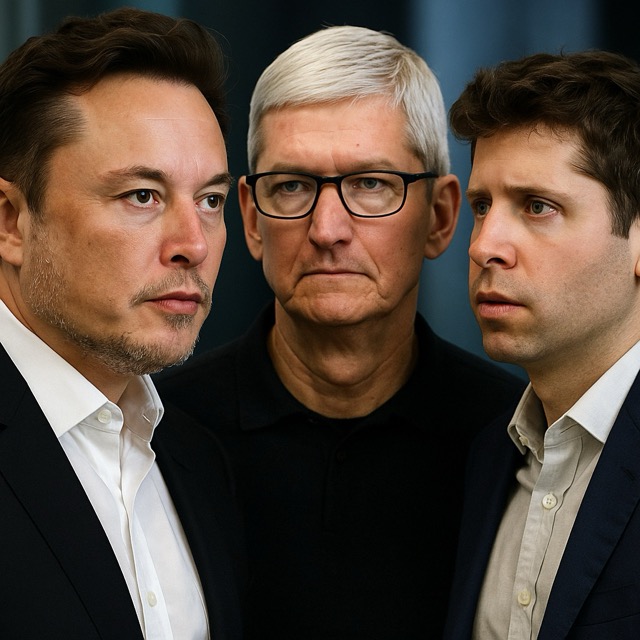
In a move that could reshape the competitive landscape of artificial intelligence, Elon Musk’s company xAI has filed a lawsuit against Apple and OpenAI, accusing the two tech giants of colluding to restrict competition through the integration of ChatGPT into Apple’s iPhones. The legal battle, announced this week in San Francisco federal court, underscores the growing tension between Musk and his former collaborators at OpenAI, and raises new questions about antitrust enforcement in the era of generative AI.
The lawsuit and its claims
The complaint filed by xAI alleges that Apple’s June 2025 announcement—bringing OpenAI’s ChatGPT as a default feature into iOS—constitutes an unlawful partnership designed to exclude other AI competitors from accessing a market of hundreds of millions of users worldwide. The lawsuit describes the Apple-OpenAI deal as “a deliberate attempt to monopolize conversational AI on mobile devices,” in violation of U.S. antitrust law. According to xAI’s lawyers, Apple’s unprecedented control of its mobile ecosystem, combined with OpenAI’s dominance in large language models, creates a “walled garden” that could stifle competition for years.
“This is not about innovation—it’s about exclusion,” reads the filing. “Apple and OpenAI have constructed a partnership that locks users into one system, reducing consumer choice and denying other AI providers the ability to compete on fair terms.”
Musk’s campaign against OpenAI
The lawsuit is the latest chapter in Musk’s very public feud with OpenAI, the company he co-founded in 2015 but left three years later, criticizing its turn toward commercialization and its close ties with Microsoft. Musk’s xAI, launched in 2023, has sought to position itself as an open, safety-focused alternative, unveiling its own large language model, Grok, last year. Despite rapid growth, xAI has struggled to gain the same traction as OpenAI’s ChatGPT, which remains the most widely used chatbot globally.
Musk has repeatedly accused OpenAI of betraying its nonprofit origins, calling it “a closed-source, profit-maximizing monopoly under the control of Big Tech.” The integration with Apple, he argues, proves his point. On X, the social platform he owns, Musk wrote: “Apple has effectively given OpenAI the keys to billions of devices. This is textbook anticompetitive behavior.”
Apple’s defense and OpenAI’s silence
Apple has defended its partnership, insisting that users retain the option to disable ChatGPT or choose alternative assistants. “We are bringing generative AI to iPhone in a way that prioritizes privacy, transparency, and user choice,” Apple said in a statement. “Users can turn off or replace ChatGPT at any time.”
OpenAI has so far declined to comment on the lawsuit, but industry insiders note that the company sees its integration into Apple devices as a crucial step in expanding mainstream adoption of AI-powered services. Sources close to the matter say OpenAI executives were expecting regulatory scrutiny but had not anticipated Musk’s legal challenge arriving so quickly.
Antitrust scrutiny on the horizon
Legal experts suggest that the case could become a landmark in defining the boundaries of antitrust law in the digital age. Traditionally, antitrust regulators have focused on pricing and market share. But in the AI context, dominance is measured in terms of data, distribution, and default settings. “When you control the default, you control the market,” said Professor Laura Chen, an antitrust scholar at Stanford Law School. “If Apple makes ChatGPT the out-of-the-box assistant, it raises legitimate concerns about whether other AIs will ever get a fair chance to compete.”
The Biden administration has made tech antitrust enforcement a priority, and the Department of Justice is reportedly monitoring the case. If regulators decide to intervene, the outcome could shape how AI services are distributed across devices for years to come.
Industry implications
The lawsuit comes at a time of fierce competition in generative AI. Google continues to push its Gemini platform, Anthropic has been growing with its Claude models, and Meta is investing heavily in open-source alternatives. For xAI, the lawsuit could be as much a strategic maneuver as a legal battle—an attempt to slow down rivals while boosting its own profile.
Some analysts believe Musk may be seeking not only to challenge the Apple-OpenAI deal but also to force greater openness in AI ecosystems. “This lawsuit is partly about legal principles, partly about business positioning, and partly about Musk being Musk,” said Mark Rivers, an analyst at TechPolicy Group. “It puts pressure on regulators and shines a spotlight on the risk of gatekeeping in AI.”
The road ahead
The case is expected to take months, if not years, to resolve. In the meantime, Apple is moving forward with its iOS rollout, which will include ChatGPT integration this fall. Whether courts or regulators will step in to block or modify the deal remains uncertain. What is clear is that the rivalry between Musk, Apple, and OpenAI has escalated from a war of words to a battle in the courts, with enormous implications for the future of artificial intelligence.
For consumers, the immediate impact may be minimal—ChatGPT will appear as a new feature on iPhones later this year. But for the AI industry, the lawsuit could mark the beginning of a new phase: one in which questions of competition, openness, and control are fought not only in labs and boardrooms but also in courtrooms.




 The Tower Post