Former President revives trade war tactics, targeting countries that impose digital levies and regulatory hurdles on U.S. technology giants.
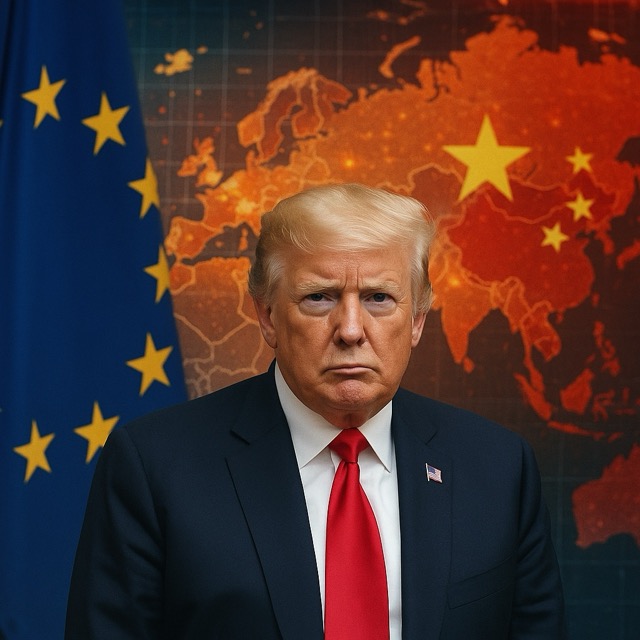
Washington, D.C., August 2025 – In a move that reignites memories of the turbulent trade wars of his first term, Donald J. Trump has announced that he will pursue new tariff measures against countries that, in his view, are unfairly targeting American technology companies through digital taxes and regulatory frameworks.
Speaking at a rally in Ohio earlier this month, Trump criticized European and Asian governments for what he described as “predatory digital taxes” that single out U.S. firms such as Google, Apple, Amazon, and Meta. “If they want to keep taxing our companies just because they are American, then they’re going to pay tariffs like they’ve never seen before,” he declared to roaring applause.
The Return of Trade Retaliation
Trump’s threat echoes his administration’s 2018-2020 tariff battles with China, Mexico, Canada, and the European Union, when duties on steel, aluminum, and consumer goods rattled global markets. This time, however, the battlefield is the digital economy — one of the fastest-growing sectors worldwide.
Over the past decade, several nations have introduced so-called “digital services taxes” (DSTs), which levy revenues generated by large foreign tech platforms within their borders. France, Italy, Spain, and India have all introduced variations of the DST, arguing that U.S. giants benefit enormously from their markets while paying disproportionately low local taxes.
The European Union has also taken broader steps, advancing legislation to rein in Big Tech dominance through competition laws, content moderation rules, and stringent data protection requirements. These measures, while popular among European consumers and regulators, have long been viewed in Washington — under both Democratic and Republican administrations — as discriminatory.
U.S. Tech Firms Caught in the Crossfire
Industry leaders are watching Trump’s latest salvo with concern. Executives at Silicon Valley companies fear that escalating tariff threats could lead to retaliatory measures that harm not only their international operations but also global supply chains.
“Trade conflicts rooted in digital taxation risk undermining innovation and cooperation in the global tech ecosystem,” said Jessica Martin, a senior policy analyst at the Washington-based Tech Freedom Institute. “While there are legitimate grievances about discriminatory taxes, tariffs are a blunt instrument that often generate unintended economic consequences.”
Major U.S. tech companies have historically lobbied against foreign digital taxes, arguing that disputes should be resolved through multilateral negotiations at the Organisation for Economic Co-operation and Development (OECD). A framework agreement reached in 2021 sought to standardize corporate taxation across digital markets, but its implementation has been uneven, and several countries have pressed ahead with their own unilateral rules.
Global Reactions
European leaders have so far responded cautiously to Trump’s threats. French Finance Minister Élodie Marchand stated that Paris would “not be intimidated” and reaffirmed France’s commitment to taxing “the profits generated by digital giants on French soil.” German officials, meanwhile, urged the United States to return to the OECD negotiation table rather than resort to tariff brinkmanship.
In Asia, India — which has one of the most extensive digital service taxes — signaled that it would defend its policies as fair measures designed to level the playing field for local startups. “Our rules are not anti-American; they are pro-India,” said Commerce Minister Rakesh Bhandari.
China, while not directly targeted in Trump’s remarks, is closely monitoring the situation. Analysts suggest Beijing could benefit if U.S. and European tech companies find themselves bogged down in a transatlantic tariff dispute.
Economic Stakes
The stakes are significant. The global digital economy is projected to account for nearly a quarter of worldwide GDP by 2030, according to a recent World Bank report. With artificial intelligence, e-commerce, and cloud computing driving new waves of growth, the regulatory and trade frameworks surrounding tech will play a decisive role in shaping global competitiveness.
Economists warn that tariff escalation could dampen investor confidence, increase consumer prices, and exacerbate geopolitical fragmentation. “Every time tariffs are used as a weapon, businesses recalibrate supply chains, and that creates inefficiencies that linger for years,” said Dr. Samuel Ortiz, an economist at the London School of Economics.
What Comes Next
Whether Trump follows through on his tariff threats remains to be seen. His advisors are reportedly divided: some argue that tariffs would strengthen his tough-on-trade image, while others fear economic blowback in the run-up to the 2026 midterm elections.
For now, the announcement has injected fresh uncertainty into global markets. U.S. tech companies, already grappling with antitrust lawsuits at home and tougher scrutiny abroad, face the prospect of becoming bargaining chips in a high-stakes geopolitical contest.
As the debate intensifies, one thing is clear: the digital economy, once viewed as a borderless realm, is increasingly becoming entangled in the same nationalist and protectionist currents that defined traditional trade disputes of the past century.



 The Tower Post