Mario Draghi’s Rimini broadside—on tariffs, defense and power—forces Europe’s strategic reckoning with the United States.

LEAD
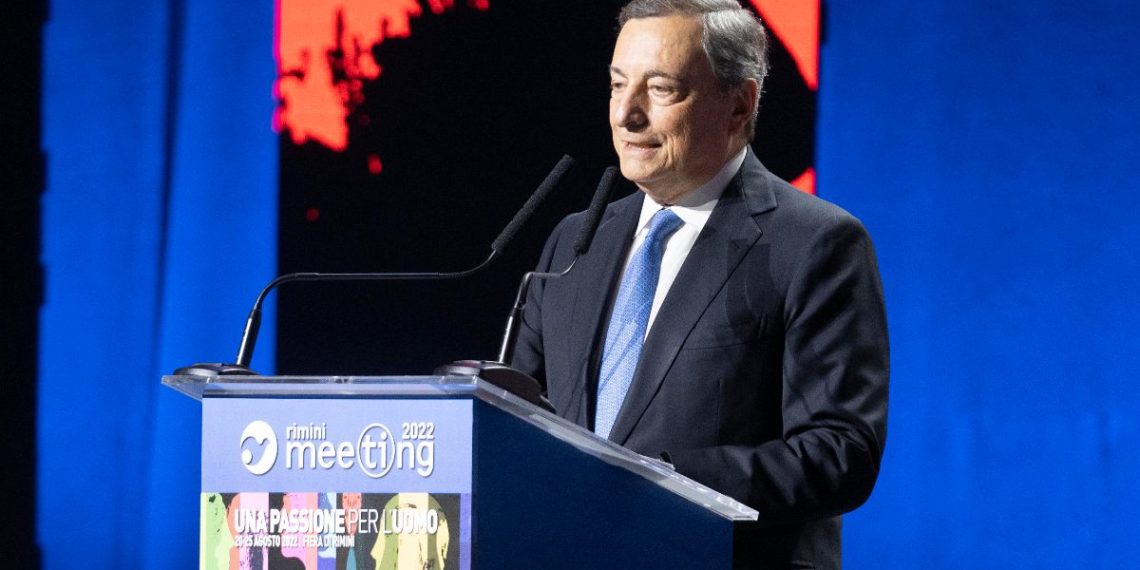
RIMINI/BRUSSELS – Europe’s long‑held conviction that sheer market size translates into leverage has met a hard reality check. Speaking before a packed audience at the Rimini Meeting on August 22, former European Central Bank president and Italian prime minister Mario Draghi said the European Union had for years believed that its 450 million consumers conferred geopolitical sway—an assumption he argued no longer holds. This year, he warned, will be remembered as the moment that belief finally ‘evaporated.’
WHAT DRAGHI SAID
Draghi’s diagnosis was blunt: the EU has had to “accept” tariffs from its biggest trading partner and oldest ally, the United States, and has been pushed by that same ally to raise defense spending—perhaps overdue, he conceded, but undertaken in ways that do not necessarily reflect Europe’s interests. He also lamented Europe’s marginal role in diplomacy from Kyiv to Gaza, despite the bloc’s substantial financial support for Ukraine and humanitarian aid elsewhere. The speech was not a lament for decline but a call for a reset of European power—political, economic and military—before events reset it for us.
TARIFFS: A RELUCTANT BARGAIN
The backdrop to Draghi’s intervention is a contentious, hurriedly assembled transatlantic trade framework announced in late July. Washington’s 15% baseline tariff on most EU goods—pitched as a compromise to avert even steeper duties—has been framed in Brussels as damage control. The Commission argues the arrangement buys time and stability; critics hear capitulation. Either way, it represents a decisive end to the presumption that Europe’s market access is shield enough against American protectionism. For exporters from autos to machinery, the near‑term calculation is simple: adjust supply chains or absorb the hit.
SIZE WITHOUT POWER
For two decades, European leaders leaned on what might be called ‘passive power’: if you set global standards, host the world’s richest consumer base, and anchor the largest single market, influence follows. Draghi’s point is that the world has moved on. China uses state capacity to fuse industry with strategy; the United States uses scale, energy, and technology to project economic power—and is willing to weaponize tariffs. Europe, meanwhile, is discovering that technical excellence and regulatory reach cannot substitute for hard power when interests collide.
VON DER LEYEN’S DEFENSE—AND ITS LIMITS
Commission President Ursula von der Leyen has defended the bargain with Washington as the least‑bad option to avert a trade war. That argument may be correct as tactics, but it underscores Draghi’s strategic critique: Europe arrived at the talks fragmented and defensive. Member states prioritized national exposures—cars here, wine and spirits there—over a unified offensive agenda on investment, energy or technology. The risk is that Brussels spends the coming months managing carve‑outs while Washington banks the geopolitical dividend.
DEFENSE: SPENDING MORE, SHAPING LESS
Across the Atlantic, pressure on defense outlays has worked. Most European allies are now at or near 2% of GDP in military spending, and NATO leaders have endorsed a longer‑term path that would lift core defense investment significantly by the next decade. But budgets are not strategy. Fragmented procurement, overlapping export controls and undersized domestic capital markets leave Europe paying a ‘power premium’—more euros for less capability. Absent a plan to pool demand, scale production and share IP, higher spending risks entrenching dependence on U.S. kit rather than building sovereign capacity.
GEOPOLITICS: SPECTATOR IN CHIEF
The paradox of 2025 is stark. On Ukraine, the EU has been a financial heavyweight and a sanctions architect; in negotiations and security guarantees, it is often a supporting act. In the Middle East, European capitals have influence but limited leverage. Draghi’s stinging line—that Europe became a ‘spectator’—captures not fatalism but a warning: without instruments of power to match its values, the EU will keep footing the bill while others shape outcomes.
ECONOMICS: FROM STANDARD‑SETTER TO SCALE‑SEEKER
Draghi’s broader remedy builds on his competitiveness work: mobilize more common financing, accelerate capital‑markets union, and remove bottlenecks that keep European firms sub‑scale. The green and digital transitions require investment at American or Chinese speed; Europe’s fragmented savings are still corralled by national rules, pension silos and risk aversion. Unless the EU unlocks pools of private capital—and sets predictable guardrails on state aid—its industry will be price‑takers on energy, laggards in advanced computing, and target‑rich for subsidized competitors.
A NEW BARGAIN WITH WASHINGTON
None of this demands a rupture with the United States. It does require Europe to show up to the next round of talks with its own offer: joint industrial projects where Europe has edge, reciprocal market opening that survives election cycles, and a defense industrial roadmap that complements, not duplicates, NATO. If the EU can couple tariff de‑escalation to concrete cooperation—in energy security, critical minerals, clean tech supply chains—the logic of alliance and the logic of economics can be aligned again.
POLITICS, NOT JUST POLICY
Draghi’s sharpest insight may be political. He is asking Europeans to trade comforting narratives for agency: to accept that stability without power is a mirage. That means confronting veto politics at home, building majorities for deeper integration, and choosing competitiveness over complacency. It also means leaders explaining that a stronger European pillar is good for NATO—and essential for Europe’s dignity.
THE ROAD FROM RIMINI
What, then, should happen next? First, lock a transatlantic tariff truce tied to clear milestones and automatic snap‑backs for violations—so the EU is not bargaining under threat. Second, launch a rapid procurement compact among willing member states for air defense, munitions and drones, with common testing, certification and export rules. Third, deliver a genuine capital‑markets union: a single EU‑wide prospectus, solvency rules that reward equity, and pension reform to mobilize private savings into risk capital. Finally, back a European compute and energy strategy that makes AI and clean‑tech scaling possible on European soil.
BOTTOM LINE
Draghi’s Rimini speech was not Europe‑bashing; it was an invitation to act. The EU’s consumers will remain a formidable asset. But assets only become power when they are organized, protected and deployed. If 2025 is the year the illusion evaporated, it can also be the year Europe relearned how to turn market strength into strategic leverage.