Central bank chief vows to stay, setting up constitutional showdown
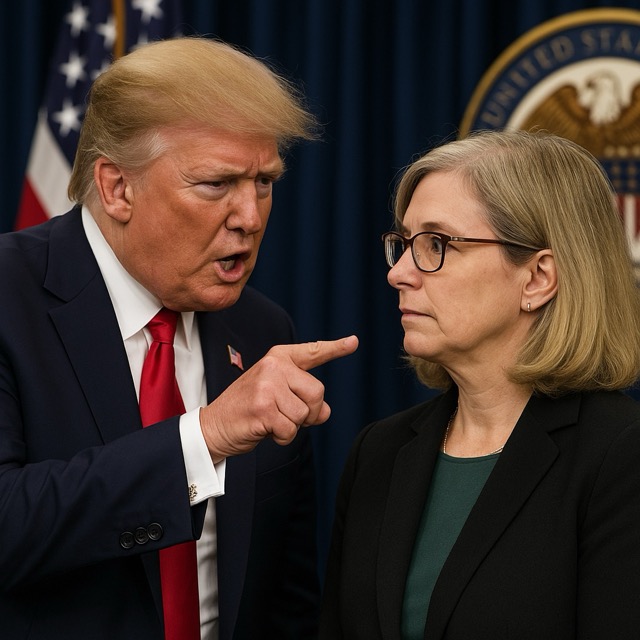
The United States is bracing for a historic clash between the White House and the Federal Reserve after President Donald Trump announced that he had fired Federal Reserve Chair Sarah Cook, accusing her of making false statements on mortgage agreements. In a sharply worded letter addressed to Cook, Trump said there was “sufficient reason” to believe she had violated federal rules, providing him “cause” to remove her from office.
“The Federal Reserve Act provides that you may be removed, at my discretion, for cause,” Trump wrote in the letter, invoking both constitutional powers and statutory authority to justify his decision. The announcement has sent shockwaves through financial markets, already jittery over global trade tensions and slowing growth in the United States.
Cook, who has served as Fed Chair since 2022, immediately pushed back against the president’s move, declaring she would not step down. “President Trump purported to fire me ‘for cause’ when no cause exists under the law, and he has no authority to do so,” she said in a statement. “I will continue to carry out my duties to help the American economy as I have been doing since 2022.”
Her defiance sets the stage for a rare constitutional and legal showdown over the independence of the Federal Reserve, the institution charged with setting interest rates and steering monetary policy in the world’s largest economy.
A legal and constitutional gray zone
At the heart of the dispute lies the question of whether the president has the power to dismiss the Fed Chair. The Federal Reserve Act states that board members may be removed “for cause,” but experts say the definition of “cause” is ambiguous. Historically, no sitting president has successfully removed a Fed Chair, and most have completed their four-year terms regardless of political pressure.
Trump’s decision could test long-standing norms. Legal scholars note that the independence of the Federal Reserve has been a cornerstone of U.S. economic stability for decades. “This is unprecedented,” said Anne Richards, a professor of constitutional law at Georgetown University. “If President Trump prevails, it could fundamentally reshape the relationship between the executive branch and the central bank.”
Cook, for her part, has retained prominent defense attorney Abbe Lowell, known for representing high-profile figures including Jared Kushner and Hunter Biden. Lowell is expected to challenge the president’s interpretation of the law in federal court.
Market reaction and political fallout
News of the attempted dismissal rattled global markets. The Dow Jones Industrial Average fell more than 600 points in early trading, while the dollar weakened against major currencies. Investors fear that undermining the Fed’s independence could destabilize monetary policy and erode confidence in the U.S. economy.
On Capitol Hill, reactions split along partisan lines. Republican allies defended Trump’s decision, with Senator Josh Hawley (R-MO) calling Cook “a partisan bureaucrat who has resisted necessary reforms.” Democrats, meanwhile, denounced the move as an authoritarian overreach. “This is nothing short of an attack on the independence of our central bank,” said Senator Elizabeth Warren (D-MA). “If he can fire the Fed Chair at will, no institution is safe.”
International observers have also expressed alarm. The European Central Bank released a statement emphasizing the “critical importance of central bank independence” to global financial stability.
What comes next
The standoff is expected to move quickly into the courts. Lowell has signaled that Cook will seek an emergency injunction to block Trump’s attempt to remove her, arguing that “for cause” must involve serious misconduct or incapacity — not a disputed interpretation of mortgage agreements.
Meanwhile, Trump has suggested he may nominate a replacement “within days.” Analysts warn that any confirmation battle in the Senate could be bruising, especially if Cook remains in her post pending legal review.
For now, the United States faces an unprecedented test: Can a president dismiss the nation’s top central banker, or will the courts uphold the independence of the institution that controls America’s monetary policy?
As Cook put it: “The Federal Reserve belongs to the American people, not to the president.”
This article will be updated as the legal and political battle unfolds.




 The Tower Post