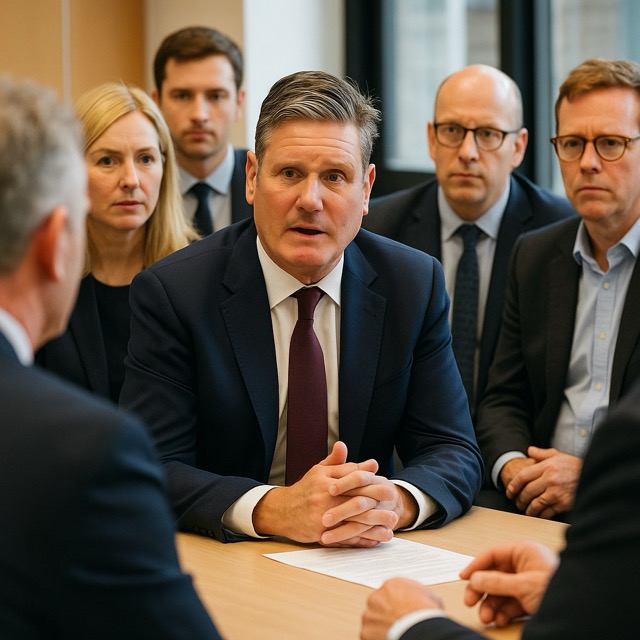
Labour ministers launch a charm offensive to calm corporate unease over economic policies and regulatory drift

When Sir Keir Starmer entered Downing Street in July 2024, he pledged to deliver “stability, responsibility, and growth” after years of turbulence under Conservative leadership. Thirteen months later, his government is facing its first serious rupture with the business community that had cautiously supported Labour’s promise of pragmatism.
Over the past weeks, ministers have been dispatched on a quiet but determined campaign to reassure corporate leaders, following a string of private complaints from executives frustrated with slow-moving reforms and mounting regulatory uncertainties.
Mounting Discontent
Several FTSE 100 executives, speaking on condition of anonymity, have described strained relations with Whitehall. “We were promised predictability, but what we’ve seen instead is indecision,” said one chief executive of a major manufacturing group. Concerns range from delays in planning reform and energy infrastructure projects, to a patchy rollout of digital taxation schemes.
The most acute tensions have surfaced in financial services, where Starmer’s government has yet to outline a comprehensive framework for post-Brexit competitiveness. The City, once reassured by Labour’s commitment to avoid sharp breaks with European markets, is now pressing for clearer guidance on capital requirements and cross-border investment rules.
The Ministers’ Charm Offensive
In response, senior ministers—including Chancellor Rachel Reeves and Business Secretary Jonathan Reynolds—have intensified their outreach. Reeves held a closed-door roundtable with leading bankers earlier this month, while Reynolds embarked on a series of regional visits to meet industrial leaders. Officials have also hinted at a forthcoming “Partnership for Growth” white paper aimed at providing businesses with long-sought clarity.
“We understand the impatience,” Reeves told reporters during a visit to Manchester. “But rebuilding Britain’s economic foundations is a long-term project. The government is determined to work hand-in-hand with business to get it right.”
Despite such reassurances, scepticism lingers. A recent survey by the Confederation of British Industry found that 62% of executives believe the government is “moving too slowly” on key reforms.
Political Stakes
The friction comes at a sensitive moment for Starmer. Labour still enjoys a comfortable parliamentary majority, but polls suggest waning public confidence in the government’s economic management. While inflation has moderated, growth remains anaemic, and consumer confidence is fragile.
Some political analysts warn that alienating business leaders could jeopardise Labour’s broader economic strategy. “If investors perceive instability, capital will flow elsewhere,” said Dr. Louise Grant, a political economist at King’s College London. “For a government that promised competence above all else, that’s a dangerous perception.”
Looking Ahead
In the coming months, Starmer’s ministers are expected to unveil a suite of measures designed to bridge the gap with business: streamlined planning approvals, incentives for green investment, and a clearer industrial strategy. Yet insiders caution that balancing fiscal responsibility with growth-boosting incentives will not be easy.
As one veteran lobbyist put it: “The government doesn’t need to be loved by business, but it does need to be trusted. Right now, that trust is wobbling.”
Whether Starmer can steady the ship may prove decisive not just for his relationship with corporate Britain, but for the credibility of his entire premiership.