As Israel readies another offensive, Washington accelerates efforts to shape a “comprehensive” plan for Gaza’s reconstruction and governance.
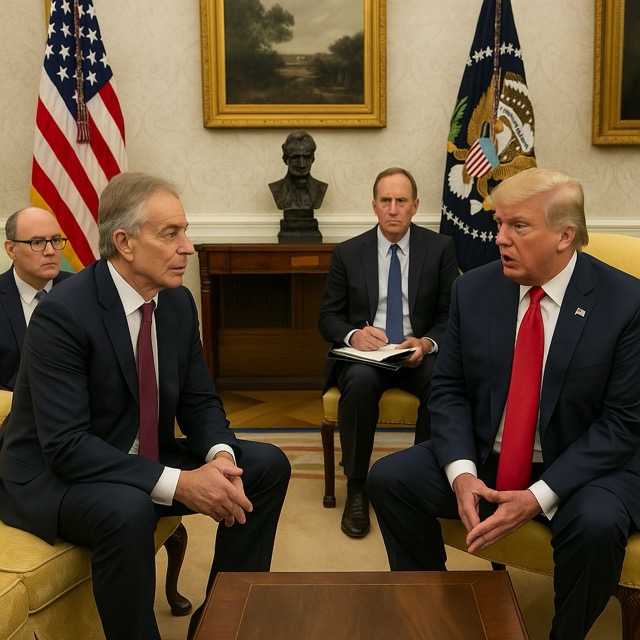
Washington — In a rare display of transatlantic coordination, U.S. President Donald Trump convened a high‑level meeting at the White House this week with former British Prime Minister Tony Blair and senior American officials to hammer out what aides described as a “comprehensive postwar plan” for Gaza. The initiative comes as Israel signals its intention to launch a new ground operation in the war‑scarred enclave, where humanitarian conditions continue to deteriorate.
According to White House officials, the talks centered on devising a “day‑after” framework for Gaza, aimed at stabilizing the territory once large‑scale hostilities subside. The plan under discussion combines elements of humanitarian relief, reconstruction funding, and a revamped security arrangement that would involve regional Arab partners alongside international monitors. While details remain closely guarded, insiders say the U.S. is intent on avoiding a repeat of the political vacuum that followed earlier conflicts in the strip.
Blair, who previously served as envoy of the Middle East Quartet, was invited by Trump as what one official described as a “pragmatic voice with experience bridging Israeli and Palestinian concerns.” Blair’s reemergence in Washington diplomacy surprised some observers, given his diminished international role in recent years. Still, officials pointed to his relationships with Gulf states and Israel as potentially valuable in shepherding support for a multilateral package.
Urgency Amid Escalation
The timing of the White House meeting underscores mounting urgency. Israeli leaders, citing continued rocket fire and militant regrouping inside Gaza, have publicly confirmed that preparations are underway for another military incursion. Israeli officials insist their objective is to dismantle remaining Hamas battalions, but humanitarian agencies warn that a renewed campaign risks deepening famine conditions in a territory already devastated by months of conflict.
The United Nations estimates that nearly 80 percent of Gaza’s 2.2 million residents face acute food insecurity, with international aid convoys slowed by bureaucratic hurdles and repeated strikes on supply routes. Hospitals, short on fuel and basic medicines, struggle to operate amid the influx of casualties. “Another full‑scale invasion without a viable civilian governance plan will tip Gaza into total collapse,” said a senior UN relief coordinator.
Washington’s Calculus
For Trump, the Gaza initiative represents both a diplomatic challenge and a political opportunity. Seeking to project leadership on a crisis that has unsettled global energy markets and inflamed tensions across the Middle East, the administration has quietly consulted with Egypt, Jordan, Qatar and Saudi Arabia. U.S. officials say the goal is to assemble a consortium of Arab states willing to contribute peacekeepers, reconstruction aid, and technical expertise to administer civilian services in Gaza once fighting abates.
But the proposal faces steep hurdles. Arab leaders remain wary of appearing complicit in a post‑war arrangement seen as legitimizing Israel’s military dominance. Palestinian representatives, for their part, have rejected any framework that excludes local political voices. “Gaza’s future cannot be engineered from Washington and Tel Aviv alone,” said a spokesperson for the Palestinian Authority. “Any sustainable solution must respect Palestinian self‑determination.”
Blair’s Role and Skepticism
Blair’s presence in the talks was met with mixed reactions. Critics point to his controversial legacy in Iraq and his past attempts at Palestinian state‑building, which many Palestinians regarded as skewed toward Israeli security concerns. Yet White House aides defended the move, calling Blair a “bridge figure” capable of rallying European support for a U.S.‑led initiative.
Diplomats noted that Blair has maintained close ties with Gulf capitals, particularly the United Arab Emirates and Qatar, both seen as crucial financiers of Gaza’s reconstruction. “If Blair can help unlock funding while the U.S. and Israel manage the security dimension, that could make the difference between paralysis and progress,” said one European envoy.
The Road Ahead
The White House signaled that a more detailed outline of the Gaza plan may be unveiled at next month’s UN General Assembly in New York, where Trump is expected to press for international buy‑in. But with Israel poised to escalate operations and Gazans bracing for more devastation, analysts caution that Washington’s blueprint risks being overtaken by events on the ground.
“Timing is everything,” said Aaron David Miller, a veteran Middle East negotiator. “You can’t credibly sell a vision of reconstruction while bombs are still falling. Unless the U.S. can broker at least a temporary ceasefire, the ‘day‑after’ will remain an abstraction.”
For now, the Trump‑Blair meeting offers a glimpse into Washington’s evolving approach: combining hard‑nosed realism with a search for partners willing to shoulder the burden of rebuilding Gaza. Whether that vision can withstand the harsh realities of the battlefield, however, remains deeply uncertain.




 The Tower Post