A simplified redesign of the Southern chain’s iconic emblem ignites a fierce debate between tradition, branding, and America’s partisan divide.
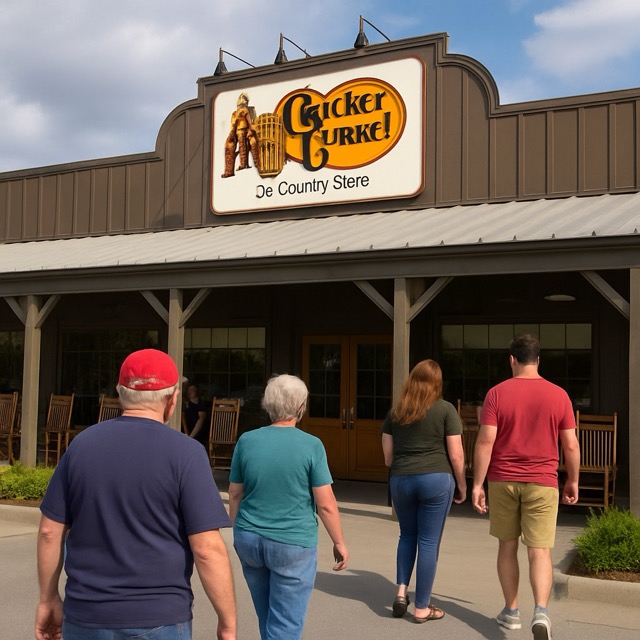
Nashville, TN— Few restaurant chains occupy the peculiar place in America’s cultural imagination quite like Cracker Barrel. Known for its Southern-style comfort food, rocking chairs lined along its porches, and country-store aesthetic, the franchise has for decades
catered to a blend of interstate travelers, retirees, and nostalgia-seekers. But this summer, what began as a quiet corporate design decision erupted into a national culture war flashpoint.
The controversy was triggered in July, when Cracker Barrel introduced a simplified version of its classic logo. Gone was the intricate image of the bearded man resting beside a wooden barrel, an emblem that had adorned menus, billboards, and storefronts since 1969. In its place, a cleaner, more minimalist mark appeared: a stylized barrel icon paired with a contemporary font. The redesign, company executives explained, was intended to modernize the brand for digital platforms and younger consumers, while retaining “a respectful nod” to tradition.
Almost immediately, critics on social media—many aligned with the “Make America Great Again” movement—accused the company of caving to “woke” marketing trends. Hashtags like #BoycottCrackerBarrel and #SaveTheLogo trended on X (formerly Twitter), with conservative commentators framing the change as yet another example of corporate America erasing heritage. One viral post claimed the redesign was “an attack on Southern identity,” while another suggested, without evidence, that political correctness had driven the shift.
The backlash found fertile ground in conservative media ecosystems. Popular talk radio hosts devoted entire segments to lamenting the loss of “authentic Americana,” and cable commentators lumped Cracker Barrel into the same category as Bud Light and Disney—companies that had, in their telling, betrayed their traditional customer bases. Former President Donald Trump even weighed in at a campaign rally in Alabama, calling the logo change “a disgrace” and promising that, under his leadership, “we will put the barrel back in Cracker Barrel.”
Not everyone, however, shared this outrage. Marketing analysts have pointed out that many legacy brands—including Pepsi, Burger King, and Wendy’s—have simplified their logos in recent years to adapt to smartphone screens and digital branding. “What Cracker Barrel did is standard practice in the design world,” said Elaine Porter, a Nashville-based branding consultant. “The intensity of the reaction says less about graphic design and more about the political climate.”
For longtime fans of the chain, reactions were mixed. Some expressed disappointment at losing what they saw as a symbol of warmth and hospitality. Others shrugged, noting that the biscuits and gravy taste the same regardless of the logo. A handful of progressive voices even applauded the change, seeing it as a way for the company to move beyond stereotypes of the Old South.
Inside Cracker Barrel’s headquarters, executives have tried to strike a careful balance. In a statement, CEO Julie Felton emphasized that “the heart of our brand remains unchanged: serving guests genuine hospitality and delicious food.” The company has no plans to reverse the logo, despite calls from some activist groups to “restore the old man and barrel.”
As the debate rages online, the actual impact on Cracker Barrel’s bottom line remains uncertain. Analysts note that short-term boycotts rarely inflict lasting damage, but the controversy highlights the increasingly fraught terrain corporations navigate in a polarized America. What once might have been a minor design tweak now serves as a proxy battlefield in the nation’s ongoing culture wars.
At a Cracker Barrel just outside Knoxville, Tennessee, customers interviewed seemed less inflamed than the internet suggested. “Honestly, I didn’t even notice the logo was different,” laughed James McCoy, a retired truck driver finishing a plate of chicken-fried steak. Across the room, a group of college students posed for selfies under the new sign. “It’s just a logo,” one of them said. “People are overreacting.”
Still, the broader lesson may be that in 2025, few aspects of public life escape politicization. From beer cans to theme parks to breakfast menus, branding choices carry symbolic weight far beyond their design intentions. For Cracker Barrel, the barrel may be smaller and sleeker, but the culture war it rolled into shows no sign of slowing down.

 The Tower Post