Private companies compete for lucrative contracts as U.S. deportation flights surge, raising questions about ethics, transparency, and human cost.
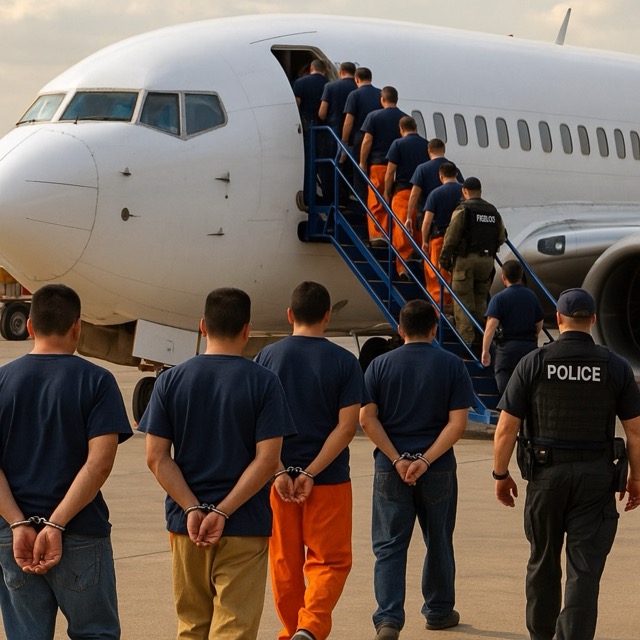
In the sweltering heat of August 2025, the tarmac at a remote Texas airfield hums with activity. A white jet, its fuselage unmarked except for a discreet registration number, sits at the ready. Its passengers are not tourists or business travelers, but migrant detainees bound for Guatemala, El Salvador, and Honduras. This is the domain of ICE Air—the network of deportation flights overseen by U.S. Immigration and Customs Enforcement.
Once a relatively obscure logistical arm of the U.S. immigration system, ICE Air has now become a multi‑billion‑dollar enterprise attracting an unusual array of private operators. Airlines, charter companies, and even logistics giants are quietly vying for government contracts to ferry detainees out of the United States.
According to procurement records reviewed this summer, at least six major contractors are competing for slices of the market, which analysts estimate could exceed $4 billion annually if current deportation trends continue. With migrant encounters at the U.S.-Mexico border topping historic highs, the Biden administration has doubled down on deportation as both deterrent and political signal. The result: a booming business in forced air travel.
A Growing Industry
ICE Air began in the early 2000s as a small fleet of chartered flights, largely invisible to the public. Today, the program operates hundreds of flights per month, shuttling detainees from detention centers to airports across the Americas and beyond.
Companies like Classic Air Charters, Omni Air International, and CSI Aviation—once niche contractors—now find themselves at the center of a rapidly expanding sector. More recent entrants, including subsidiaries of major airlines, are testing the waters, lured by steady federal payments in a volatile aviation market still recovering from pandemic scars.
“It’s one of the few areas where flight demand is guaranteed regardless of consumer trends,” explained John Whitfield, an aviation industry analyst based in New York. “For companies struggling with fluctuating ticket sales, a government deportation contract represents stability.”
Yet the profits are shadowed by controversy.
Ethical Questions
Critics argue that the competition for deportation flights turns human suffering into a revenue stream. Advocacy groups have documented harrowing conditions on ICE flights, from shackled passengers to lack of medical care.
“Every takeoff is a tragedy for families torn apart,” said Marisol López, director of the nonprofit Border Watch. “Now we see corporations scrambling for contracts as if this were any other logistics job. It normalizes an inhumane system.”
In July, protests erupted outside a Florida airport after activists discovered that a commercial airline subsidiary was preparing to operate deportation flights under contract. Facing public backlash, the company later suspended its bid.
Transparency in the Shadows
Adding to the tension is the secrecy surrounding ICE Air’s operations. Flight routes are rarely disclosed in advance, and passengers are often unaware of their departure until hours before boarding. Government audits have repeatedly flagged gaps in oversight, including poor record‑keeping and inadequate safety monitoring.
Still, demand shows no sign of slowing. With immigration debates dominating the 2024 elections and continuing into 2025, political pressure to enforce removals remains intense.
ICE defends the flights as a necessary component of national policy. “Our mandate is to enforce U.S. immigration law,” an agency spokesperson told reporters this month. “Air transportation ensures removals are carried out efficiently and securely.”
What Comes Next
For contractors, the next round of bidding—expected this fall—could reshape the industry. Analysts predict consolidation, with larger firms swallowing smaller operators.
Behind the numbers, however, are thousands of individuals—many fleeing violence, poverty, or political repression—whose futures are bound up in the silent machinery of ICE Air.
As the competition intensifies, the United States faces a stark question: Is deportation merely a logistical challenge to be solved by market forces, or a moral dilemma demanding a different path?
For now, on the hot runways of Texas and Arizona, the flights keep departing—quiet, efficient, and profitable.




 The Tower Post