Traditional giants face soaring costs and cultural hurdles as Tesla and China’s new players set the pace
Global Automotive Report
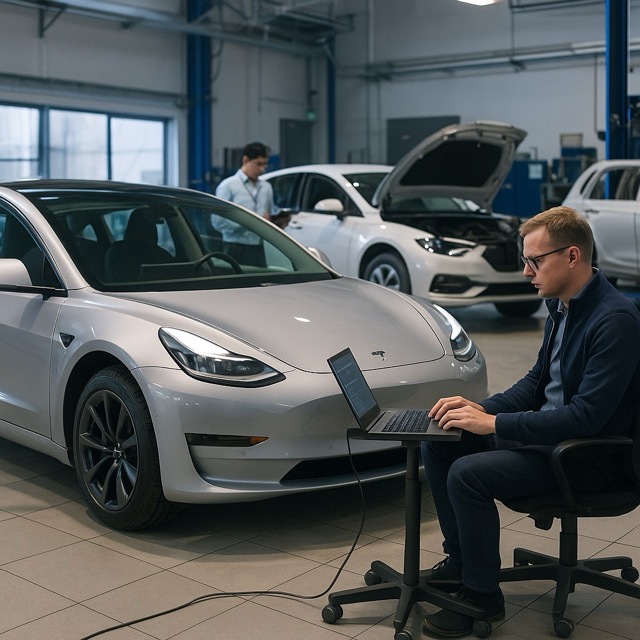
For more than a century, the automobile industry has been defined by steel, horsepower, and assembly lines. But in 2025, its most valuable asset is no longer mechanical—it’s digital. The world’s biggest carmakers are racing to reinvent themselves as software-driven companies, trying to match Tesla and a rising cohort of Chinese competitors whose vehicles function more like rolling smartphones than traditional cars.
At the center of this shift is the so-called “software-defined vehicle” (SDV), a car where the majority of innovation—and value—resides in code. Unlike the incremental updates of past decades, SDVs rely on centralized computing platforms, continuous over-the-air upgrades, and an ecosystem of apps and digital services. For consumers, the promise is a car that improves over time, gains new features remotely, and integrates seamlessly with digital lives. For carmakers, however, the journey has been far less smooth.
Tesla pioneered the SDV model more than a decade ago, and the results are evident: its vehicles command some of the highest margins in the industry, driven not just by hardware sales but also by subscription-based services such as premium driver assistance and entertainment packages.
Meanwhile, Chinese firms such as BYD, Nio, and Xiaomi Auto are scaling fast, leveraging both state support and the country’s deep expertise in consumer electronics. Their cars boast advanced in-car operating systems, AI-powered voice assistants, and seamless integration with social platforms familiar to millions of Chinese drivers. This mix of affordability and digital sophistication has begun to unsettle Western incumbents.
For legacy automakers—Volkswagen, General Motors, Toyota, and others—the pivot to digital has proven both costly and culturally disruptive. Building cars has long been about precision manufacturing, supply-chain optimization, and incremental efficiency gains. Building SDVs, however, requires hiring armies of software engineers, rewriting legacy IT systems, and reimagining product cycles around constant iteration rather than fixed models.
Volkswagen’s much-publicized difficulties with its Cariad software unit highlight the challenges. Delays in delivering a unified vehicle operating system forced costly setbacks across multiple EV launches. General Motors has invested billions in software platforms and autonomous driving technology but continues to face investor skepticism over its ability to monetize those services. Toyota, long a master of lean manufacturing, is now racing to close its software gap, recently announcing partnerships with Silicon Valley firms.
Consulting firm McKinsey estimates that global automakers will need to spend over $100 billion annually on software development by 2030. Unlike physical tooling, which amortizes over long production runs, software requires ongoing investment, frequent updates, and cybersecurity defenses against increasingly sophisticated threats.
Moreover, the cultural transition is steep. “You can’t just bolt software onto a car and call it innovation,” says Elena Morales, an automotive analyst at Bernstein. “The entire mindset has to shift—from product cycles measured in years to continuous improvement measured in weeks.”
Some companies have tried to buy their way forward, acquiring startups in cloud computing and AI. Others have entered partnerships with tech giants like Google, Amazon, and Huawei. Yet these alliances also raise existential questions: if Big Tech controls the software layer, what is left to differentiate traditional automakers beyond their metal and branding?
Despite the hurdles, few doubt that the future of the car is software-defined. Analysts predict that by 2035, digital services could account for nearly 40% of industry profits. But the transition is likely to redraw the competitive map: some legacy companies may reinvent themselves successfully, while others risk sliding into irrelevance.
As the industry navigates this upheaval, one thing is clear: the race is no longer about who can build the fastest engine, but who can ship the best code. And in this new competition, the finish line keeps moving—one software update at a time.



 The Tower Post