Dry weather, shrinking subsidies, and tumbling prices place the agricultural sector under severe strain
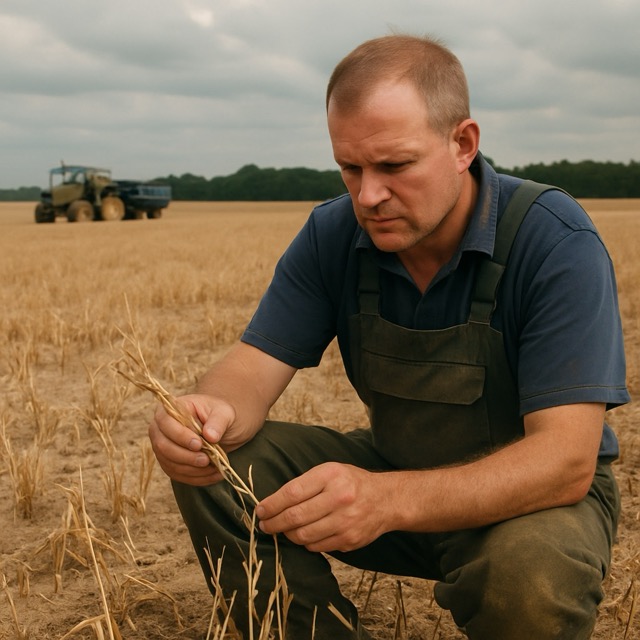
British farmers are facing the prospect of a second consecutive year of poor harvests, raising alarm across rural communities and stirring renewed debates over food security, climate resilience, and government agricultural policy. With large swathes of the country enduring prolonged dry spells, the sector finds itself in the grip of a crisis that farmers warn could alter the face of UK agriculture for years to come.
Climate Stresses Meet Economic Pressures
The Met Office has confirmed that summer 2025 has been one of the driest in decades, with rainfall totals in parts of the South and East registering 40% below the seasonal average. Wheat and barley yields, staples of the UK farming landscape, are already projected to fall well short of expectations, echoing the disappointing figures from last year’s harvest.
“The soil simply isn’t recovering,” said Tom Ridley, a third-generation farmer from Cambridgeshire. “We’ve done what we can with irrigation, but water costs are soaring and restrictions are tighter. We’re watching crops fail before they even reach maturity.”
The weather alone, however, is not the only source of pressure. Wholesale prices for grains and livestock have slumped, driven by both global oversupply and weakening demand from Europe and Asia. Farmers report that many of their products are selling below production costs, threatening the viability of family-run businesses.
Government Support in Retreat
Exacerbating the crisis is a shift in government policy. Since the phase-out of the EU’s Common Agricultural Policy (CAP) subsidies post-Brexit, farmers have been operating under a leaner UK framework known as the Environmental Land Management scheme (ELMs). While designed to incentivize sustainable practices, many growers complain the system provides less direct income support at a time when margins are already razor thin.
“We’re being asked to do more with less,” said Sarah Bennett, who runs a mixed farm in Yorkshire. “The environmental goals are important, but when you can’t keep your business afloat, those goals become impossible to achieve.”
Industry groups such as the National Farmers’ Union (NFU) have stepped up lobbying efforts, calling for emergency relief measures. NFU President Minette Batters issued a stark warning this week: “Without immediate intervention, we risk seeing mass farm closures, job losses, and greater reliance on imported food.”
Rural Communities at Risk
The ripple effects are already being felt beyond the fields. Agricultural suppliers, machinery firms, and rural markets are experiencing slowdowns. Villages dependent on farming jobs are bracing for economic decline. Some younger farmers, disillusioned by mounting debt, are choosing to abandon the profession altogether.
Local councils in farming regions are also voicing concerns. A recent report from Norfolk County Council predicted that declining yields could reduce regional GDP by up to 7% if current conditions persist.
A Turning Point for UK Agriculture?
Experts suggest the crisis could mark a turning point in how Britain approaches food production. Analysts at the London School of Economics argue that the combination of climate volatility, shrinking subsidies, and global market uncertainty demands a new agricultural strategy that balances productivity, sustainability, and resilience.
Professor Claire Hamilton, an agricultural economist, observed: “British farming is at a crossroads. Either we continue with piecemeal responses that leave farmers vulnerable, or we invest in long-term solutions—such as drought-resistant crops, smarter irrigation systems, and more robust domestic food markets.”
Looking Ahead
For now, farmers remain in a state of anxiety as the harvest season unfolds. Many are already preparing for difficult conversations with banks and suppliers, while keeping one eye on Westminster for signs of relief.
“Farming has always been about resilience,” Ridley reflected. “But resilience has its limits. Without real support, I’m not sure how many of us can keep going through another year like this.”
As Britain edges toward autumn, the reality is sinking in: the nation’s breadbasket is under duress, and the future of farming—long a cornerstone of rural identity and national food security—hangs in the balance.



 The Tower Post