A Controversial Diplomatic Move That Signals Closer Ties with Moscow

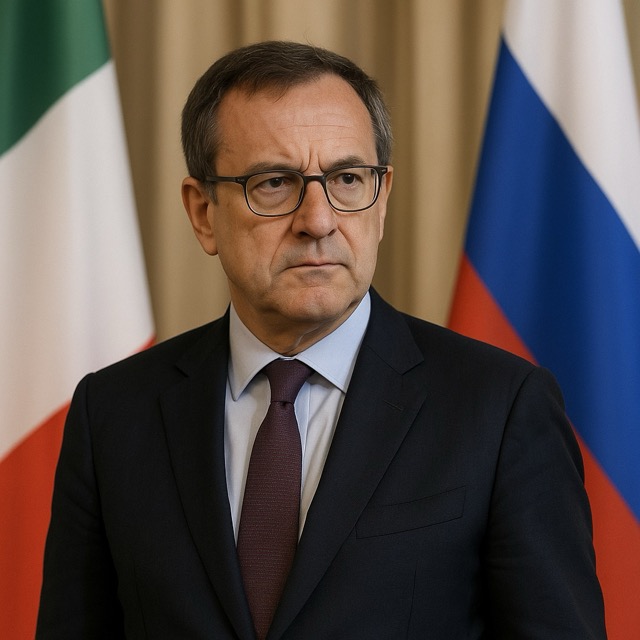
The Italian government has officially appointed Stefano Beltrame as the country’s new ambassador to Russia, a decision that is already sparking heated debate both domestically and among European allies. The seasoned diplomat, with decades of experience in foreign affairs, is widely known for his proximity to key figures of the Lega party and for his role in orchestrating contacts between Rome and Moscow during some of the most delicate years of Italy-Russia relations.
Beltrame’s career has been marked by significant postings abroad and strong connections within Italy’s political establishment. Yet what draws attention today is not simply his diplomatic record, but his close ties to Deputy Prime Minister Matteo Salvini, as well as regional leaders like Luca Zaia and Economy Minister Giancarlo Giorgetti. Insiders describe Beltrame as a trusted adviser, particularly to Salvini, who has long advocated a more pragmatic and cooperative stance toward the Kremlin.
The Metropol Connection
Beltrame’s name first gained broader public recognition years ago, when he played a pivotal role in arranging the 2018 Moscow trip that exposed the depth of the Lega’s relationship with Russian officials. The meetings at the Metropol Hotel, which became emblematic of the party’s outreach to the Kremlin, were seen by many in Europe as a signal of Salvini’s alignment with Vladimir Putin’s political vision. While the alleged financial implications of that episode never translated into formal charges against the Lega, the symbolism of that encounter still resonates today.
Beltrame himself has never publicly denied his involvement in facilitating the contacts, presenting his work instead as standard diplomatic networking aimed at safeguarding Italy’s geopolitical interests. His supporters highlight his ability to keep channels open with Moscow during times of growing tension between Russia and the West, portraying him as a realist capable of balancing Italy’s Atlantic commitments with the economic and energy needs that bind the country to Russia.
A Shift in Italy’s Foreign Policy?
The nomination comes at a particularly sensitive moment for Europe. Relations between the European Union and Russia remain strained, with sanctions still in place following the protracted conflict in Ukraine and ongoing disputes over energy security. For many EU partners, Italy’s move appears to risk undermining the bloc’s common stance on Moscow. Several European diplomats, speaking off the record, have voiced concerns that Rome could drift closer to Putin at a time when unity is crucial.
In Italy, the opposition has reacted sharply. Leaders from the Democratic Party and the Five Star Movement have accused Prime Minister Giorgia Meloni’s government of “bending to Salvini’s agenda” and jeopardizing Italy’s credibility in Brussels. They argue that Beltrame’s appointment is not just a diplomatic choice but a political signal, one that could compromise Italy’s standing in NATO and within the EU.
Salvini’s Hand
Matteo Salvini, for his part, has welcomed the decision. In a statement issued yesterday, he praised Beltrame as “a diplomat of rare skill and courage, a man who understands the importance of dialogue with Russia for the future of Europe.” Sources close to Salvini say that he personally lobbied for Beltrame’s appointment, seeing it as an opportunity to reinforce his longstanding message that Italy should act as a bridge between East and West rather than blindly following Brussels or Washington.
Beltrame’s relationship with Salvini, however, could prove to be a double-edged sword. While it guarantees political backing at home, it may also fuel skepticism abroad about the impartiality of his mission. Critics worry that his embassy could become an instrument of partisan politics rather than a neutral outpost of Italian diplomacy.
Moscow’s Reaction
The Kremlin has responded warmly to the news. A spokesperson for the Russian Ministry of Foreign Affairs described Beltrame as “a respected diplomat and an old acquaintance of Moscow,” adding that his presence “will contribute to restoring trust and cooperation between our two countries.” Russian state media outlets have already highlighted his past involvement in fostering ties with Salvini’s Lega, framing the nomination as evidence of a gradual thaw in relations with Rome.
Analysts caution, however, that this optimism may be premature. While Beltrame’s appointment clearly indicates a willingness from the Italian government to keep channels with Russia open, it does not automatically translate into a change of policy on sanctions or defense. Italy remains formally committed to NATO and the EU, both of which continue to maintain restrictive measures against Moscow.
Looking Ahead
The next months will prove decisive in understanding the real impact of Beltrame’s appointment. His challenge will be to navigate between the demands of his political sponsors in Rome and the expectations of Italy’s allies abroad. Should he succeed, Italy might carve out a unique role as an interlocutor between Moscow and the West. Should he fail, Rome risks isolation within the European bloc.
For now, what is certain is that Italy has chosen a figure whose past ties and political affiliations make his mission one of the most scrutinized and controversial diplomatic postings in recent memory. As Europe grapples with internal divisions and external threats, the appointment of Stefano Beltrame underscores once more how the fault lines of international politics are being redrawn—and how Italy, under pressure from its domestic political dynamics, may be drifting closer to Vladimir Putin’s orbit.