After nearly five decades, Washington imposes a final mandate despite European objections, reshaping the geopolitical balance in the Middle East.
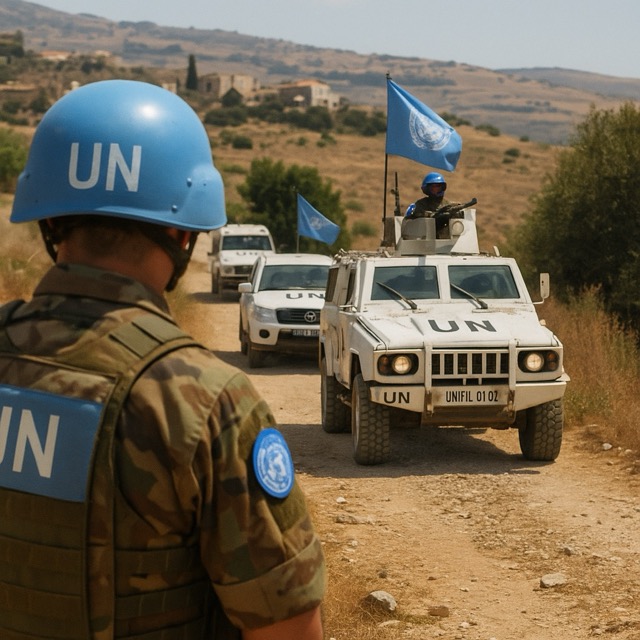
The United Nations Interim Force in Lebanon (UNIFIL), once considered one of the longest-running peacekeeping missions in the history of the UN, is set to wind down after a final mandate extension, sealing the defeat of European diplomatic efforts led by Italy and France.
For months, Rome and Paris fought in the UN Security Council to maintain the mission, which has been deployed along the Blue Line since 1978 to monitor the volatile border between Lebanon and Israel. Both governments argued that the presence of nearly 10,000 peacekeepers, including a significant European contingent, has been a stabilizing factor, preventing escalation and fostering dialogue in one of the world’s most fragile regions.
But Washington, backed by London and a coalition of non-permanent members frustrated by what they described as “mission fatigue,” ultimately prevailed. The United States agreed in 2024 to a six-month extension, bowing to allied pressure, but made clear it viewed UNIFIL as outdated in both strategic scope and financial burden. In the Security Council session this week, U.S. Ambassador Karen Mills declared: “The time has come to recognize that UNIFIL has fulfilled its historical purpose. The Lebanese Armed Forces must take full responsibility for security on their own soil.”
The End of a 47-Year Chapter
UNIFIL was born out of the ashes of Israel’s first invasion of Lebanon in 1978, expanding dramatically after the 2006 war between Hezbollah and Israel. Its blue helmets became a familiar sight in southern Lebanese towns, patrolling villages, mediating disputes, and often standing as the only buffer between armed factions.
For Italy and France, the mission was more than a UN mandate—it was a projection of European influence in the Mediterranean and Middle East. Both countries provided successive commanders of UNIFIL and invested political capital in maintaining its credibility.
“Ending UNIFIL is a diplomatic setback for Europe,” said Paolo Gentile, a former Italian defense official. “For Rome, it also represents a blow to our strategy of engagement in the region, where our military presence had offered leverage far beyond hard power.”
Paris was equally vocal. French Foreign Minister Claire Dubois lamented what she called “a hasty decision dictated by American electoral politics,” warning that the absence of UNIFIL could leave southern Lebanon vulnerable to renewed clashes.
Washington’s Calculations
Behind Washington’s decision lies a mix of strategic realignment and domestic pressure. The Biden administration, already stretched by commitments in Ukraine, the Indo-Pacific, and Africa, faced growing calls in Congress to reduce the U.S. share of UN peacekeeping budgets.
“The mission was consuming nearly $500 million a year without measurable progress,” argued a senior U.S. official. “Peacekeeping is not meant to be permanent state-building. Lebanon must stand on its own feet.”
Critics, however, accuse Washington of shortsightedness. Analysts warn that the vacuum left by UNIFIL could embolden Hezbollah, deepen Israel’s security anxieties, and test the fragile stability of the Lebanese Armed Forces, which are struggling with chronic underfunding and political paralysis in Beirut.
Regional Ripples
Reactions in the Middle East were swift. Israeli Prime Minister David Shalev cautiously welcomed the decision, noting that “UNIFIL’s presence had often been symbolic rather than effective.” Yet Israeli military officials privately expressed concern that the withdrawal of peacekeepers might force Israel to intensify its own monitoring and increase readiness along the northern frontier.
In Lebanon, the caretaker government issued a muted statement acknowledging “the invaluable contributions of UNIFIL” while vowing to strengthen cooperation with the UN during the transition. Hezbollah, for its part, described the move as “a recognition of resistance” and claimed that UNIFIL’s departure was proof of Western retreat from the region.
Europe on the Defensive
The diplomatic battle over UNIFIL has highlighted Europe’s diminishing influence within the UN Security Council. Despite coordinated lobbying, Italy and France were unable to rally sufficient support to counter Washington’s resolve.
“This episode underscores the structural weakness of European foreign policy,” said Sophie Marquand, a political scientist at Sciences Po. “Europe still has soldiers and resources but lacks the strategic weight to confront U.S. retrenchment. The Middle East is no longer a European playing field.”
Italy, which commanded UNIFIL for much of the past decade, faces domestic questions over its continued military commitments abroad. Rome currently contributes troops to missions in Iraq, the Sahel, and the Horn of Africa, in addition to NATO operations.
“UNIFIL was central to Italy’s role as a security provider,” said General Marco Bellini, retired. “Its closure forces us to rethink our engagement model.”
What Comes Next
The UN resolution approved this week stipulates that UNIFIL will begin a phased withdrawal in September, with full disengagement scheduled by June 2026. A transitional support office will remain in Beirut to coordinate humanitarian and development programs, but no armed peacekeepers will be left on the ground.
The final months will be dedicated to handing over responsibilities to the Lebanese Armed Forces, whose ability to fill the gap remains uncertain. International donors have promised new aid packages, but Lebanon’s enduring economic crisis raises doubts about their effectiveness.
“UNIFIL’s departure will be a stress test,” said Nadim Khashan, a Lebanese analyst based in Beirut. “If the Lebanese state cannot project authority in the south, we may see a dangerous security vacuum.”
The Closing of a Symbol
For many Lebanese villagers, the blue helmets were more than soldiers; they were a visible symbol of international concern for their fragile homeland. From Italian engineers rebuilding roads to French medics treating civilians, UNIFIL personnel left an imprint that transcended their mandate.
“People trusted them,” said Fatima, a schoolteacher from Tyre. “They were not just soldiers, they were friends.”
As the mission prepares to fold its flags, one of the UN’s most enduring chapters in peacekeeping is coming to a close—an end that reflects not only shifting geopolitics but also the limits of international will.
“UNIFIL’s story is a reminder that peacekeeping is temporary,” said former UN official Jeffrey Harrington. “It was never designed to be forever. The tragedy is that Lebanon is not ready for what comes after.”


 The Tower Post