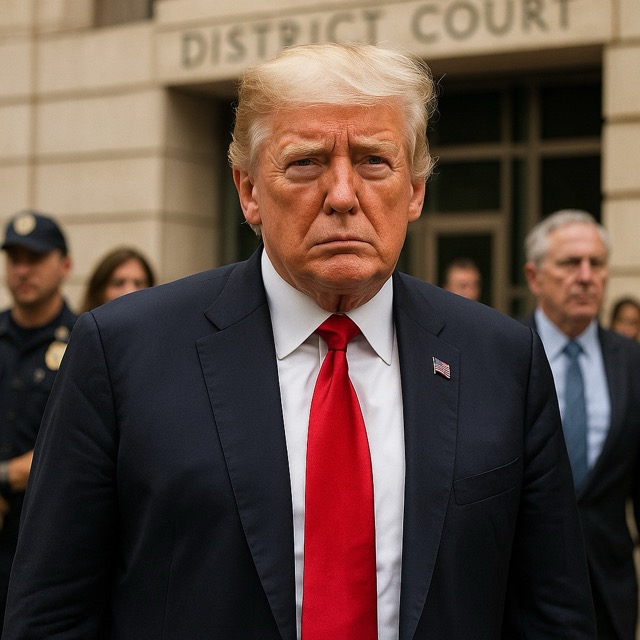
A federal judge blocks fast-track expulsions beyond the southern border, striking at the heart of Trump’s mass deportation campaign.

In less than a week, former president and current Republican frontrunner Donald Trump has suffered two significant blows to his 2025 political agenda. After being forced to retreat on punitive tariffs following mounting domestic backlash and warnings from international partners, Trump’s immigration strategy has now encountered a major obstacle in the courts.
On Friday, a federal judge in Washington, D.C., issued an injunction blocking the Trump administration from carrying out expedited deportations of individuals apprehended far from the U.S.-Mexico border. The ruling, delivered by Judge Mariana Flores of the District Court for the District of Columbia, effectively halts the White House’s attempt to dramatically expand fast-track removals nationwide, beyond the immediate border zone.
The decision is widely seen as a direct challenge to the administration’s most aggressive attempt yet to deliver on its campaign promise of mass deportations. Trump had repeatedly pledged, both during his 2024 campaign and since taking office in January, to launch what he described as the “largest deportation operation in American history.”
Judge Flores, in her 62-page opinion, argued that the government’s plan risked violating constitutional protections of due process for individuals who may have lived in the U.S. for years without authorization. Under the administration’s directive, immigration authorities would have been empowered to bypass immigration courts and remove undocumented individuals within days, provided they could not demonstrate lawful presence.
“Fundamental fairness requires that individuals be afforded an opportunity to present their claims before a neutral arbiter,” the judge wrote. “Extending summary removal procedures deep into the nation’s interior would strip long-standing residents of those protections and undermine the constitutional framework.”
Civil liberties groups and immigrant advocacy organizations hailed the ruling as a critical safeguard against what they describe as a dangerous abuse of executive power. “This is a victory for the rule of law,” said Andrea Morales, director of the American Civil Rights Coalition. “The administration cannot simply erase due process because it is politically expedient.”
The ruling comes at a delicate moment for Trump, who has faced intense criticism from both Democrats and moderate Republicans over his trade policies. Earlier this week, congressional leaders from both parties urged the White House to reconsider its sweeping tariff increases after the measures triggered volatility in financial markets and diplomatic pushback from key U.S. allies.
The one-two punch—tariff backlash and a judicial setback—marks a difficult phase for a president who has sought to project strength and control over the nation’s economic and immigration agenda. Trump responded swiftly to the ruling, calling it “a disgraceful interference by an activist judge” during a rally in Ohio on Saturday. “The American people want safety, security, and strong borders,” he told supporters. “We will not let the radical left and weak judges stop us.”
Legal experts caution that the decision is unlikely to be the final word. The Justice Department is expected to appeal, potentially setting the stage for a confrontation at the Supreme Court. Yet the injunction throws immediate uncertainty into the administration’s strategy and delays any rapid escalation of deportation operations.
Immigration remains one of the most divisive issues in American politics, and the ruling is expected to galvanize both Trump’s base and his opponents. For Trump loyalists, the setback reinforces their belief that the judicial system is stacked against conservative priorities. For Democrats and immigrant rights advocates, it is proof that legal institutions still provide a check against what they describe as authoritarian overreach.
Strategists from both parties anticipate the ruling will become a central theme in the months ahead, shaping debates in Congress and on the campaign trail. “This is not just about immigration—it’s about the limits of executive power,” said political analyst Sarah Klein. “The courts are signaling that even in an era of polarized politics, constitutional protections remain a red line.”
As Trump doubles down on his rhetoric and prepares to appeal, the United States braces for yet another institutional showdown. The coming months promise a bitter clash between the executive branch and the judiciary, one that could define the contours of American immigration policy—and constitutional law—for years to come.
For now, immigrant communities across the country breathe a temporary sigh of relief, even as uncertainty looms. The battle over deportations has entered a new phase, and with it, the enduring question of how far presidential power can stretch in pursuit of political promises.