A 10% government stake in the chip giant extends Washington’s grip on the economy, as Republicans ignore the “Marxist” overtones
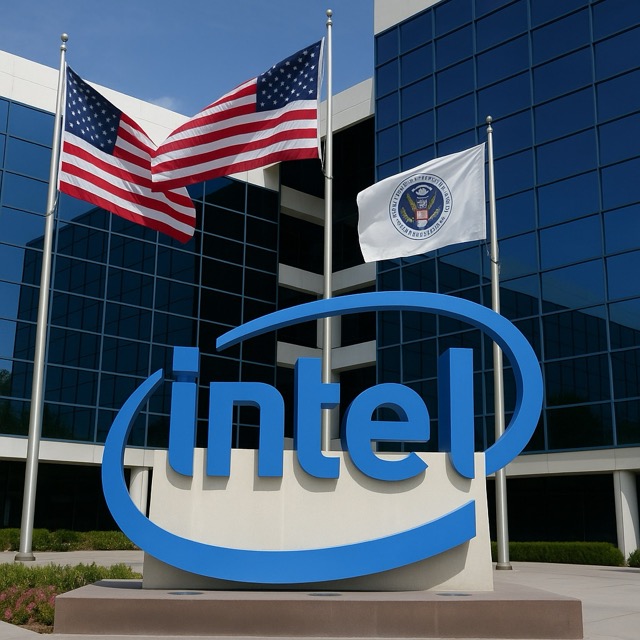
In an extraordinary twist for a party that has long championed free markets, the Trump administration confirmed this week that it has taken a 10 per cent equity stake in Intel, the U.S. semiconductor giant. The move, justified on grounds of national security and economic sovereignty, represents one of the most overt government interventions in the private sector in modern American history.
A quiet revolution in Washington
The acquisition, valued at roughly $35 billion, was announced with little fanfare on Monday morning. Treasury Secretary Steven Mnuchin II described the move as a “strategic investment to safeguard America’s technological leadership.” The language was careful, but the implications are staggering: the United States government, under a Republican president, now holds direct ownership in one of the country’s most vital technology firms.
Critics on Wall Street and in academia were quick to point out the irony. “If a Democratic administration had attempted something like this, Republicans would be shouting about socialism and central planning,” noted Stanford economist Elaine Richards. “Yet here we have the most populist conservative administration in living memory taking a step that looks uncomfortably close to Marxism.”
The silence of the GOP
Perhaps most striking is the silence of the Republican establishment. While libertarian-leaning commentators have raised alarm bells, party leadership has largely avoided criticism. House Speaker Mark Meadows described the stake as “a bold move to defend America against China.” Senate Minority Leader Mitch McConnell, once a vocal opponent of government bailouts, merely said the deal “underscores the urgency of protecting national supply chains.”
Behind the scenes, some lawmakers appear uneasy but unwilling to challenge a president who continues to dominate Republican primaries. “This is not the capitalism we were taught to defend,” admitted one senior GOP aide on condition of anonymity. “But nobody wants to be seen as weak on China.”
Intel’s delicate position
For Intel, the arrangement is double-edged. On one hand, the government’s backing guarantees stability, lucrative defense contracts, and political insulation against foreign rivals. On the other hand, the company faces the specter of politicization. Will future product roadmaps be dictated not by market demand, but by Washington priorities? Will Intel’s global partners hesitate to cooperate with a firm so closely tied to the U.S. state?
Intel CEO Patrick Gelsinger insisted the partnership would preserve “full commercial independence.” But in Silicon Valley, skepticism abounds. “You can’t serve two masters—your shareholders and the government—without conflict,” one veteran chip executive said.
A broader pattern of state capitalism
The Intel stake is only the latest in a string of interventions. Over the past two years, the Trump administration has created special tax credits for domestic battery production, forced the merger of two defense contractors to secure missile supply chains, and pressured automakers into signing “patriotic sourcing” agreements. While each move has been framed as national security policy, the cumulative effect is unmistakable: Washington is becoming an active shareholder in the economy.
Markets have responded with cautious optimism. Intel shares rose 4 per cent after the announcement, reflecting confidence that federal backing will insulate the company from downturns. Yet analysts warn that such a precedent could distort competition. “If Intel can count on government money, how will smaller rivals survive?” asked JP Morgan’s tech strategist Marcus Lee. “This may create a two-tiered market where politically favored firms thrive and others suffocate.”
Historical echoes
To historians, the moment is laden with irony. America spent decades denouncing state-owned enterprises in the Soviet Union and China as proof of the inefficiency of planned economies. Now, the U.S. is quietly building its own version of state capitalism—albeit draped in nationalist rather than socialist rhetoric.
“This is Hamiltonian economics on steroids,” said Harvard historian Paul Kim. “The government is not just guiding markets, but owning them. The ideological labels—capitalist, socialist, Marxist—are being bent out of recognition.”
The road ahead
Whether this experiment will endure beyond Trump’s tenure remains uncertain. A future administration could choose to divest, or to deepen state involvement. Much will depend on global conditions: the semiconductor war with China shows no sign of cooling, and Washington may feel compelled to retain its leverage.
For now, the Republican Party appears content to shelve its free-market orthodoxy in the name of national security. As critics have observed, it may be the most paradoxical legacy of the Trump era: an America that preaches capitalism abroad while quietly embracing state control at home.
Two questions linger: Has the Republican Party abandoned its ideological compass? And will America’s new experiment with state ownership strengthen its global position—or erode the very market dynamism it seeks to defend?



 The Tower Post