Norway’s choice of UK-built Type 26 warships — over U.S., French and German rivals — signals a new phase of North Atlantic security and industrial integration
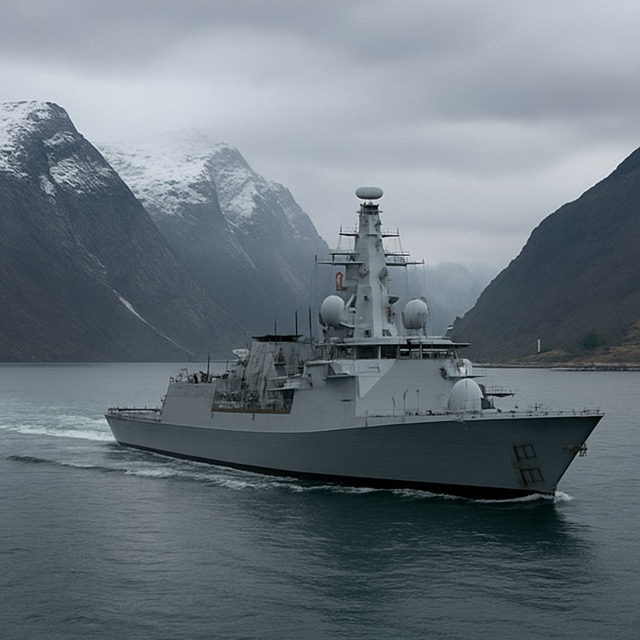
LONDON/OSLO — In a landmark moment for European defence, the United Kingdom has secured a £10 billion agreement to supply Norway with a new fleet of anti‑submarine warfare frigates, the country’s largest-ever warship export and Oslo’s biggest defence procurement to date. The decision caps a competitive race that pitted Britain against heavyweight rivals from the United States, France and Germany — and it places the North Atlantic at the centre of Europe’s next phase of rearmament.
At the heart of the deal are the Royal Navy’s Type 26 frigates, a quiet, long‑range submarine hunter designed around the demands of the North Atlantic: strong seas, harsh weather and the need to detect, deter and, if necessary, defeat Russian submarines operating along NATO’s northern flank. The ships will be built at BAE Systems’ yards on the River Clyde in Glasgow, drawing on a supply chain that stretches across the UK and into Norway. British ministers say the programme will support thousands of jobs through the 2030s, while giving Scottish shipbuilding a durable export pipeline.
For Oslo, the choice is as much about geography as kit. Norway’s narrow fjords, deep coastal waters and proximity to the Greenland‑Iceland‑UK (GIUK) gap make anti‑submarine warfare a strategic obsession. The country has invested heavily in undersea surveillance and new submarines in recent years; replacing its aging surface fleet with purpose‑built ASW frigates is the next leg of that journey. Deliveries are slated to begin at the start of the next decade, with at least five ships planned and options understood to be under discussion.
The competition was fierce. U.S. and European yards pushed proven designs — Washington’s Constellation‑class derivative, France’s FDI frigate and Germany’s F126 concept — each offering variations in sensors, weapons and industrial partnerships. In the end, Norwegian officials leaned into interoperability with the Royal Navy and the wider Type 26 community, which already includes export partners Australia and Canada. That commonality promises lower lifecycle costs, shared upgrades and smoother operations in combined task groups from the Baltic to the Barents.
Politically, the selection gives the UK a post‑Brexit industrial and diplomatic win on the European stage. It binds London and Oslo into a deeper maritime partnership at a moment when Europe is rediscovering the value of sea power — not only to escort replenishment ships and protect energy platforms, but also to shield undersea cables and pipelines that knit advanced economies together. The UK and Norway already cooperate closely in the Arctic; a shared frigate family allows that cooperation to scale, with common tactics, training and logistics.
The strategic backdrop is unambiguous: Russia’s submarine arm retains the ability to threaten shipping lanes, energy corridors and critical seabed infrastructure. Since 2022, NATO navies have refocused on the North Atlantic after decades oriented toward distant expeditionary operations. Norway’s frigates will be the sharp end of that pivot — optimised to find quiet adversaries in cold water, embark specialist helicopters and deploy towed-array sonars while maintaining enough punch to defend themselves and nearby ships from air and missile attack.
Industrial politics mattered, too. The contract spreads work across a network of more than 400 British suppliers, while opening doors for Norwegian firms in areas such as sensors, combat systems integration, software and through‑life support. In practice, that means long‑term joint teams, shared engineering data and cross‑border supply chains resilient enough to withstand wartime shocks — lessons painfully underscored by the pandemic and the war in Ukraine.
The timing is designed to dovetail with the Royal Navy’s own build of eight Type 26s, creating a larger class across two allied fleets. That scale is not just a bookkeeping win; it changes what NATO can do. Common hulls make it easier to rotate ships through maintenance without hollowing out task groups. Shared baselines ease the path to spiral upgrades — new radar modes here, a software‑defined sonar enhancement there — rolled out across multiple navies without each country reinventing the wheel.
What tipped the calculus? Officials in both capitals point to three factors. First, acoustic performance: the combination of a quiet propulsion train, low‑signature hull design and advanced towed‑array sonar gives the Type 26 a reputation for stalking submarines at range. Second, growth margin: with space, power and cooling to accommodate future sensors and weapons, the design is built for the long haul. Third, alliance value: training pipelines, logistics hubs and deployed operations become simpler when close allies sail similar ships.
None of that negates the risks. Big warship programmes are hard. Supply chains can wobble, costs can creep and yard workloads can collide. Britain and Norway will have to choreograph construction schedules to avoid bottlenecks and protect the Royal Navy’s own delivery cadence. They will also need to agree how much national customisation to allow without fragmenting the class — a balancing act between sovereignty and standardisation that every multinational programme wrestles with.
In Norway’s case, sea control is not an abstract concept; it is a lived reality. The country’s economy leans on offshore energy and maritime trade, and its coastline is a thousand‑mile invitation to grey‑zone probes. New frigates will patrol that frontier with better endurance, more capable helicopters and mission bays that can flex between anti‑submarine gear, uncrewed systems and humanitarian stores. In a crisis, the same hulls can escort tankers, shepherd amphibious forces or serve as the command node for a dispersed screen guarding subsea infrastructure.
For London, the export validates an approach that paired a top‑end ASW frigate (Type 26) with a simpler, general‑purpose design (Type 31) to stabilise workloads and pricing. Glasgow’s yards now have clarity deep into the 2030s, with the spillover effects that come from training apprentices, investing in digitised production lines and anchoring a maritime cluster of small and medium‑sized suppliers. The signal to other customers is clear: Britain can deliver complex ships at scale, and not just for itself.
Why it matters: The choice aligns northern Europe’s maritime defences around a common ASW spine just as Russia tests NATO’s seams and seabed. It also underlines a broader shift: European rearmament is not only about budgets, but about interoperability, industrial scale and time‑to‑field.




 The Tower Post