Von der Leyen says capitals are finalising detailed options for post‑conflict deployments — with U.S. capabilities in support — as leaders gather to lock in national commitments.
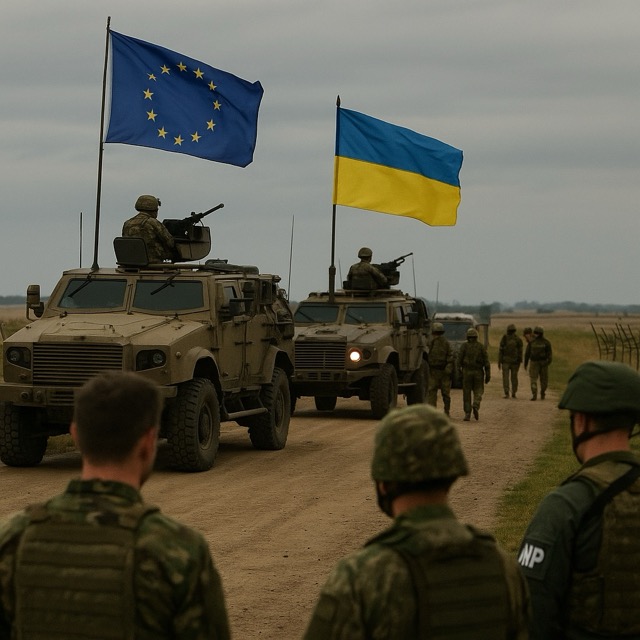
European capitals are assembling “pretty precise plans” for a European‑led troop deployment to Ukraine once the fighting stops, a move billed as part of post‑conflict security guarantees that would be backed by U.S. capabilities but not U.S. ground troops. The push — described by European Commission president Ursula von der Leyen in recent remarks — comes ahead of a high‑level meeting in Paris where leaders are set to firm up national commitments to a Western force designed to deter a renewed Russian assault and to shore up a fragile peace.
Officials and diplomats say the options now on the table are more detailed than at any time since the invasion began. Draft concepts foresee a multinational “reassurance force” deployed in phases, initially to monitor ceasefire lines, protect humanitarian corridors and key logistics hubs, and help Ukraine rebuild air‑defence coverage and de‑mine contested territory. A second phase could expand to safeguarding critical infrastructure, supporting border management and training units of Ukraine’s future army on rotation. The working assumption in several capitals is that the presence would be robust, lightly armoured at a minimum and potentially numbering in the tens of thousands, with rapid‑reinforcement plans pre‑agreed if Russia violates a ceasefire.
Crucially, planners emphasise that any deployment would be European‑led, with the United States providing what one senior official called “the long spine” — command‑and‑control enablers, intelligence, surveillance and reconnaissance, strategic lift, and, if required, stand‑off air and naval support. Washington has signalled it will not place U.S. boots on Ukrainian soil under a ceasefire arrangement, but it is prepared to underwrite the backstop to make the force credible. For European governments that have long depended on American capabilities, that combination — no U.S. tripwire soldiers, but U.S. command systems and sensors in the background — is the political key that unlocks military planning.
The effort reflects three years of hard lessons. In 2022–24, Europe’s fragmented stockpiles, dispersed procurement and hesitancy over escalation repeatedly slowed deliveries to Kyiv. In 2025, the calculus is shifting. With Ukraine insisting that any settlement include NATO‑like guarantees and a strong national army, EU and non‑EU European governments have been pushed toward a simple conclusion: the cost of an anemic peace will be higher than the cost of a credible deterrent now. That logic is driving a two‑track approach — a standing European presence to police a ceasefire and a sustained programme to rearm Ukraine at scale for the long term.
Substance still matters more than slogans. On the military side, defence chiefs from the coalition of willing countries have worked through practicalities that used to be political taboos: common rules of engagement, how to share air‑defence pictures and electronic‑warfare threat data, drone de‑confliction in a crowded sky, and a fast escalation ladder if Russian forces probe the line. Several governments are pressing for a layered air‑defence umbrella over deployment zones — blending Patriot‑class systems, European medium‑range interceptors and point‑defence against drones — to reduce risk to troops and civilians. Another live debate concerns the chain of command: to avoid automatic NATO triggers, the force would operate outside the Alliance’s formal command structure, but with close NATO liaison and access to Alliance planning tools.
On the political side, Paris and London have taken a leading role in corralling contributions, with Berlin, Warsaw and the Nordics signalling readiness to provide manoeuvre units, engineers and air‑defence batteries. Smaller states are being asked to pledge niche capabilities — de‑mining teams, counter‑UAS detachments, medical evacuation, satellite imagery analysis — that can plug gaps. Several parliaments will still need to authorise deployments; leaders want headline commitments on the table now so that ratification debates can begin as soon as there is a ceasefire framework to enforce.
Money is the other pillar. Brussels has encouraged capitals to tap the EU’s new defence‑financing instruments to expand production and to underwrite Ukraine’s future force. The Commission argues that long‑term predictability — multiyear contracts for ammunition, missiles, drones and air‑defence interceptors — is essential both to sustain Kyiv’s army and to ensure European factories invest. Complementing that push, a package of EU loans for joint defence procurement has been set at €150 billion, and member states have signalled that portions of it could be steered toward Ukraine’s defence‑industrial recovery, from air‑defence assembly lines to repair depots. Alongside that, a coalition pledge to provide at least €40 billion in military support in 2025 established a floor for annual assistance that leaders say must be sustained even under a ceasefire.
Ukraine’s red lines are shaping the plans. President Volodymyr Zelensky has rejected any settlement that limits the size or role of Ukraine’s armed forces, and he has publicly demanded guarantees that look and feel like NATO’s Article 5, even if the legal form is different. Kyiv also wants protection for its skies and seas, safe return routes for displaced civilians, and international support to clear mines and unexploded ordnance that scar farmland and industrial zones. European officials privately note that none of those requirements can be met by promises alone; they require metal, people and money on the ground.
Moscow has signalled it will oppose any Western troops in Ukraine, branding the concept a red line. That is one reason planners describe the European presence not as “peacekeepers” in the UN sense — which would require Russian acquiescence — but as a deterrent and reassurance mission tied to a ceasefire deal that Kyiv accepts. To lower the risk of miscalculation, European capitals are exploring de‑confliction channels, restrictions on heavy armour near the line, and transparency measures on troop movements. None of these steps eliminates danger; they aim to bound it.
The domestic politics across Europe are challenging. Governments face scepticism from opposition parties on both left and right about a long‑term deployment, the expense of rearmament and the risk of being drawn into renewed fighting. Leaders insist that tight mandates, regular parliamentary reporting and clear sunset clauses — tied to benchmarks such as verified Russian withdrawals and a durable ceasefire monitoring regime — can build public consent. Advocates also argue that the economic costs of a broken truce — renewed refugee flows, disrupted trade, higher energy prices — would dwarf the price of a preventive presence.
All of this will come to a head in Paris this week, where European leaders and NATO’s secretary‑general are due to refine the force concept, review national offers and sketch out a timeline for initial operational capability once a ceasefire is in place. Diplomats say the agenda includes how to fold non‑EU contributors such as the UK and Norway into financing packages; how to stand up a joint headquarters that can talk seamlessly to both NATO and Ukraine’s command; and how to lock in U.S. commitments on the enabling side — from ISR tasking to strategic airlift — that make the plan militarily real.
What remains uncertain is the politics on the other side of the table. The gap between Ukraine’s minimum requirements and Russia’s demands is wide. Even if negotiators sketch a ceasefire, the question of territory and sovereignty will not be settled quickly. That is precisely why European planners are moving now: they want forces and funding lines defined before the ink is dry, not after a fragile truce begins to fray.
Europe has debated strategic responsibility for decades. In Ukraine, that debate is about to become concrete. If leaders can pair a credible European presence with sustained rearmament of Ukraine, the result could be a deterrent strong enough to keep a hard peace. If they cannot — if deployments are delayed, air‑defence gaps persist and financing ebbs — then the West will have built a promise too fragile to bear the weight of events. The next few days will test whether Europe’s “pretty precise” plans are a blueprint for stability or simply another set of talking points that fail on contact with reality.

 The Tower Post