Ahead of Monday’s parliamentary election, Foreign Minister Espen Barth Eide and his chief rival warn that staying outside the EU is leaving Oslo exposed — but neither will risk a membership vote.
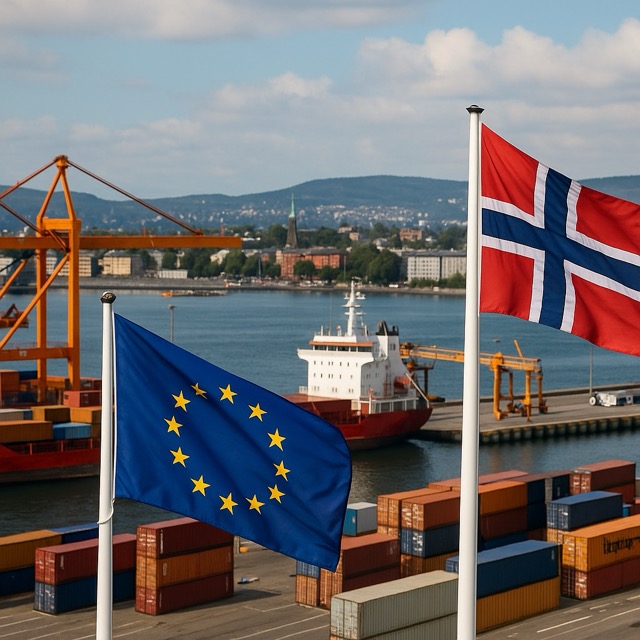
Norway’s long‑standing compromise with Europe — full access to the single market without a seat at the table — is straining under the weight of a shifting global order. As Donald Trump’s renewed tariff campaigns collide with the continuing trade reverberations of Brexit, two of Norway’s most prominent foreign‑policy voices now converge on a blunt assessment: remaining outside the European Union makes the country more vulnerable in the places that matter most — trade, security and industrial policy.
Foreign minister Espen Barth Eide says the balance between influence and access has tilted. Norway can still sell its goods into the EU via the European Economic Area (EEA), but it cannot shape the rules that increasingly decide who trades on what terms. His principal rival, Conservative grandee and former foreign minister Ine Eriksen Søreide, broadly agrees. In separate interviews and campaign stops in late August, both argued that Norway’s ‘outsider’ status is becoming costlier as the EU turns trade, subsidies, climate and security into one integrated policy toolkit. Yet neither backs a membership referendum now — a recognition that the politics remain treacherous even as the economics become clearer.
The stakes are immediate. From August 1, Washington’s latest round of ‘reciprocal’ and universal tariffs have widened and hardened, with legal wrangling now playing out in U.S. courts and Brussels weighing calibrated retaliation. For Norway — outside the EU customs union and not covered by whatever bargaining leverage the bloc can marshal — the danger is twofold: tighter U.S. market access for key exports and a seat on the sidelines when the EU hammers out responses that shield its members. Oslo may find itself forced to implement the outcomes of others’ negotiations without having voted on them, a familiar EEA-era frustration with sharper edges.
A campaign framed by trade realism, not referendum romanticism
Norway votes on Sunday and Monday, September 7–8. The ballot is being fought on bread‑and‑butter issues — prices, taxes and public services — but trade politics lurk just beneath. Eide, a Labour heavyweight, has amplified the argument that in an era of weaponised interdependence, influence is insurance. Søreide, from the centre‑right, reaches a similar destination from a different path: predictability for exporters and alignment with Europe’s rapidly evolving industrial policy are worth more than performative independence. Both are calibrated for a country that rejected EU membership in 1972 and again in 1994 yet quietly depends on the EU framework to sell nearly everything it makes.
That calibration is why neither camp wants to risk a vote on joining. Polls have shifted compared with past decades, but pro‑EU sentiment still lacks a comfortable majority and could turn an election victory into a constitutional quagmire. By keeping a referendum off the table, both sides are betting that closer day‑to‑day coordination with Brussels — faster incorporation of EU rules via the EEA, more structured participation in EU programmes, and sector‑specific accords — can blunt the costs of being just outside the room without igniting another national identity fight.
Tariff turbulence hits a rule‑taker’s blind spot
Norway’s vulnerability is most obvious where law, logistics and politics meet: the border. Trump’s tariff push — a mix of across‑the‑board duties and country‑by‑country ‘reciprocal’ rates — has already forced European capitals to choose between accommodation and reprisal. EU members can pool leverage, time retaliation and carve side‑deals as a bloc. Norway, by contrast, depends on bilateral fixes and goodwill. When the EU ring‑fences its own industry from U.S. measures or deploys its Anti‑Coercion Instrument, the protection covers EU members; EEA partners benefit indirectly at best, and sometimes not at all.
Those asymmetries are practical, not theoretical. Consider seafood, the emblem of Norwegian trade. Tariff shifts change buying patterns overnight; preferential access negotiated in Brussels can determine whether a Norwegian exporter ships to Hamburg or Houston. The same goes for aluminium, shipping services and energy technology. A universal 10% U.S. tariff, layered with higher ‘reciprocal’ rates for specific partners, doesn’t just shave margins; it reroutes supply chains. For a non‑EU economy grafted into the single market for goods but outside the customs union and trade policy, every such rerouting is a fresh test of resilience.
Brexit’s aftershocks and Europe’s new trade‑security nexus
If Trump’s tariff activism is the external shock, Brexit is the slow burn that keeps redefining Europe’s trade perimeter. Norway’s post‑Brexit deals preserve much of what mattered with the UK, but the loss of Brussels‑led alignment has multiplied rules‑of‑origin puzzles and fragmented standards. Meanwhile the EU has fused its climate, security and industrial toolkits — from the Carbon Border Adjustment Mechanism (CBAM) to defence‑adjacent supply‑chain programmes — into a strategic package. Inside the EU, those tools can be tuned to national needs. Outside, Norway must transpose the rules and hope the dials fit.
Energy underscores both the opportunity and the risk. As a critical gas supplier to the continent and a leader in offshore wind, carbon capture and electrification, Norway has leverage. But the politics are delicate: domestic power prices, interconnector capacity and EU state‑aid rules now sit on the same chessboard as security‑of‑supply and industrial subsidies. Eide argues that tighter coordination with Brussels will help protect Norway’s energy interests without surrendering control. Søreide counters that predictability for business — not symbolism about formal membership — is what matters most in the next four years.
A familiar paradox: market access without a vote
The EEA Agreement still buys Norway extraordinary access to the EU’s market of 450 million people. But it comes with a democratic discount: Oslo implements swathes of EU law with only advisory influence in the preparatory phase. That model has been defensible as long as trade policy was technocratic plumbing. In the age of sanctions, subsidies and cross‑border industrial policy, plumbing has become power politics. The paradox grows: the more strategic trade becomes, the more costly it is to be a rule‑taker.
Veterans in both parties remember the bruising referendums of 1972 and 1994 and know the country is not ready to relive them. Business associations, meanwhile, are pragmatic: they want less friction at the U.S. border, stable terms inside Europe and faster incorporation of EU rules that underpin supply‑chain finance. Voters want lower prices and reliable services. All roads point to the same near‑term course: shadow the EU more closely, argue for carve‑outs where Norway is uniquely exposed, and postpone an existential choice on membership.
What can be done now? The policy menu, short of a referendum
First, accelerate the EEA ‘pipeline’. Norwegian officials already participate in Commission expert groups; the government can expand that presence, submit more timely EEA‑EFTA comments and prioritise domestic transposition so that exporters are never a regulatory cycle behind. Second, pursue sectoral side‑agreements — from green industry to digital trade — that mirror EU‑U.S. arrangements where feasible, reducing the risk that Norway becomes a regulatory orphan when big economies cut bespoke deals. Third, deepen coordination on sanctions and export controls so that compliance burdens fall predictably and uniformly on Norwegian firms rather than unpredictably via third‑country rerouting.
Fourth, build a ‘tariff shock absorber’ for exposed sectors. Temporary credit lines, hedging facilities and targeted logistics support can help seafood, aluminium and maritime services ride out abrupt U.S. policy swings. Finally, lean into Europe’s security‑industrial programmes where participation is open to EEA states: the more Norway is wired into the EU’s supply‑chain and defence ecosystem, the less collateral damage it suffers when trade spats turn political.
Politics still constrain the ceiling
None of this resolves the basic question that Eide and Søreide are careful not to put on the ballot. Full EU membership would end the legitimacy gap in trade policy — but only a referendum could authorise it, and neither side believes the public is there. Even a strong election mandate in September would not change that math. In the meantime, the practical test for the next government is whether it can deliver the benefits of closeness without the backlash that a formal membership campaign could trigger.
In that sense, Norway’s dilemma is increasingly European: sovereignty is being redefined by interdependence, and the tools that matter — tariffs, standards, state aid, energy rules — are wielded at continental scale. As Trump’s tariff wars roll on and Brexit’s aftershocks continue to reorder the map, Oslo’s status quo looks less like prudent distance and more like a calculated risk. Both of the country’s leading foreign‑policy voices say the risk is rising. For now, they are betting that smarter proximity to the EU — not a leap into it — can keep Norway on the safe side of an increasingly jagged world economy.
Editor’s note: This article reflects reporting and analysis in late August 2025, ahead of Norway’s parliamentary election on September 7–8.


 The Tower Post