As Washington downshifts overt engagement and Beijing stages a military spectacle, the stakes for Taiwan’s security — and U.S. credibility — rise.
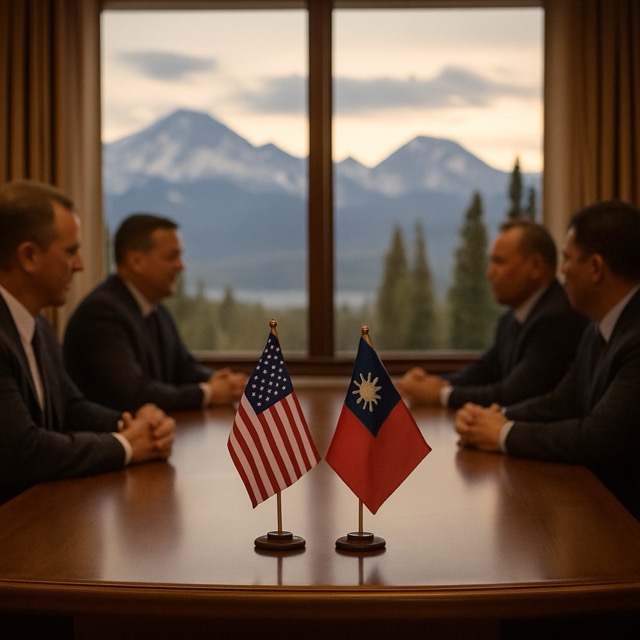
The quiet arrival of a small Taiwanese delegation in Anchorage, Alaska, late last month barely stirred local headlines. Yet for officials in Taipei, Beijing and Washington, the meeting that followed was anything but routine. According to people briefed on the talks, senior defence officials from the United States and Taiwan convened discreetly in Anchorage in the final days of August — a deliberately low‑profile venue chosen to keep tempers cool at a hot moment in U.S.–China relations.
The encounter brought together Jed Royal, the acting top Indo‑Pacific official at the U.S. Department of Defense, and Hsu Szu‑chien, then serving as Taiwan’s deputy national security adviser. The two sides, joined by a handful of aides, met behind closed doors at a secure site, working through a narrow agenda focused on practical defence cooperation: training schedules, munitions stockpiles, and the slow‑moving pipeline of U.S. arms already approved for sale to Taiwan. No communiqués were issued and cameras were kept away. The secrecy was the point.
Timing added urgency. Days later in Beijing, Chinese President Xi Jinping presided over a sprawling military parade marking the 80th anniversary of the end of World War II. Xi reviewed formations of troops, hypersonic missiles and drone submarines as foreign dignitaries including Russia’s Vladimir Putin and North Korea’s Kim Jong Un looked on — a tableau crafted to project confidence and cohesion among China and its authoritarian partners. For Taipei, the juxtaposition was striking: quiet coordination with its principal security partner one week, and a meticulously choreographed display of Chinese power the next.
The Alaska talks also came in the shadow of a snub that rattled Taipei. In June, Washington canceled a planned high‑level meeting in the U.S. capital between Taiwan’s defence minister, Wellington Koo, and senior Pentagon officials. Officially, the decision was chalked up to timing and competing priorities. Unofficially, several officials acknowledged that the White House did not wish to inflame tensions with Beijing at a delicate moment for U.S.–China economic negotiations and exploratory summit planning. The abrupt cancellation sowed doubts in Taipei about whether political optics in Washington might again trump hard security needs across the Taiwan Strait.
Anchorage, then, was damage control as much as it was defence coordination. Participants focused on restoring momentum on practical items that rarely make headlines but matter in a crisis. First on the list: the munitions backlog. Taiwan has tens of billions of dollars in approved U.S. systems and ammunition still in the delivery queue — a mix of air‑defence interceptors, anti‑ship missiles, artillery, and F‑16 components. Logistical bottlenecks and competing demands have slowed deliveries. For Taiwanese planners shifting toward an asymmetric, “porcupine” posture designed to raise the cost of any Chinese attack, the availability of expendable munitions is as important as any marquee platform. Anchorage produced no silver bullets, but U.S. officials reaffirmed the goal of accelerating deliveries where possible and expanding interim training and maintenance support on island.
A second area of focus was training. Since Russia’s full‑scale invasion of Ukraine, Taiwan has revamped its reserve system and dispersed critical assets, but gaps remain in joint fires, coastal defence, and civil‑military resilience. American officers have quietly increased rotational training at U.S. facilities, while National Guard exchanges have deepened. The new conversation centered on scaling these efforts in the year ahead without crossing Beijing’s red lines for “official” military cooperation that could trigger retaliation. As one attendee put it privately, the task is to get Taiwan ready “enough to be credible” while still keeping the temperature below a boil.
Budget politics hovered over every discussion. In August, President Lai Ching‑te’s government unveiled a defence blueprint that would lift spending above 3% of GDP next year, with a longer‑term target of 5% by 2030. That trajectory, encouraged by Washington, reflects both a sharpened Taiwanese threat perception and a sober view of U.S. bandwidth. In Anchorage, U.S. counterparts pressed for sustained investments in munitions production, air defence density, and survivable command‑and‑control — the less glamorous but indispensable foundations of deterrence. Taipei’s team, in turn, asked for predictable timelines and transparency on U.S. export approvals to help sequence contracts and domestic industry ramp‑ups.
All of this unfolded against the optics war in Beijing. Xi’s parade featured new long‑range missiles and undersea drones — capabilities aimed at neutralizing U.S. carrier groups and complicating any effort to resupply Taiwan in a conflict. The political message was as important as the hardware: China can set the stage, invite friends, and make Washington look reactive. Taipei’s calculation, shared by many in the region, is that an overreaction to Chinese theatrics can be counter‑productive, while under‑reacting risks normalizing coercion. The Alaska meeting was a bid to walk that tightrope — quietly tending to real defence shortcomings while avoiding a public spat that could give Beijing a propaganda win.
Still, the unease in Taipei is real. The June cancellation stung because it fit a broader pattern of mixed signals from Washington. Public vows of support have at times been paired with transactional rhetoric about allies and trade, and with the occasional suggestion that Taiwan should spend more before expecting more. For a small democracy living in the shadow of a much larger, increasingly capable military rival, that uncertainty complicates planning — and politics. Defence officials must assure a wary public that deterrence is holding even as Chinese ships and aircraft keep up near‑daily pressure around the island.
What did Anchorage achieve? On paper, not much: no announcements, no new programmes, no photographs of handshakes. In substance, it appears to have done three things. First, it re‑established working‑level habits after an avoidable political rupture, allowing planners to keep moving on training cycles and maintenance support without waiting for a more theatrical “reset.” Second, it clarified sequencing for parts of the arms pipeline — particularly munitions and air‑defence spares — where even modest clarity can save months later. Third, it signaled to Beijing that quiet U.S.–Taiwan coordination will continue regardless of summitry, tariff drama, or parades in Tiananmen Square.
Whether that is enough to bolster deterrence is another question. China’s People’s Liberation Army is bigger, better resourced, and more geographically advantaged than Taiwan’s forces. But advantages on paper do not automatically translate into battlefield success. Geography cuts both ways. So does politics. Taiwan’s democracy confers legitimacy that China lacks; Beijing’s coalition, while growing, is hardly seamless. And as Ukraine has shown, the side that enters a conflict with coherent logistics, a reliable industrial base, and practiced command relationships can surprise larger adversaries.
For the United States, the lesson of Anchorage is less about secrecy than about steadiness. Allies and partners — not just in Taiwan but across the Indo‑Pacific — are reading signals for consistency as much as capability. If Washington wants to keep crises from becoming conflicts, it must pair its declaratory policy with durable, measurable progress on the ground: contracted deliveries that arrive, training that builds real proficiency, and infrastructure that can absorb and sustain forces under fire. Those are the yardsticks that matter in Taipei, and the ones by which Xi’s parade — however loud — will ultimately be judged.
As the summer of 2025 gives way to a diplomatically crowded autumn, neither side appears eager for a public confrontation over Taiwan. Beijing will keep flexing and probing; Taipei will keep investing and dispersing; Washington will try to thread needles between supporting a partner and avoiding an escalatory spiral with a peer rival. Anchorage did not change that trajectory. But in a contest where the quiet work often matters most, it was a necessary reminder that deterrence is built in back rooms long before it is tested on open seas.
Sources (selected)
• Reuters, “US, Taiwanese defense officials met in Alaska last week, official says,” Sept. 4, 2025.
• Reuters, “US cancelled meeting with Taiwan as China trade talks loomed, FT reports,” July 30, 2025.
• Associated Press, “China displays its military strength in a parade on the 80th anniversary of the end of WWII,” Sept. 3, 2025.
• Reuters, “Taiwan to massively hike 2026 defence budget as US presses spending increase,” Aug. 20, 2025.
• Reuters, “Taiwan president ups defence spending target to 5% of GDP,” Aug. 22, 2025.



 The Tower Post