Ukrainians escaping the front describe how Moscow’s advance is shadowed by drones that stalk roads and courtyards. In Cernobbio, Italy’s President Mattarella rebukes Trump: “Europe is a land of peace—yet some would make us enemies and vassals.”
The evacuation car didn’t have a sign on its roof or a flag on the dashboard. There was a child seat in the back and a suitcase strapped into the trunk with cord. It moved quickly along a back road pitted by shell craters, then slowed at a village checkpoint. Overhead came the now-familiar snarl of a small engine, the stitch in the air that can turn a routine escape into a fatal mistake: an FPV drone circling for a target. Drivers hit the shoulder; families lay flat in the ditch. To many Ukrainians who have fled front-line towns in the east and south this summer, the hunting has felt personal. They call it, bitterly, a “human safari.”
Rights monitors, police records and hospital logs have mapped a pattern that matches those testimonies: Russian forces are increasingly pairing glide bombs and artillery with swarms of cheaply assembled first-person-view drones to harass evacuation routes, strike parked cars as families load bags, and drop grenades into courtyards where civilians gather. What began as a battlefield innovation has migrated into everyday terror far from trenches—an economy of violence crafted to punish movement and to empty towns by fear as much as firepower.
In late August, as the battle tempo spiked around Kupiansk and Kostiantynivka, local prosecutors documented a string of drone attacks on civilian vehicles, ambulances and apartment blocks. Volunteer convoys learned to drive with headlights off, phones wrapped in foil, and engines revving at irregular speeds to confuse hovering quadcopters guided by live video. Nonprofit evacuation teams now carry portable frequency detectors and maintain pre-planned emergency detours. Even then, escapes often end with shrapnel, broken glass and the same three questions: Did the drone see us? Was it aiming for us? Who else didn’t make it out?
There is no single number that captures how many people have been caught by the drones, but the trend line is unmistakable. Ukrainian officials say July and August brought record volumes of Shahed and FPV sorties. Hospitals in Kharkiv and Dnipro report spikes in injuries consistent with low-yield explosive drops into stairwells and courtyards. Human rights groups who examined attack footage conclude that in multiple instances the aircraft loitered and adjusted their approach to strike civilians rather than military targets. The term “human safari,” once dismissed as rhetorical excess, has entered official reports. In the south, investigators say, the drone campaign is designed to shepherd residents into flight—away from homes and towards the road.
What it feels like, for those on the receiving end, is an intimacy of danger. Artillery is indifferent. A drone looks at you. It follows when you run. The buzzing grows louder as it corrects course, adjusting to your body’s instinct to zigzag. People swap survival tips: never cluster, never linger at intersections, never stop to film. Parents teach children to recognize the note of the engine and to lie stomach-down, hands over the head, facing away from any wall of glass. Local officials have started adding “drone-safe” drills to the megaphone instructions that once focused only on missile alerts.
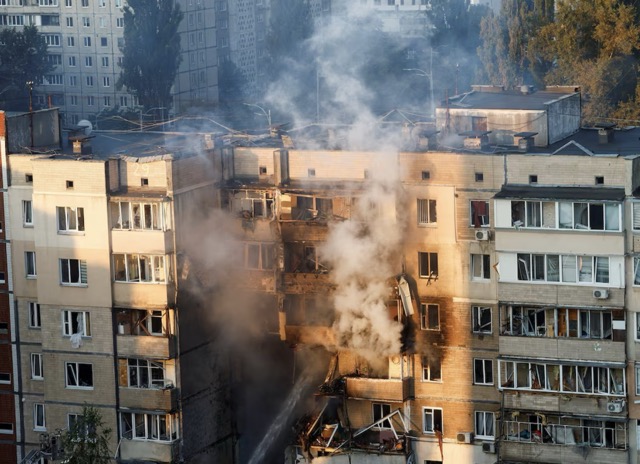
This summer’s attacks have coincided with grinding Russian pressure along the Donetsk front and in the Kupiansk sector, where roads in and out of contested villages have become perilous arteries. Ukrainian commanders describe the drone barrages as the airborne edge of a larger strategy: use cheap, disposable systems to pin down defenders and terrify civilians while heavier weapons reshape the battlefield. Even in the capital, the war’s distance has thinned. In early September, for the first time, smoke curled from the upper floors of Ukraine’s central government building after a mass wave of drones and missiles. In neighborhoods across Kyiv, residents swept up shards from stairwells after interceptors detonated overhead.
Yet amid the attrition, the country keeps moving. The evacuation of the elderly and disabled from near-front districts in Donetsk has become a daily ritual—the careful work of police, firefighters and volunteers in battered vans. In Kharkiv oblast, medics carry tourniquets beside blood-pressure cuffs and now wear ear protection in ambulances against the sudden bark of overhead drones. The psychology of the escapes has changed. The hope of returning soon has faded; the priority is to arrive alive, anywhere.The road north from Kramatorsk is lined with the remnant architecture of 20th-century industry—silent conveyors, the skeletons of sorting towers, brick kilns with collapsed roofs. At a gas station turned aid post, the paperwork table is a door balanced on cinder blocks. A woman from a village near Kupiansk signs the manifest for a seat on a bus to Poltava; her neighbor refuses, clutching her dog and saying she’ll risk one more night. A police officer reads her the evacuation order again, slow and careful, like a prayer.
International law is unequivocal: deliberate or reckless attacks on civilians are war crimes. Indiscriminate strikes are unlawful. The use of drones does not change the rule; it complicates accountability. Who piloted the quadcopter? From which console? How was the target chosen? Investigators have begun to answer those questions with digital forensics—scraping metadata from videos posted by Russian units, interviewing survivors, geolocating impact sites and cross-checking serial numbers from fragments. Their findings, published over the summer, are filling case files that will matter long after the last siren fades.
The mass displacement driven by these tactics is reweaving Europe’s social fabric. Before the full-scale invasion, Ukraine’s cities were net magnets. Today, more than six million people are refugees abroad and millions more are displaced within the country. Aid agencies say the profile of those leaving in late summer 2025 skews older and poorer—people who held out through two winters and now concede defeat to exhaustion and noise. Shelters near Lviv and Uzhhorod say they hear the same phrase at intake: “We didn’t think they’d come for us.”
The politics of the war sloshed onto the shores of Lake Como this weekend, where Italy’s business and political elite met at the annual Ambrosetti Forum in Cernobbio. In a video address, President Sergio Mattarella defended the European project as a guarantor of peace and living standards, and asked a pointed question: how could a union that has “never unleashed a conflict” come to be seen by some as “an obstacle, even an enemy”? His language was widely read as a rebuke to former U.S. President Donald Trump’s coarse vocabulary of geopolitics—a world reduced to “enemies and vassals,” as Mattarella warned against. The message from Cernobbio was less about trade than about posture: Europe must resist being defined by others and act as a subject of history, not its object.
That debate is not academic for Ukraine. The weapons that mute the buzz of incoming drones, the spare parts that reload air defense batteries, the money that keeps trains and hospitals open—these all flow through decisions taken in Brussels, Rome, Berlin and Washington. Europe’s cohesion, Mattarella argued, is not charity but self-interest in a world of resurgent empires and corporate behemoths. For families on the hinge of the front, the abstraction lands as a very practical question: Will there be another bus tomorrow?
Back near the checkpoint, the drone’s engine note fades, then returns from a different angle. The driver rechecks the road in the side mirror, counts three heartbeats and guns the car through the open stretch. The child in the back seat sleeps, one shoe on. The mother squeezes her phone in her pocket, screen dark, and rehearses the route one more time in her head: the turn by the old mill, the bend where the apple tree leans, the bridge with the missing rail. Every escape is a cartography of memory. And every kilometer that slips under the tires is another line on the map of a country that refuses to be hunted.



 The Tower Post