After the late‑August eviction of Milan’s emblematic social center, tens of thousands filled the streets: a scaffold incursion at the “Pirellino”, eggs and firecrackers against police near the Prefecture, and a political crossfire over the city’s future.
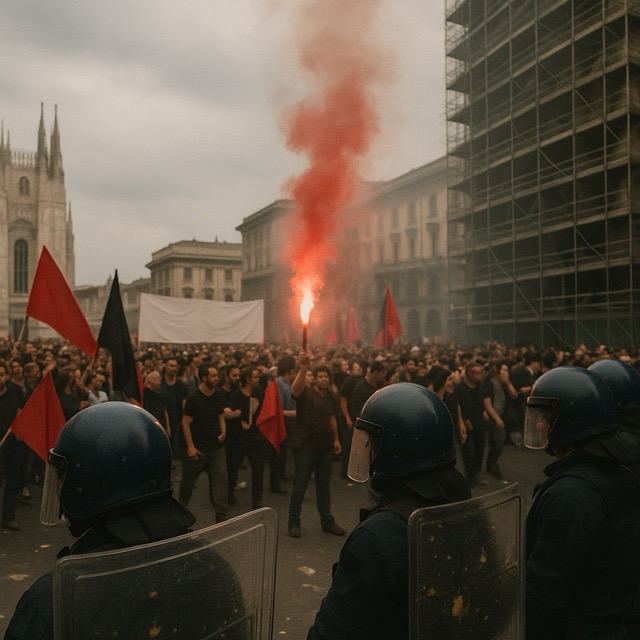
MILAN The battle over Leoncavallo — the city’s most famous self‑managed social center — returned to the streets three weeks after its eviction, drawing a vast crowd and a clash of political narratives. Organizers claimed around 50,000 participants; police estimates hovered near 20,000–25,000. The demonstration flowed for hours, part festival, part protest, and briefly tipped into confrontation.
Two processions set off in early afternoon. One departed Milano Centrale around 1 p.m.; another, larger stream formed at Porta Venezia and swelled with neighborhood groups, students, artists and long‑time volunteers. By mid‑afternoon the columns merged and pushed toward Piazza Fontana and then Piazza Duomo, where a dense human field of banners and smoke flares eventually filled the square.
The march was triggered by the August 21 eviction of Leoncavallo’s premises in via Watteau — a court order pending for years and, according to court records and press reports, postponed more than 130 times. Supporters call the center a decades‑old civic commons and cultural engine; the government frames the clearance as the overdue end of an illegal occupation.
At mid‑route came the day’s most dramatic images. A group of activists entered the construction site nicknamed the “Pirellino”, climbing scaffolds, setting off flares and spilling pink paint down the protective mesh. From the ground, chants of “No alla città dei padroni” — “No to a bosses’ city” — rolled up the steel latticework. The episode instantly became the symbol of the day: to some a creative act of dissent, to others a dangerous trespass that could have ended badly.
Shortly after, near the Prefecture at Piazza Tricolore, a fringe group peeled away and threw eggs and small firecrackers toward lines of riot police guarding the gates. The confrontation was noisy but brief; officers tightened ranks and the main corteo resumed its route. Most of the march proceeded without major incidents as stewards in orange vests worked to keep the arteries open.
Interior Minister Matteo Piantedosi was a constant target of chants as the procession crossed the city center. Toward evening, as the crowd spilled into Piazza Duomo, speakers on a truck repeated a single refrain — “Save the Leoncavallo” — and urged the municipality to find a stable, recognized site for the displaced activities.
The numbers matter because both sides need them. The movement points to an intergenerational square — students walking next to pensioners, families with strollers beside concert‑goers and mutual‑aid volunteers — as proof that Milan’s development model must include self‑managed spaces. Authorities counter that popular turnout does not override court rulings: an eviction ordered years ago has now been carried out, and the city must uphold the law.
The “Pirellino” action drew swift condemnation from the real‑estate world. Manfredi Catella, the prominent developer tied to Milan’s skyline projects, called the incursion and similar stunts “illegal actions,” casting them as the supposed “new proposal” of a model of urban democracy he rejects. The words ricocheted through the march’s sound system and social feeds, prompting loud boos from the crowd and renewed debate over who gets to shape the city’s image.
Politics threaded every block. Supporters of the government praised the police posture and decried the insults shouted at the interior minister; opposition figures and cultural workers accused national leaders of criminalizing social spaces instead of negotiating durable solutions. Senate President Ignazio La Russa, from the governing coalition, publicly expressed solidarity with Piantedosi over the insults — a note that further polarized the day’s commentary.
Beneath the theater lies a practical problem. Leoncavallo’s community must move equipment, reschedule concerts, and relocate services that once drew thousands to via Watteau. Activists used the Duomo stage to ask City Hall for a site with legal certainty — not a reprieve that can be revoked with the next political gust. Municipal officials have floated the idea of a transparent public call that, in principle, could recognize a new home; the contours remain vague, and trust on both sides is thin.
By nightfall, street sweepers collected flyers and the ash of spent fireworks. Police reported only sporadic scuffles in the central portion of the route. On social channels, each camp posted its own cut of the day: brass bands and hand‑painted banners for some; the scaffold climb and the brief clashes for others. The same images will feed opposing narratives for days to come.
Fifty years after its birth in a derelict factory, Leoncavallo again sits at the fault line between Milan’s brand — creative, international, polished — and a grassroots demand for accessible, self‑governed cultural rooms. Saturday’s turnout did not settle the argument. It did, however, measure the constituency that still claims the center as a civic good and frame the question facing the city: not only where Leoncavallo goes next, but what — and for whom — Milan is being built.



 The Tower Post