From BRICS and the SCO to digital money and contested sea lanes, August 2025 marks a hinge moment between the no‑longer and the not‑yet.
A sense of ending often arrives before anyone is ready to name it. Across capitals from Washington to Beijing and New Delhi to Brussels, officials speak in careful euphemisms—”competition,” “de‑risking,” “strategic autonomy”—to describe a world that is plainly reorganizing itself. The long interregnum between the no‑longer and the not‑yet has run out of time. Power is moving, and as in every realignment, the first dominoes do not fall cleanly.
Eurasia—an expanse stretching from Lisbon to Vladivostok and south to the Arabian Sea—is where most of the new gravity resides. Its actors are not one bloc but a tangled web of partnerships and rivalries: China’s scale, India’s demographic momentum and strategic autonomy, Russia’s sanctioned resilience and energy leverage, the Gulf’s capital and logistics, and Europe’s industrial base and regulatory reach. The West still holds unmatched financial and technological depth. But a counter‑architecture is hardening: BRICS has expanded, the Shanghai Cooperation Organisation (SCO) has matured, and new payment rails and corridors are being built to reduce exposure to U.S. and EU pressure.
In the past year, BRICS admitted Indonesia as a full member while Saudi Arabia hovers as a quasi‑member and frequent invitee. The grouping—now broader and more heterogeneous—is less a coherent economic union than a diplomatic multiplier, a forum where non‑Western priorities gain procedural legitimacy. That does not mean it can legislate a new order. It does mean that coalitions of the willing can move faster around specific projects, from commodity trading platforms to infrastructure financing.
The SCO, long dismissed as a security talk‑shop, has become an institutional backdrop for deeper coordination between Beijing and Moscow and for confidence‑building among Central Asian states. Russia’s wartime dependence on Chinese finance, technology and markets has made the relationship more asymmetrical—Moscow needs Beijing more than the reverse—but it has also created a denser mesh of trade and energy ties that will not unwind quickly.
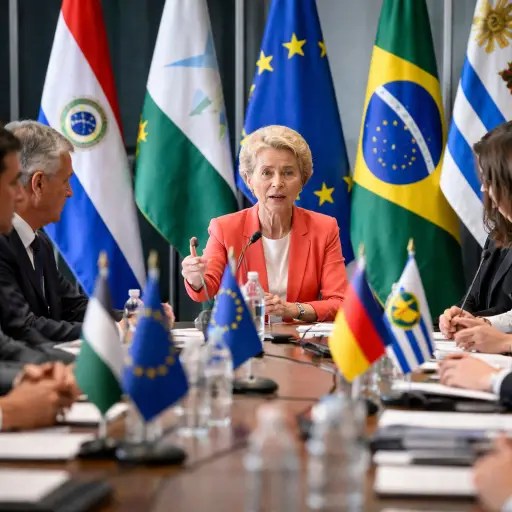
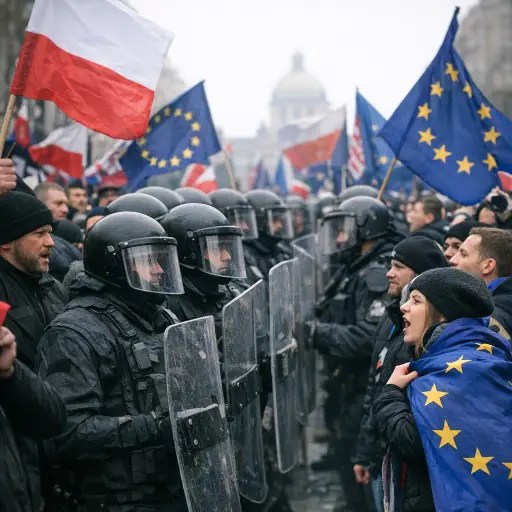
Europe, too, is adjusting. The EU’s effort to simultaneously de‑risk from China, sustain support for Ukraine, and defend industrial competitiveness has produced a patchwork of tariffs, subsidies and partnerships. The bloc’s 2024 elections did not produce a dramatic populist wave but did shift the center of gravity on migration, security and industrial policy. European manufacturers are pleading for flexibility on climate timelines and a more pragmatic stance toward Chinese supply chains—even as Brussels tightens scrutiny of subsidies and outbound investment.
On the other side of the Atlantic, Washington’s posture has also changed. With a new White House since January 2025, tariff threats have returned to the center of U.S. statecraft, rattling allies and adversaries alike. For New Delhi, now governing in a coalition, the transactional turn in U.S. policy has narrowed room for quiet compromises on data, defense and trade. India is doubling down on its signature doctrine—strategic multi‑alignment—while keeping deep ties with the Quad and courting capital from the Gulf and Japan. Yet New Delhi is also buying discounted Russian crude, exploring local‑currency settlements, and testing the limits of Western patience.
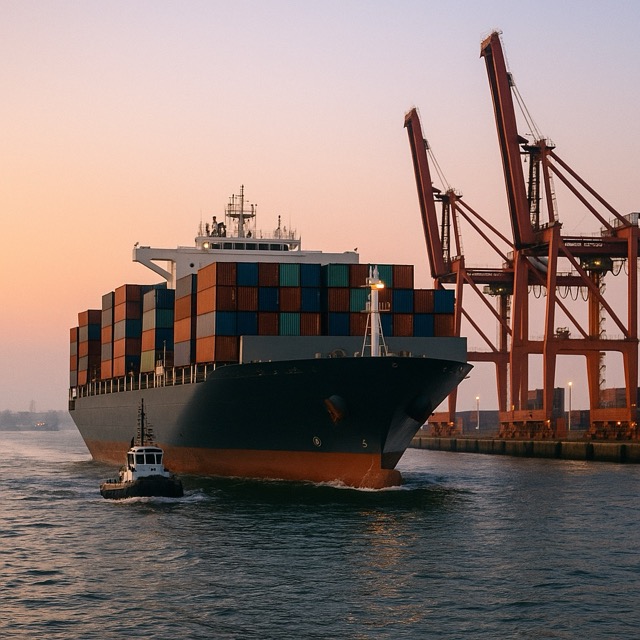
If there is a single theater where this contest feels most tangible, it is the world’s shipping lanes. Red Sea disruptions, missile and drone strikes, and the sinking of merchant vessels in mid‑2025 sent insurance premia soaring and rerouted cargoes around the Cape of Good Hope. The Suez, once the symbol of just‑in‑time globalization, has become a barometer of geopolitical risk. For Europe, which imports energy and Asian finished goods through these arteries, the knock‑on cost of insecurity is measured in inflation and industrial strain.
Energy remains the deepest lever in Eurasia’s challenge. Russia no longer sells most hydrocarbons to Europe, but it has rebuilt its customer base in Asia. Pipeline politics are back: Power of Siberia’s flows to China are rising, and a second route via Mongolia is again on the table. Whether and when contracts are finalized, the strategic logic is clear: Moscow wants guaranteed Asian demand; Beijing wants diversified supply and price leverage versus LNG. The Gulf monarchies, meanwhile, are calibrating investments into Indian refineries, Chinese petrochemicals and African minerals, hedging against all sides.
Then there is the quiet, technical revolution: money itself. Sanctions since 2022 have accelerated a search for alternatives to dollar‑centric pipes. Cross‑border experiments with central bank digital currencies—once niche—have moved from pilots to limited deployment. Even where Western institutions pull back for governance or geopolitical reasons, Chinese and Gulf partners continue iterating. The result is not immediate “de‑dollarization,” but a steady thickening of non‑dollar options for trade settlement, especially in energy and commodities. Every additional rail lowers switching costs for the next crisis.
None of this means the West is in retreat. The United States still anchors the global financial system, dominates advanced semiconductors, and sets the strategic tempo in the Atlantic and Indo‑Pacific. Europe’s capacity for regulatory coalition‑building remains formidable. Japan and South Korea are quietly re‑shoring critical manufacturing. India’s talent pool and digital public infrastructure give it unique leverage over the next wave of services and AI supply chains. But the era of one default pathway for trade, finance and security has ended.
Consider the politics. Eurasian powers are not aligned on everything: India’s border disputes with China and competition in the Indian Ocean endure; Russia and China have overlapping ambitions in Central Asia; Tehran and Riyadh still eye each other with suspicion despite tactical de‑escalation. Yet when confronted with Western pressure—tariffs, export controls, secondary sanctions—these actors often find it easier to coordinate with each other than to fold. The more the West uses blunt economic tools, the more incentive there is to build workarounds.
Europe’s conundrum is emblematic. The EU wants to keep market access in China while nurturing a domestic EV ecosystem; it needs cheap inputs from Asia yet fears technological dependency; it stands firm on Ukraine but faces voter fatigue and industrial pain. The answer, Brussels argues, is a calibrated mix of “de‑risking,” targeted tariffs, and fresh industrial policy. The risk, manufacturers warn, is that the mix becomes incoherent: too tough to stay competitive, too soft to be strategic.
India’s calculus is different. Having secured a third term, albeit with coalition partners, New Delhi is pushing supply‑chain partnerships with Europe and the U.S. while courting BRICS finance and Gulf capital. It is hedging across payment systems, logistics corridors and defense deals. India is unlikely to choose a camp; it is building bridges so it never needs to. That middle path—if sustained—could make it the swing power that shapes how far Eurasia’s challenge can go.
Russia and China have, in the meantime, developed a thick connective tissue of trade in hydrocarbons, agriculture and dual‑use goods. The trendline is choppy—flows dip when sanctions tighten or demand slows—but the direction is unmistakable. Beijing gains discounted energy; Moscow gains a lifeline—and leverage over neighbors that must now navigate a Russia anchored more firmly in Asia.
The Gulf states are playing a longer game. Sovereign funds are pouring money into ports, data centers and EV value chains from Casablanca to Chennai. The UAE’s logistics footprint now bridges Africa, South Asia and the Mediterranean. Saudi Arabia is testing the benefits of closer alignment with both BRICS partners and Western investors, wary of burning bridges but keen to extract better terms in a buyers’ market for capital and technology.
Beneath the headlines lie three structural shifts. First, redundancy is replacing efficiency in global supply chains. Firms are building inventory buffers and “China‑plus‑one” networks through Vietnam, India, Mexico and Eastern Europe. Second, the plumbing of finance is fragmenting: multiple messaging systems, more local‑currency trade, and experimental digital settlement platforms. Third, security economics—the fusion of defense and industry—has gone mainstream. The cost curves of drones, AI‑enabled sensing and missile defense are now business variables, not just military line items.
The immediate horizon is messy. Red Sea risk could spike again; a tariff spiral between the U.S., the EU and China would squeeze European industry and ricochet through developing markets; energy prices remain hostage to geopolitics from the Black Sea to the Strait of Hormuz. Yet uncertainty does not mean paralysis. It means strategy matters more. The actors who combine patient capital, trusted standards and real‑world logistics will write the next chapter.
For the West, that starts with clarity. Decide where to compete, where to coexist, and where to compartmentalize. Fund industrial policies that actually scale, not just headline‑grabbing subsidies. Rebuild trade ties with swing states—India, Indonesia, Vietnam, Brazil—on terms that respect their autonomy rather than forcing binary choices. And invest in maritime security and critical infrastructure protection with partners from the Gulf to the Horn of Africa.
For Eurasian coalitions, the task is coherence. Heterogeneity is a strength only if it enables complementary specializations: Russian energy, Chinese manufacturing, Indian services, Gulf logistics and finance. That requires predictable rules, lower political risk, and dispute mechanisms that work. It also requires managing the contradictions that come with simultaneous rivalry and partnership.
We are not at the end of the West, nor at the start of a monolithic Eurasian century. We are at the hinge—the moment when the interregnum ends and new institutions, norms and corridors begin to lock into place. In this world, the decisive competition is less about flag planting and more about who builds, funds and secures the networks that others choose to use. Those who read the dominoes in motion—not as a cascade to be stopped, but as a pattern to be shaped—will find that even in a time of uncertainty, agency is still the most valuable currency.
 The Tower Post