After Florida moves to scrap school immunization mandates, the president breaks from the hard line, calling proven shots “not controversial” and urging caution about abandoning requirements.
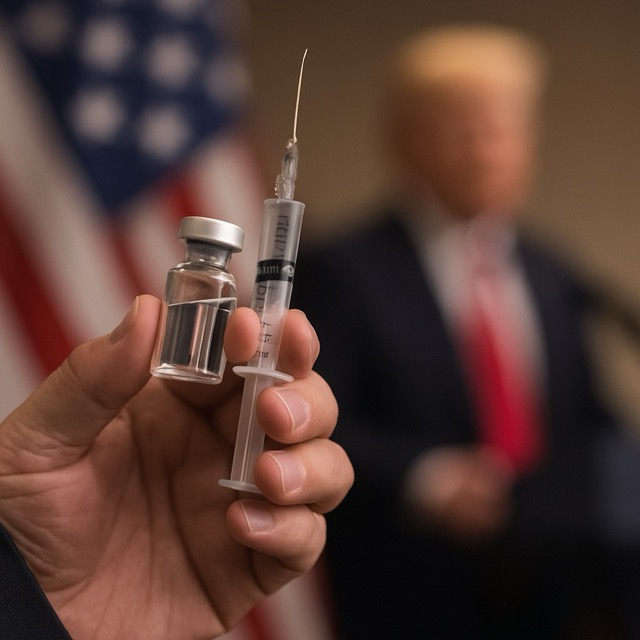
In a striking recalibration on one of America’s most polarizing public-health battles, President Donald Trump is urging the country to distinguish between vaccines that are unproven and those that, in his words, “work… pure and simple.” The remarks—delivered as Florida moved to eliminate all state vaccine mandates, including longstanding school immunization requirements—represent a rare public rebuke of allies pushing to dismantle compulsory vaccination entirely.
“You have vaccines that work,” Trump told reporters at the White House at the end of the week, adding that people should be “very careful” about declaring that no one needs to be vaccinated. While he did not endorse blanket mandates, he emphasized that certain shots are “not controversial at all” and should be taken, pointing in particular to bedrock immunizations and the updated Covid vaccines.
The comments landed days after Florida Surgeon General Joseph A. Ladapo announced a plan to end all state vaccine mandates—including the list of shots traditionally required for schoolchildren, such as measles, mumps and rubella (MMR), polio, varicella and hepatitis B—framing the move as an expansion of “medical freedom.” Governor Ron DeSantis, who built a national profile challenging pandemic rules, backs the effort. Public-health leaders warn that rolling back school requirements risks the return of preventable outbreaks.
Trump’s tone marks a notable turn. Throughout his political rise, he courted vaccine-skeptical constituencies even as his first administration’s Operation Warp Speed sped the development of Covid shots in 2020. Now, confronted with a state-level push to erase mandates outright—and mounting fallout from vaccine policy turmoil inside his own administration—he is staking out a middle lane: defending vaccines he deems tried-and-true while keeping distance from sweeping coercion.
The recalibration is not occurring in a vacuum. Health and Human Services Secretary Robert F. Kennedy Jr., a longtime critic of vaccine mandates, faced withering bipartisan scrutiny on Capitol Hill this week over changes at the CDC and his public statements questioning mainstream immunization policy. The spectacle has sharpened a question that has dogged the administration for months: how the White House will balance a promise of “freedom” in health decisions with the practical need to maintain herd immunity against diseases that for decades have been held at bay.
Florida’s gambit is the most sweeping yet. Ladapo’s announcement would make the Sunshine State the first in the nation to scrap universal school-entry vaccine requirements, setting up a likely clash with local districts and potentially the courts. Advocates of the repeal argue that parents—not governments—should decide which shots their children receive. But pediatricians’ groups and epidemiologists warn that loosening requirements has historically been followed by dips in coverage and flare-ups of measles and other illnesses.
The broader political environment is volatile. By early September, at least one analysis counted hundreds of vaccine-related bills introduced in statehouses this year, with a smaller share becoming law, underscoring how immunization has migrated from medical consensus to culture-war terrain. Florida’s move has energized activists in other Republican-led states, even as polling continues to show strong parental support for keeping school vaccine requirements in place.
Within the White House, Trump’s remarks reflect a strategic effort to reclaim the mantle of pragmatic stewardship over the nation’s health infrastructure. Advisers concede privately that the public remains intensely allergic to fresh mandates. But the president’s allies also note that voters still credit him for accelerating the first Covid shots—and that an outright repudiation of vaccines would imperil that legacy, as well as the stability of school and workplace norms.
Trump’s formulation—praising “amazing” and “not controversial” vaccines while warning against categorical opposition—seeks to preserve flexibility. It also leaves considerable ambiguity. Which vaccines, exactly, fall into the safe, beyond-debate bucket? Childhood immunizations, like MMR and polio, appear to qualify. So do updated Covid boosters, based on the president’s remarks. But he has stopped short of embracing any restoration of federal mandates, and he has continued to defend Kennedy as a well-meaning foil whose skepticism, he says, brings “different views” into the room.
For public-health planners, the immediate concern is practical: how to prevent backsliding. Even incremental declines in childhood vaccine coverage can punch holes in community protection, allowing measles and whooping cough to leap from cluster to cluster. Urban school districts, many already stretched by staffing shortages and learning-loss recovery, could face renewed outbreaks—and contentious debates over exclusion policies—if families treat the Florida experiment as a green light to skip routine shots.
Legal experts say Florida’s plan will likely trigger challenges if it conflicts with local health ordinances or federal protections for vulnerable students. In the near term, though, the political battle may be the more decisive one. Trump’s calibrated line gives Republican governors room to distance themselves from the most extreme proposals without appearing to bend to elite pressure. For Democrats, it offers a new opening to argue that immunization is a shared civic duty rather than a partisan litmus test.
The president’s remarks also hint at the beginning of a reset with the medical community. By endorsing vaccines with decades of safety and efficacy data—and by explicitly including Covid in that category—Trump is speaking to clinicians who have pleaded for clearer signals from Washington. Whether that rhetoric translates into policy is the test ahead: from funding for school-based clinics and outbreak response to the composition of federal advisory panels, now reshaped under Kennedy.
For now, Trump’s message is simple, if not fully settled: some vaccines work, and people should take them. In a country where “mandate” remains a fighting word, that may be the closest thing to consensus on offer. The stakes—for classrooms, hospitals and the nation’s political health—could hardly be higher.
Timeline: Florida’s plan was unveiled on September 3, 2025, at a Tallahassee news conference; by the end of the week, Trump’s remarks in Washington set a contrasting tone from the Oval Office. The White House stopped short of promising any intervention, but aides signaled the administration would “support the science” as states revisit immunization rules.
Public reaction has been swift. Hospital leaders and pediatric associations warned of “avoidable harm” should school requirements vanish, while anti-mandate advocates hailed Florida’s move as a long overdue course correction. Conservative lawmakers in other states said they would study the Florida model, even as purple-state Republicans cautioned that collapsing measles protections would be a political and moral red line.
Historically, school-entry vaccine rules have been among the most effective tools in public health—quiet levers that lifted immunization rates across socioeconomic lines. The idea is simple: keeping classrooms open and safe requires a basic floor of protection. Overturning that consensus, critics argue, risks substituting sporadic outbreaks and wider disruptions for today’s relative stability.



 The Tower Post