On September 7–8, Russia unleashed the largest air assault of the war; frontline pressure mounts around Pokrovsk as F-16s arrive and Europe debates postwar security guarantees.
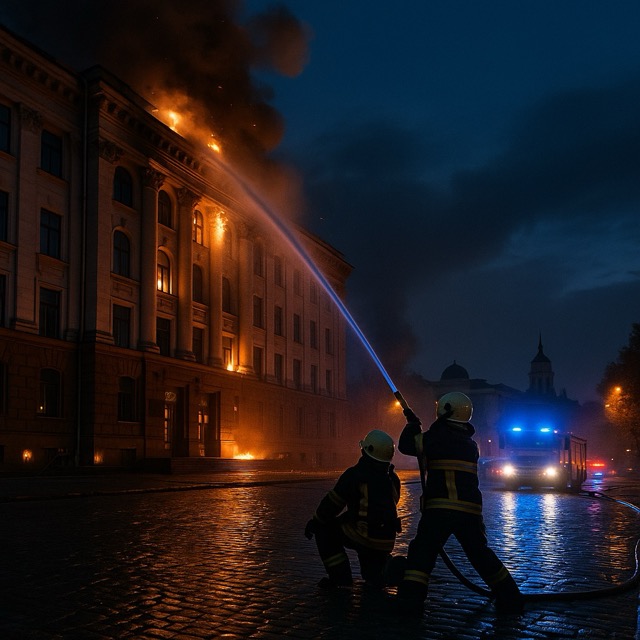
Russia’s overnight bombardment of September 7–8 set Ukraine’s main government building ablaze in central Kyiv, the first time that symbol of statehood has been hit since the full‑scale invasion began. Ukrainian officials said the assault involved more than eight hundred attack drones and a dozen missiles, killing at least four people, including an infant, and injuring dozens across the country. President Volodymyr Zelensky urged allies to rush additional air‑defence systems, while Washington signaled it is weighing tougher energy sanctions on Moscow.
The scale of the strike underscored a bleak reality: the war is entering a new phase in which Russia’s expanding drone and missile production can generate saturation attacks that even Ukraine’s dense air defences struggle to blunt. Although most inbound drones were reportedly intercepted, debris ignited fires in residential towers and damaged city infrastructure. In Kyiv’s Pecherskyi district, firefighters worked beneath a column of smoke pouring from the Cabinet building’s top floors, a visual that jolted even battle‑hardened residents.
Away from the capital, the ground war remains attritional but consequential. Russia continues to press along the western edge of Donetsk Oblast—particularly the Pokrovsk axis—seeking to grind forward and threaten Ukraine’s remaining logistics hubs in the region. Ukrainian commanders describe a tempo of dozens of contact clashes a day, with Russia leveraging glide bombs and massed infantry to probe gaps, while Ukrainian artillery and drones attempt to attrit advancing units. Analysts at the Institute for the Study of War say Moscow is regrouping and reinforcing there ahead of a potential larger push, even as its gains remain slow and costly.
The fight for Pokrovsk, a coal‑town‑turned‑rail junction farther west than many of Russia’s earlier objectives, has become emblematic. If Russia were to break through, military logisticians say, it could force Ukraine to reroute supplies across longer, more vulnerable roads; if Ukraine holds, it preserves depth for the defence of the broader Donbas line. Recent Russian claims of capturing nearby settlements have met with swift Ukrainian counter‑attacks, and independent mapping suggests the front line has moved by kilometres, not tens of kilometres, since midsummer.
Ukraine’s own deep‑strike campaign is shaping the war’s geometry. Overnight, Kyiv said its forces struck sections of the Druzhba oil pipeline in Russia’s Bryansk region and targeted industrial facilities feeding the Russian war economy. Those attacks, paired with months of drone strikes on refineries and fuel depots, are designed to raise costs for Moscow, complicate front‑line logistics and—crucially—deter the largest air barrages by forcing Russia to divert resources to homeland defence.
The air war is also evolving with the phased entry of Western fighter jets. The Netherlands says it has completed the transfer of two dozen F‑16s, with other donors—including Norway and Belgium—on track to deliver more airframes by year’s end. Ukrainian pilots trained abroad are now flying combat sorties under strict operational security, dispersing to rough airstrips and moving frequently to avoid Russian targeting. The Vipers are not a silver bullet: Russia’s layered air defences and dense electronic warfare make every sortie a high‑risk calculus. But Ukrainian officers argue that even a modest fleet can complicate Russia’s glide‑bomb tactics and extend the reach of air‑launched standoff munitions.
On the diplomatic front, Europe’s debate is shifting from emergency aid to the architecture of a postwar security regime. A French‑ and British‑led ‘coalition of the willing’ says 26 countries have agreed in principle to provide security guarantees to Ukraine once a ceasefire or peace deal takes hold—ranging from sustained funding and training to a possible stabilization presence on Ukrainian soil. Kremlin leader Vladimir Putin has warned that any Western troops in Ukraine—before or after a deal—would be treated as ‘legitimate targets,’ a threat that underscores why Kyiv seeks binding assurances, not vague promises.
The United States remains pivotal. After months of wrangling in Washington, the White House has indicated it could back tougher secondary sanctions on Russian oil and is publicly pressing Europe to close loopholes. At the same time, Western leaders this spring lifted long‑standing restrictions on the use of some donated systems, allowing Ukraine—under certain conditions—to hit military targets on Russian territory. Kyiv has leaned into that latitude, pairing longer‑range Western missiles with home‑built drones to strike depots, airfields and command posts.
Russia, for its part, is not fighting alone. Moscow’s expanding military‑industrial ties with China have helped it scale up long‑range strike drone production, according to Western researchers. And in a striking admission last week, Putin thanked North Korea for sending personnel to support Russian operations, a move that, if sustained, would mark a significant deepening of the Russia–DPRK relationship beyond ammunition and missile transfers. Pyongyang has simultaneously promised broader assistance, showcasing a rare three‑way front with China in public ceremonies.
At sea, Ukraine’s asymmetric campaign continues to hollow out Russia’s Black Sea presence. Months of strikes on naval headquarters, dry docks and ships forced the Black Sea Fleet to pull major assets back from exposed piers in Sevastopol, redistributing risk to ports like Novorossiysk and further east. That shift, coupled with coastal defences and maritime drones, has kept a de facto grain corridor alive even after the collapse of the 2022 UN‑backed deal—though hazards from mines and sporadic missile strikes persist for shippers hugging the western littoral.
Behind the front, the humanitarian ledger is worsening. The UN estimates that roughly 12–13 million people inside Ukraine will require aid this year, with around 3.6–3.8 million still internally displaced and more than 4 million holding temporary protection across the European Union. June and July saw the highest civilian casualty totals of 2025 as Russia escalated its aerial campaign against cities and energy facilities. With autumn approaching, aid agencies warn that another winter of power disruptions could push vulnerable households into acute need unless repairs and cash assistance scale quickly.
Ukraine is also trying to produce its way toward resilience. Zelensky says domestic industry now supplies a majority of the armed forces’ needs—particularly drones, artillery shells and armored vehicle repairs—thanks to accelerated procurement and wartime deregulation. Independent verification is difficult, but the visible proliferation of Ukrainian‑made one‑way attack drones and the steady growth of private manufacturers suggest real momentum. The country’s defence‑tech sector has emerged as both a battlefield asset and a pillar of longer‑term economic recovery plans.
Economically, the war’s spillovers are global. Oil markets ticked higher over the weekend on talk of fresh sanctions aimed at Russia’s crude exports, even as OPEC+ opted for only a modest production increase. Any sustained tightening would ripple into inflation‑sensitive economies just as Europe boosts defence outlays and debates civil‑preparedness measures that seemed unthinkable a decade ago.
In the coming weeks, watch three variables. First, air‑defence density: If Ukraine can field more Patriot, SAMP/T and NASAMS batteries—and keep them supplied with interceptors—the marginal damage from Russia’s massed raids will fall. Second, the Pokrovsk axis: A failed Russian push there would squander manpower and equipment ahead of winter; a breakthrough would force Kyiv to redraw its logistics map. Third, the F‑16 factor: As pilots gain proficiency and tactics adapt, the jets’ psychological and operational effects could outpace their small numbers—or be blunted by Russia’s electronic warfare and long‑range air defences.
For now, after the fire on Kyiv’s hill, neither side shows any appetite for compromise on core aims. Ukraine seeks to restore control over its territory and secure binding security guarantees; the Kremlin presses maximalist demands and wagers it can outlast Western resolve. Between them lies a months‑long grind shaped by factories, sanctions, and the geometry of air defence—an unforgiving arithmetic that will define how far, and how fast, the lines on the map can move.


 The Tower Post