Addis Ababa prepares to inaugurate Africa’s largest hydropower project on September 9, promising electricity to millions while Egypt and Sudan warn over water security and demand a binding deal.
ADDIS ABABA
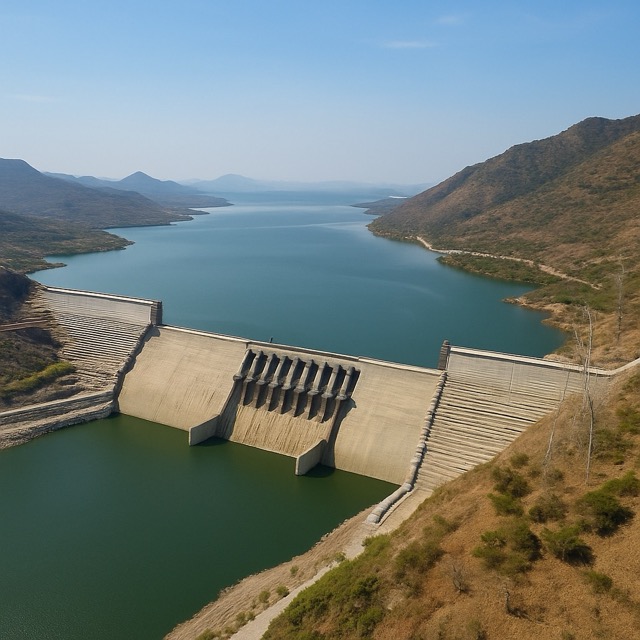
On Tuesday, Ethiopia will cut the ribbon on the Grand Ethiopian Renaissance Dam (GERD), a decade‑and‑a‑half in the making and now the largest hydropower project on the African continent. For Ethiopians, the dam is an emblem of self‑reliance and a promise of abundant, cheaper electricity after years of rationing. For Egypt and Sudan, the 74‑billion‑cubic‑meter reservoir impounded on the Blue Nile is a source of profound unease. The inauguration crystallizes a new balance of power along the world’s longest river — and a new set of risks that only diplomacy can tame.
Conceived in 2011 and producing its first power in 2022, GERD has been steadily ramping up to an installed capacity exceeding five gigawatts across 13 Francis turbines, according to Ethiopian officials. Government planners say the output will more than double national generation, expand access in a country where many households still rely on kerosene and wood, and turn Ethiopia into a regional exporter. High‑voltage interconnectors with Kenya are already live, and “wheeling” trials have begun to send Ethiopian electricity onward to Tanzania — early markers of an Eastern Africa power market finally stirring to life.
The scale is staggering. The main dam — a 145‑meter‑tall wall of roller‑compacted concrete set 14 kilometers from the Sudanese border — holds back a reservoir that can store roughly one and a half times the Blue Nile’s average annual flow at the Egypt‑Sudan frontier. Engineers say the project can smooth seasonal variability, releasing steadier flows in the dry months and taming some floods in the wet season. Ethiopian officials frame the dam as a regional public good: clean baseload power for East Africa and, potentially, more predictable water for farmers downstream.
Cairo and Khartoum are not reassured. Egypt, which depends on the Nile for about 90 percent of its freshwater, argues that unilateral operation of a structure this large without a binding agreement puts tens of millions at risk — especially in a multi‑year drought, when coordination would matter most. Sudanese experts, for their part, acknowledge reductions in destructive flash floods during the reservoir‑filling years but warn that uncoordinated releases could jeopardize the operation of Sudan’s own dams and threaten riverbank communities.
The diplomacy is as complex as the engineering. A 1959 treaty between Egypt and Sudan apportioned nearly all Nile flows between the two states; Ethiopia, the source of most Blue Nile waters, was not a party and rejects that arrangement as a colonial relic. In 2015, Egypt, Ethiopia and Sudan signed a Declaration of Principles committing to “equitable and reasonable use” and to seek agreement on the filling and operation of GERD. Yet after intermittent African Union‑led talks and multiple rounds of shuttle diplomacy, the core dispute — how to share drought risk — remains unresolved.
Ethiopia’s position has hardened with progress on the ground. Officials insist the dam has been filled and managed cautiously, citing dry‑season releases that, they say, have increased downstream flows in some months. They argue that GERD, like the Aswan High Dam before it, will ultimately benefit all riparians by reducing volatility. But in the absence of shared data and codified procedures, trust remains scarce. Egyptian planners warn that an extended drought sequence could force painful cuts to irrigation unless clear release guarantees are in place.
What would a workable deal look like? Experts describe a package that pairs Ethiopia’s sovereignty over day‑to‑day operations with clear, enforceable drought‑management triggers that scale releases according to reservoir levels and basin inflows, coupled with near‑real‑time data sharing and an independent dispute‑resolution mechanism. Because every hydrological year is different, such a framework would need to be flexible — and credible enough to survive political shocks.
The broader story is that the river is becoming an energy highway. The Ethiopia–Kenya high‑voltage direct‑current link, commissioned in 2022, has unlocked regular power sales to Nairobi and enabled the first “wheeling” of electrons to Tanzania this year. Kenya has already asked to double its imports ahead of schedule to meet industrial demand. If GERD’s turbines perform as designed, Ethiopia could expand exports to neighbors from Djibouti to South Sudan, anchoring the Eastern Africa Power Pool and, potentially, helping to crowd out costlier, dirtier generation across the region.
Still, big dams create winners and losers. Hydropower can displace diesel generation and cut carbon emissions, but reservoirs increase evaporation losses and can trap sediment that would otherwise nourish farmland downstream. In Ethiopia, maximizing the benefits will require heavy investment in transmission and distribution so the grid can deliver new power to homes and factories. In Egypt and Sudan, the risk calculus depends not just on Ethiopia’s releases but on how efficiently water is used at the farm gate — from lining canals to shifting to less thirsty crops.
Tomorrow’s inauguration will be draped in national symbolism — a celebration of engineering grit and a declaration of arrival for a country that financed the dam largely from domestic sources. Yet what happens the day after will matter more. Without a binding operating agreement, each dry spell will test the fragile equilibrium between upstream ambition and downstream dependence. With one, the GERD could become what its champions promise: a catalyst for shared prosperity, not a trigger for crisis.
For now, the Nile’s new reality is this: the gates at GERD will close and open in Ethiopia, but their consequences will be felt from the highlands to the delta. Whether that reality breeds cooperation or confrontation will depend on decisions made in the coming months — at negotiating tables in Addis Ababa, Cairo and Khartoum, and in control rooms where engineers translate politics into cubic meters per second.
How we got here
When site works began in 2011 near the town of Guba in Ethiopia’s Benishangul‑Gumuz region, the country was grappling with rolling blackouts and surging demand from a fast‑growing population. Progress was uneven. Changes in contractors, cost overruns and political turbulence slowed momentum. The first two turbines came online in 2022, a third and fourth in 2024, and civil works pushed ahead to raise the reservoir toward its full‑supply level of 640 meters above sea level.
The reservoir’s stepwise filling — spread over multiple rainy seasons — was designed to minimize shock downstream. In wet years, Ethiopia could store more without cutting into flows; in dry years, it would store less. That principle is broadly accepted by basin hydrologists, but the absence of detailed, jointly monitored rules has left room for suspicion. Egypt contends that, even with careful filling, evaporation over a lake that can stretch more than 200 kilometers will permanently reduce the volume available downstream.
The drought arithmetic
Much of the scientific debate now revolves around drought sequencing. The worst‑case scenarios — several consecutive low‑rainfall years across the Ethiopian highlands — create hard trade‑offs between conserving water in GERD’s reservoir to preserve hydropower and sending additional water downstream to sustain agriculture and ecosystems. The Aswan High Dam, which for decades has served as Egypt’s buffer against hydrological shocks, could cover some deficits, but not indefinitely. Coordinated operation between the two dams is the obvious safety valve — but it requires trust, telemetry and rules.
Politics over power
Politics complicates technocratic fixes. All three capitals face domestic pressures that narrow room for compromise. In Ethiopia, GERD has become a unifying national project financed through bonds and public contributions; few leaders can afford to be seen as yielding control. Egypt’s leadership has framed the dispute as existential, linking it to food security and urban water supplies for more than 100 million citizens. In Sudan, a nation recovering from conflict and economic crisis, elites are split between those who emphasize flood control benefits and those who focus on operational risks.
What to watch next
Diplomats expect a post‑inauguration push to revive talks under an African Union umbrella, potentially backed by technical facilitation from the United Nations and the World Bank. A credible package would likely include: (1) a staged drought‑management plan with tiered release schedules; (2) automated, transparent sharing of reservoir and inflow data; (3) safety coordination and emergency‑release protocols tied to Sudan’s Roseires and Sennar dams; and (4) a non‑political arbitration mechanism to resolve future disputes before they become crises.


 The Tower Post