On the 80th anniversary of Japan’s surrender, Xi Jinping fuses memory and muscle to recast China’s wartime role—and to warn Washington and Taipei.
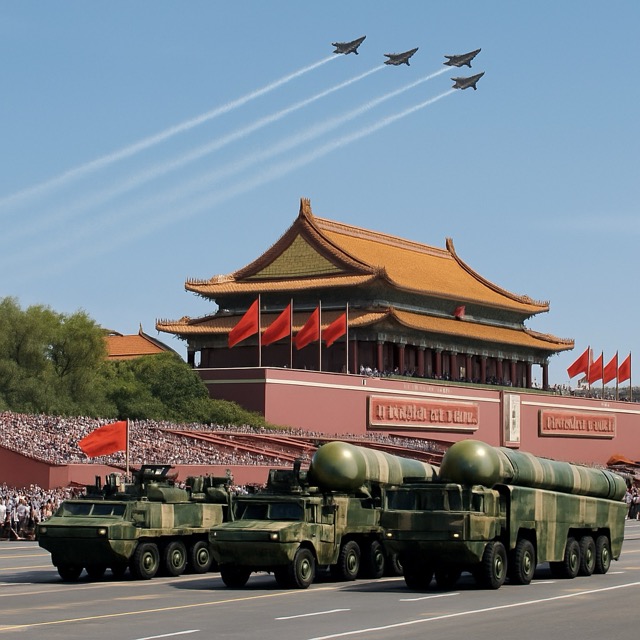
Tanks rumbled down Chang’an Avenue, hypersonic missiles gleamed under a crisp late-summer sky, and fighter jets sliced contrails over Tiananmen Square. On September 3, the 80th anniversary of Japan’s surrender in World War II, China staged a meticulously choreographed Victory Day parade that doubled as a thesis about history and a warning about the future. President Xi Jinping, flanked by Russian President Vladimir Putin and North Korea’s Kim Jong-un, paid tribute to China’s wartime sacrifices even as he underscored a contemporary promise: that the People’s Liberation Army will safeguard China’s “sovereignty and unification.” Few in the reviewing stands—or watching abroad—missed the implication for Taiwan.
The imagery was as political as it was military. Uniformed formations moved with metronomic precision across the square where the Communist Party proclaims its mandates. Xi’s speech glazed the pageantry with purpose: China, he said, stands on the “right side of history,” a nation that will not be bullied, whose rejuvenation is unstoppable. The message threaded remembrance with resolve. The war story he told, however, is not merely commemorative; it is curatorial—an edited narrative that elevates the Party’s role in the “Chinese People’s War of Resistance Against Japanese Aggression” and recasts that struggle as a moral template for China’s posture today.
This is not new, but the 80th anniversary amplifies it. In Beijing’s telling, the Chinese people—under the Party’s leadership—were decisive actors in the defeat of Japanese militarism. In the standard Allied narrative, the United States’ island-hopping campaigns, naval dominance, the atomic bombings of Hiroshima and Nagasaki, and the Soviet entry into the war were pivotal to Japan’s surrender. Between those frames lies a contentious history: the Nationalist government of the Republic of China, not the Communist Party, did the bulk of the fighting on China’s mainland—facts that Taipei was quick to emphasize this week. Taiwan’s President Lai Ching-te marked the anniversary by honoring Republic of China soldiers and pointedly declaring that “Taiwan does not commemorate peace with the barrel of a gun.” Beijing dismissed such remarks as provocation.
If memory is the stagecraft, metal is the subtext. The parade showcased a suite of advanced systems meant to deter adversaries and impress domestic audiences: underwater drones, counter-drone defenses, and what analysts identified as a new intercontinental ballistic missile, the DF-61. The PLA’s hypersonic anti-ship missiles—which have unsettled Western planners—rolled past the rostrum, a visual argument that any force operating near China’s shores, including the U.S. Navy’s Seventh Fleet, will face growing risk. Fighter jets, bombers, and attack helicopters filled the sky; amphibious units and rocket forces punctuated the ground display. The choreography nodded to lessons from contemporary conflicts, particularly the importance of unmanned systems, long-range precision fires, and electronic warfare.
Optics magnified the signal. The presence of Putin and Kim paired the parade with an unmistakable tableau of alignment—an image that will reverberate in Washington, Tokyo and beyond. For Beijing, the guests telegraphed that China’s rise is backed by partners who complicate U.S.-led coalitions. For critics, the photo-op fused authoritarian solidarity with military might. Either way, the theater worked: the absence of major Western leaders and the eager attendance of several Russia-friendly states drew the dividing lines in high relief.
To domestic audiences, the day’s script reinforced the Party’s central claim to legitimacy: that it shepherded China through humiliation and war to sovereignty and strength. Xi’s cadence—remember, honor, cherish peace—carried a refrain familiar from prior anniversaries, yet with a sharper coda: national rejuvenation requires unity. That last word, unity, is where the parade’s memory politics meet strategic intent. In Party parlance, unity includes Taiwan.
Across the strait, Taiwan’s government read the spectacle as both intimidation and persuasion. Intimidation, because the hardware on display would be central to any campaign to coerce or invade the self-governed island. Persuasion, because Beijing’s narrative seeks to fold Taiwan into a shared family history in which resisting foreign aggression and completing “reunification” are two chapters of the same book. Taiwanese officials counter that the story erases the Nationalist army’s sacrifices and conflates memory with mandate. The broader public, polls and street interviews suggest, is increasingly jaded by mainland shows of force—even as concern about the PLA’s growing capacity remains high.
For Washington, the parade read like a PowerPoint in motion. U.S. analysts who have tracked China’s leap in shipbuilding, missile accuracy, and integrated air defenses saw their spreadsheets rendered in steel. The hypersonic anti-ship threat, paired with a maturing sensor network, complicates U.S. carrier operations. A more survivable nuclear triad, if confirmed, could alter calculations about escalation control. And the PLA’s experiments with swarming drones and underwater unmanned vehicles speak to a battlespace that is faster, more autonomous, and less forgiving of slow decision cycles. The practical upshot is familiar: a renewed American focus on dispersal, deception, and hardened logistics—and fresh calls from hawks to accelerate munitions production and base resilience across the first and second island chains.
To Japan and Australia, close U.S. allies whose planners live within range of many of the systems trundling through Tiananmen Square, the display will feed existing trends: deeper security cooperation, investments in missile defense and counter-strike, and an appetite for joint exercises that demonstrate real, rather than theoretical, interoperability. Tokyo’s own defense build-up—controversial at home but buoyed by regional anxieties—is unlikely to slow. Canberra, which has yoked its future submarine program to the AUKUS partnership, has already signaled that Beijing’s saber-rattling strengthens, not weakens, its alignment with Washington and Tokyo.
Beijing insists that the spectacle is about peace through strength, not preparation for war. Xi’s text paid homage to foreign friends who helped China resist Japan and pledged that China “will never be intimidated by any bullies.” Yet the sequencing of peace and power in the parade’s message leaves little mystery about the audience. The PLA’s task of safeguarding “sovereignty and unification” is not a universal platitude; it is an explicit reference to bringing Taiwan under Beijing’s control. When Xi frames today’s challenges as a choice between peace and war, dialogue and confrontation, he is also telling Washington that China’s bottom line is not negotiable.
Still, the precise meaning of such theater is not automatic. Parades can deceive. The PLA is modernizing rapidly but remains untested in high-intensity combat. Some of what rolled by may be prototypes, not mass-fielded systems. Logistics, joint command, and combat sustainment—the unglamorous guts of war—are harder to parade. Taiwan’s defenders and their partners have agency: hardening infrastructure, fielding mobile and survivable fires, stockpiling critical munitions, and expanding reserve training all raise the costs and uncertainty any attacker would face. And history’s other lesson—often invoked, seldom heeded—is that nationalism, once stoked, does not always obey the intentions of those who light the fuse.
The deeper project visible on Beijing’s broad boulevard is the re-editing of the past to authorize the future. In this cut, the Second World War becomes a morality play where a Party-led China rescues civilization from fascism, then resumes its rightful place at the center of Asia. A peace-loving China thus fights when it must; today, those who impede “reunification” are heirs to yesterday’s aggressors. It is a powerful story—emotionally resonant, cinematically told, and, for many Chinese who lost forebears to brutal occupation, not without truth. It is also a political story, sharpened to fit the demands of the present.
What happens next will not be decided by parades, but by choices under pressure. In the months ahead, watch the tempo and complexity of PLA flights and sailings around Taiwan; the pace of U.S. and allied deployments and exercises; and the grind of Taiwan’s defense reforms. Also watch the rhetoric: if the wartime narrative tightens further—if references to “unfinished national rejuvenation” grow more explicit—the signal will be that Beijing is preparing its public for sterner steps. Anniversaries are mirrors: they show not only who a nation has been, but who it hopes to be. On this anniversary, Beijing reflected a past of sacrifice and a future of resolve—and pointed unmistakably across the strait.
—
Sources (selected):
• Associated Press, “China displays its military strength in a parade on the 80th anniversary of the end of WWII,” Sept. 3, 2025.
• Reuters, “On China’s parade day, Taiwan says it does not mark peace with gun barrel,” Sept. 3, 2025.
• The Guardian, coverage and analysis of China’s Victory Day parade, Sept. 3–4, 2025.
• Chinese MFA/CGTN, full text of Xi Jinping’s remarks at the 80th anniversary commemoration, Sept. 3–4, 2025.
• DefenseScoop, analysis of capabilities showcased at the parade, Sept. 5, 2025.


 The Tower Post