Treasury chief Scott Bessent vows to “collapse” Moscow’s economy; U.S. presses Europe for a united front after the war’s largest air assault on Ukraine
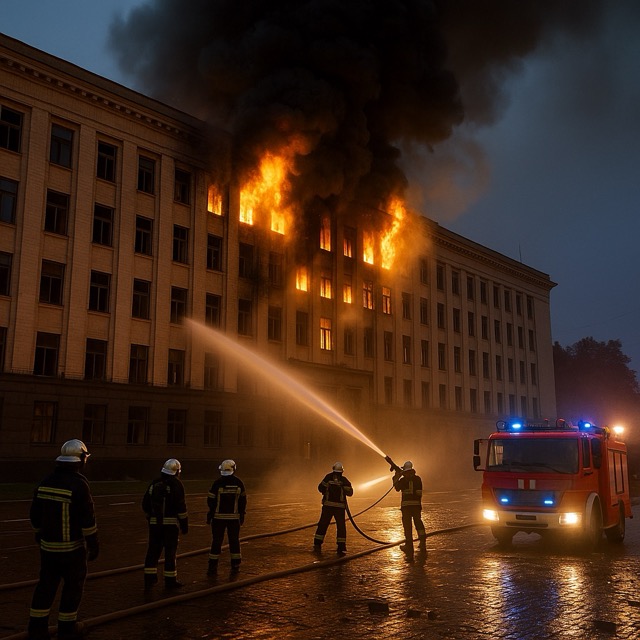
WASHINGTON/KYIV — In the wake of Russia’s largest aerial assault of the war, which set a key government building in Kyiv ablaze and sent smoke billowing across the Ukrainian capital, the White House signaled a decisive turn. President Donald Trump said he is prepared to move to a “second phase” of economic measures against Moscow, while Treasury Secretary Scott Bessent vowed that a tightly coordinated U.S.-European campaign could drive Russia’s economy into “full collapse,” forcing the Kremlin back to negotiations.
The shift comes after the weekend barrage that pounded Kyiv and other cities, killing and injuring civilians and igniting the roof of a central government complex — a symbolic strike that Ukrainian officials said underscored Russia’s intent to break morale far from the front lines. Local authorities reported fires across multiple districts as rescue crews picked through twisted rebar and shattered glass. The attack, which officials described as the largest since the invasion began, drew sharp condemnations from both Washington and Europe.
“Yeah, I’m ready for more,” Trump told reporters, describing the next steps only as a “second phase” without detailing specific measures. Bessent was more explicit in recent remarks, floating secondary tariffs and sanctions on countries that continue buying Russian oil — a list that includes major importers such as India and China. Such penalties would aim to squeeze Moscow’s export lifeline by punishing third-country intermediaries, tightening the enforcement of price caps and insurance restrictions, and narrowing the Kremlin’s access to hard currency.
European officials, meanwhile, are weighing their own next package — the nineteenth since 2022 — with options that diplomats say include additional actions against Russian banks and energy interests, stricter limits on payment networks and crypto flows, and fresh curbs on the oil trade. A European delegation is expected in Washington this week as both sides seek to synchronize measures and prevent loopholes that have blunted past efforts.
The administration’s harder line follows months of mixed signals. Trump had long hinted he could broker a swift end to the conflict; he also prioritized face-to-face diplomacy, including a controversial meeting with Russian President Vladimir Putin on U.S. soil earlier this year. But the ferocity of Moscow’s latest strikes and Kyiv’s pleas for help have revived pressure in Washington to recalibrate. Ukrainian President Volodymyr Zelenskyy castigated Russia’s onslaught and urged a “robust American response,” warning that the cost of delay would be measured in lives and in the destruction of critical infrastructure.
Bessent’s argument — that economic pressure can change the Kremlin’s calculus — rests on using the West’s leverage over trade, finance and shipping to choke revenues that fund Russia’s war machine. He has described a race “between how long the Ukrainian military can hold up versus how long the Russian economy can hold up,” making the case that more aggressive steps can tip the balance. That would mean expanding the net around traders, refiners and transport firms that touch Russian barrels, while strengthening penalties on banks, insurers and brokers that help disguise flows.
The approach is not without risks. Europe still relies on global energy markets that can be roiled by tighter controls, and secondary sanctions on big buyers could ripple through supply chains. India, which has emerged as a top purchaser and refiner of discounted Russian crude, has already bristled at steep U.S. tariffs on some of its exports, calling them unjustified and warning of potential retaliation. China, for its part, has broadened settlements in currencies other than the dollar and sought to harden its economy against Western pressure.
For Washington and Brussels, the central challenge is closing the enforcement gap. The Russian state has repeatedly adapted, using complex shipping arrangements, gray-market traders and transshipment points to evade caps and controls. Officials say the next package will devote as much attention to implementation as to the headline measures: more aggressive tracking of “dark fleet” tankers, tighter constraints on reinsurance and vessel servicing, and a clearer threat of losing access to Western financial infrastructure for firms that facilitate sanctioned trade.
Ukraine’s immediate needs remain urgent. The strikes that tore through the capital underscored Kyiv’s demand for additional air defenses and deeper stocks of interceptors. At the same time, Kyiv’s allies are weighing how far to go in backing long-range strikes on Russia’s energy infrastructure — a campaign that Ukrainian forces argue is necessary to degrade wartime revenues, but which risks escalation if mismanaged. Western officials say any new sanctions regime would be paired with measures to accelerate deliveries of air-defense systems and spare parts.
European unity will be pivotal. The war has repeatedly tested the bloc’s cohesion, especially as energy prices and electoral politics have shifted across member states. Yet diplomats say images of flames licking the roof of Kyiv’s government complex — and of families sheltering in smoke-filled corridors — have reignited a sense of urgency. “This is a moment for a common front,” one senior official said, noting that EU capitals want tighter coordination with Washington to ensure that penalties bite at the same time and in the same places.
Markets, for now, are gauging the odds of a broader disruption. Oil prices ticked higher on the prospect of tougher enforcement, while shipping insurers warned clients to expect enhanced diligence and possible premium hikes on routes with opaque ownership and flagging. Analysts noted that Russia’s economy has proven more resilient than many forecast in 2022, boosted by wartime spending and redirected trade flows — but that resilience could fray under concerted pressure on export earnings and the banking channels that carry them.
What would “phase two” look like in practice? Officials and analysts point to a layered playbook: secondary sanctions and tariffs on buyers of Russian oil and refined products; expanded designations on banks and energy firms that facilitate payments; tighter rules on vessel servicing, certification and port access for ships linked to evasion; and coordinated bans on specific high-value exports — from chemicals to industrial components — that still seep into Russia via third countries. None of those steps alone is decisive. Together, advocates say, they can constrict the Kremlin’s room to maneuver while raising the costs of continued aggression.
Even with sharper tools, the politics will be delicate. Washington must balance pressure on Moscow with the need to keep partners — especially in the Global South — onside. Europe, too, will have to manage domestic fatigue and economic headwinds as winter approaches. And Kyiv, facing nightly sirens and battered ministries, will press relentlessly for measures that change conditions on the ground, not just the rhetoric in capitals.
For now, the message from the transatlantic allies is unmistakable. The weekend’s destruction in Kyiv has accelerated a sanctions rethink. Trump’s vow of a “second phase,” paired with Bessent’s blunt talk of “full collapse,” sets a new marker for escalation. Whether Moscow bends — or finds new workarounds — will depend on how quickly and how tightly Washington and Brussels can close ranks.
Sources
Reuters — Trump ready for ‘phase two’ of Russia sanctions; U.S. weighs new measures after Kyiv strikes (Sept. 7–8, 2025).
Washington Post — Russia’s largest-ever air attack on Ukraine burns Kyiv government building (Sept. 7, 2025).
Associated Press — Mass drone and missile attack damages key government building in Kyiv (Sept. 7, 2025).
The Guardian — Trump says he is ready for more Russia sanctions; Zelenskyy urges robust response (Sept. 8, 2025).
Al Jazeera — Trump floats new sanctions after Russia’s largest air assault; Bessent says tougher measures could bring ‘full collapse’ (Sept. 7, 2025).
Bloomberg — Bessent: Economic pressure from U.S. and Europe could force Putin to negotiate (Sept. 7, 2025).
Omni Ekonomi — EU mulls a new (19th) sanctions package and coordination with the U.S. (Sept. 8, 2025).


 The Tower Post