Ruto confronts the West as Africa’s adaptation bills soar amid floods, drought and shrinking aid
Kenya’s President William Ruto has accused Western leaders of breaking a “climate blood pact,” warning that wavering support for adaptation funding is leaving millions across Africa exposed to escalating storms, floods and drought. Speaking at the Second Africa Climate Summit in Addis Ababa this week, Ruto said wealthy countries had failed to honor the political commitments they struck at recent UN climate talks to scale finance for the world’s most vulnerable.
“The gap between promises made in conference halls and the realities in our communities is widening,” Ruto said, arguing that Africa — responsible for a fraction of historical emissions — is paying for a crisis it did not cause. His comments, echoed by other African leaders and civil society groups at the summit, come as donor budgets tighten, climate disasters intensify and new global finance targets remain largely aspirational.
The Addis Ababa gathering — a sequel to the 2023 Nairobi summit that pitched the continent as a hub for green investment — sought to channel more capital to resilient infrastructure, clean power and climate-smart agriculture. Yet the politics of money loomed large. The Organisation for Economic Co-operation and Development (OECD) now projects a significant drop in overall development assistance in 2025 after a decline in 2024, a trend that threatens to undercut climate programs just as needs spike.
At the same time, the UN climate process has struggled to turn pledges into pipelines. Delegates at COP29 in 2024 agreed in principle to triple climate finance for developing countries to an annual $300 billion by 2035 and to mobilize $1.3 trillion a year from public and private sources over the same horizon. But on-the-ground delivery is lagging. The new Fund for Responding to Loss and Damage, created to help countries recover from climate calamities, has attracted well under $1 billion in pledges to date — a symbolic start, African negotiators say, but far short of the tens to hundreds of billions many estimate will be needed annually.
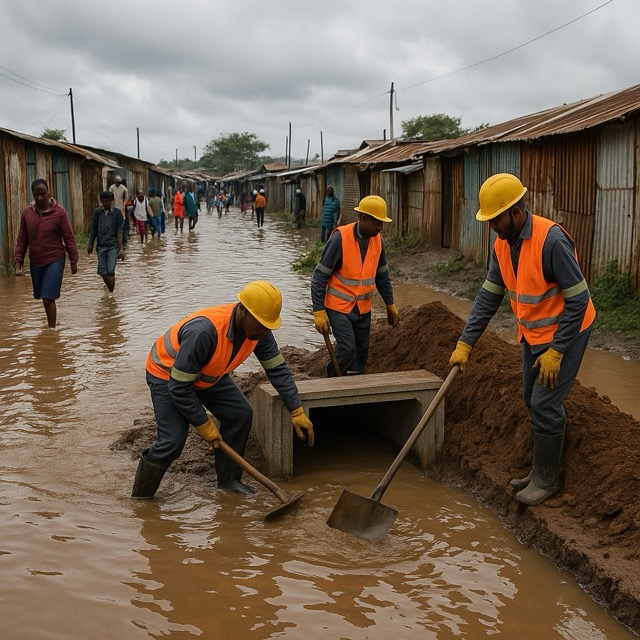
That arithmetic is brutally visible in Kenya. After a historic drought that stressed pastoral regions in 2022–2023, torrential El Niño–charged rains in 2024 and renewed flooding in 2025 washed away homes, schools and roads. Government and humanitarian assessments this year estimate that well over a million people faced acute food insecurity at the peak of the long rains season, with outbreaks of waterborne disease adding to the toll. For residents of Nairobi’s informal settlements and arid northern counties alike, adaptation isn’t an abstraction but a daily calculation: elevate a house, rebuild a culvert, switch to drought-tolerant seed — or move.
Patrick Verkooijen, head of the Global Center on Adaptation, told attendees that broken promises “are not just budget lines — they are lives and livelihoods.” Others warned that donors are pivoting toward short-term disaster response at the expense of long-term resilience, funding sandbags today while deferring investments in drainage, early warning systems and climate-smart farming that could prevent the next crisis.
African leaders insist the narrative must shift from charity to investment. Ethiopia touted new hydropower capacity and an ambitious tree-planting drive; Kenya pointed to its geothermal-heavy grid, electric mobility pilots and a growing green finance rulebook, including a national taxonomy adopted this year to guide sustainable capital. But the pipeline is still thin. Private investors want bankable projects and clear revenue streams, while public lenders remain cautious amid rising debt costs, currency risks and fragile utilities.
The political crosswinds are stiffening. Several European capitals have signaled tighter aid budgets, and Washington’s climate posture has whiplashed across administrations. Ruto’s rhetorical escalation — invoking a “blood pact” — reflects mounting frustration that Africa’s adaptation agenda keeps getting pushed to the margins of global geopolitics. With COP30 set for Brazil in November, negotiators say credibility will hinge on whether wealthy countries can lock in predictable, scaled-up funding lines for adaptation, not just mitigation.
Experts stress that adaptation finance is uniquely challenging: projects are dispersed, returns are often social rather than commercial, and benefits accrue over years. That argues for more grants and concessional loans to de-risk investments, alongside reforms to multilateral development banks so they can lend more, faster, and on terms small municipalities can actually use. It also means national governments must prioritize maintenance as much as ribbon-cutting. A new drainage network fails after the first storm if it isn’t cleared, monitored and insured.
Kenya’s treasury is experimenting. Officials are preparing sustainability-linked bonds and exploring debt swaps that would free fiscal space for food security and resilience programs. Local governments are piloting climate budgets tied to county risk assessments. And agencies are working with the Green Climate Fund and others to aggregate small adaptation projects into portfolios big enough for institutional money. These steps are promising, but scaling them will require a steadier flow of external finance than Africa has seen in years.
Civil society groups at the summit pressed for tougher measures on the polluters most responsible for warming, from windfall taxes on fossil exporters to levies on aviation and shipping. The idea is to create automatic, cross-border revenue streams that don’t depend on annual parliamentary fights in donor countries. Others urged wealthy nations to finally deliver on the promise — made in Glasgow — to at least double adaptation finance by 2025, noting that the latest UN assessments still show a yawning gap between needs and flows.
In the informal settlement of Mukuru in Nairobi, residents say they measure progress in centimeters — the height to which a floor is raised above last season’s flood line; the thickness of a new culvert under a footpath; the distance a mobile money transfer stretches when food prices spike after a washed-out harvest. County officials and community groups describe modest victories: a repaired bridge, a relocated school, a clinic stocked with cholera test kits. But they add that each fix reveals the next vulnerability, and without predictable external support, the cycle repeats.
For Ruto, the politics is personal and regional. His country’s economic fortunes are intertwined with stable weather, reliable power and functioning roads. Absent those basics, growth stalls and debt strains intensify. Across the continent, the stakes are bigger still: a youthful population brimming with ambition and a storehouse of critical minerals essential for the energy transition. Leaders argue that helping Africa adapt is not charity but insurance for a world whose supply chains and climate security are inextricably linked.
Whether the “climate blood pact” is revived will be evident in the months ahead. Between now and COP30, donor governments will finalize budgets, development banks will set lending envelopes, and private investors will scan for credible, shovel‑ready projects. On the ground, the next rainy season will not wait. In villages along the Athi River and in dryland towns from Garissa to Turkana, people will judge grand announcements by whether their streets drain, their boreholes hold, and their children can stay in school when the weather turns. For them, adaptation is less a slogan than a lifeline — one that, so far, too often slips.
Sources: Africa Climate Summit coverage (Associated Press; The Guardian); Financial Times interview quoting Ruto’s “climate blood pact” remark; UNFCCC releases on COP29 finance outcomes and the Fund for Responding to Loss and Damage; OECD brief on projected 2024–2025 declines in official development assistance; UNEP’s 2024 Adaptation Gap Report; ReliefWeb/IPC updates on Kenya’s 2024–2025 floods, food insecurity and disease outbreaks; Kenya National Treasury budget and green finance taxonomy notes, 2025.




 The Tower Post