On a London stop, the alliance’s secretary‑general and Britain’s prime minister align on air defence, Ukraine guarantees and a bigger role for European industry.
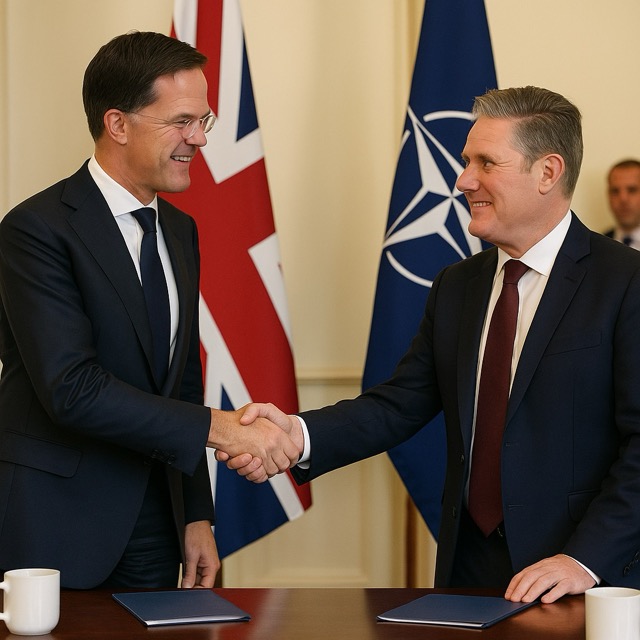
LONDON —NATO Secretary‑General Mark Rutte met British Prime Minister Keir Starmer in London on Tuesday for talks focused on Europe’s air and missile defences, long‑term security guarantees for Ukraine and the scale of investment required to make Europe’s militaries fit for purpose. The visit — Rutte’s second high‑profile stop in the British capital since taking office last autumn — follows fresh allied consultations on a “coalition of the willing” to underpin any eventual peace agreement with Kyiv and to deter renewed Russian aggression if diplomacy stalls.
Downing Street cast the London meeting as a chance to sync the United Kingdom’s 2025 Strategic Defence Review with the alliance’s push to translate pledges into production lines and deployable units. For Rutte, it is the latest step in a campaign to jolt European capitals into what he calls a necessary “quantum leap” in collective defence — including a four‑fold increase in allied air and missile‑defence capacity — an argument he sharpened in London during a June address and bilateral with Starmer.
For Starmer’s government, the agenda dovetails with a domestic defence reset. In February, the prime minister set a path to raise core defence spending to 2.5% of GDP by 2027 and, conditions permitting, toward 3% in the next parliament. In June, he broadened the frame, pledging to lift wider national‑security outlays to 5% of GDP by 2035. Whitehall’s review lays out where that money would go: replenishing munitions stockpiles, accelerating production of long‑range weapons, hardening the UK’s air and missile defences, and wiring the armed forces for data‑rich, drone‑heavy operations.
All of it sits within a strategic premise the two men share: Europe must carry more of the load for its own defence. With Washington’s attention pulled by domestic politics and global rivalry, London and Brussels have argued that European NATO members need to shift from the rhetoric of “stepping up” to the reality of factories, framework contracts and ready formations. Rutte’s message since taking office has been that credibility is measured in brigades at high readiness and interceptors on rails — not communiqués.
Ukraine’s war remains the metronome for these choices. Rutte said last week he expects clarity “soon” on the shape of European security guarantees for Kyiv — a framework intended to keep weapons and financing flowing, tighten sanctions and deter future incursions after large‑scale fighting ebbs. Starmer has been among the European leaders arguing that any settlement must be underwritten by real capabilities, not paper promises. London has matched financial guarantees with orders for air‑defence missiles manufactured in the UK, and insists that European production must surge to meet demand.
Tuesday’s conversation, officials said ahead of the visit, was designed to turn ambitions into deliverables. On air defence, that means accelerating integrated sensor networks, expanding stockpiles of interceptors and securing the propellants and micro‑electronics that often become bottlenecks. On land forces, it means more training rotations and higher readiness levels for British and allied brigades earmarked for NATO’s northeastern flank. At sea, the UK is pushing a “hybrid” Royal Navy — blending crewed ships, submarines and autonomous systems — to patrol the North Atlantic and defend critical undersea infrastructure.
The politics are no easier than the engineering. Britain’s Treasury faces hard choices: inflation has eased but not vanished, growth is uneven and the government’s social‑spending agenda competes with defence for scarce pounds. Across Europe, leaders must persuade voters that higher outlays are not merely a reaction to today’s war but insurance against tomorrow’s coercion. Rutte, a veteran coalition‑builder, has been explicit that solidarity requires sustained spending and that allies who lag will face pressure to meet their commitments.
Even so, Europe’s rearmament is edging from promise to plan. Defence ministries are placing multi‑year munitions contracts; industry is adding shifts; and procurement rules are being tweaked to favour common designs over national boutique projects. The UK review puts particular emphasis on rebuilding sovereign industrial depth — from explosive precursors to guidance components — while staying knitted into NATO supply chains. Officials in London argue this is less about protectionism than resilience: ensuring that Europe can sustain high‑intensity operations for as long as it takes.
For Ukraine, the practical question is tempo. Kyiv needs air‑defence interceptors and artillery shells now, even as allies work on 2027–2030 production curves. British officials say the goal is to bridge that gap with a mix of emergency purchases, donations from existing stocks and co‑production deals that bring Ukrainian plants into allied programmes. NATO headquarters, meanwhile, is focused on ensuring that any “coalition of the willing” complements — rather than fragments — alliance planning, logistics and command‑and‑control.
Britain’s domestic politics also shape what London can promise. Starmer’s government has tried to frame defence as part of a broader “national resilience” agenda, linking shipyards in Govan and a revitalised drone‑ and missile‑engine supply chain to jobs and regional growth. That message aims to maintain cross‑party consensus on Ukraine and build support for multi‑year procurement that stretches beyond electoral cycles. But as independent experts warn, the review’s reforms will require disciplined execution: fewer bespoke programmes, more common kits and ruthless prioritisation.
Rutte’s own authority rests on moving allies through tight timelines and higher baselines. In speeches, he has argued that NATO must be “stronger, fairer and more lethal” — stronger in readiness, fairer in burden‑sharing and more lethal in the sense of modern firepower that deters without firing. That trinity anchors his London talking points. He needs Britain — one of the few large European militaries with global habits and industrial heft — to help anchor the alliance’s pivot from declarations to delivery.
None of this will be settled in a single afternoon at No. 10. But meetings like Tuesday’s matter because they convert political direction into taskings for planners and buyers. If the UK and NATO lock in common air‑defence standards, place long‑term orders for interceptors and sensors and align fielding timelines, Europe’s skies will be harder to bully. If they cannot, adversaries will notice the gap between rhetoric and readiness — and test it.
The choreography of Rutte’s visit also reflects a wider diplomatic campaign. London remains a stage on which NATO sets the tone for allies, and where messages to Moscow are meant to be heard. Appearing together, the secretary‑general and the prime minister signal that Europe’s centre of gravity on defence is shifting from aspiration to execution — and that, even amid domestic pressures, Britain intends to help lead that shift.
The next benchmarks will come quickly: progress on a security‑guarantee architecture for Ukraine; announcements on new air‑defence orders and co‑production; and budget decisions in London’s autumn statements and across European capitals. Success will look prosaic — factories at capacity, training areas crowded, warehouses stocked. Failure will be obvious on radar screens and in casualty figures. Rutte and Starmer know which story they want to write; Tuesday’s meeting was an attempt to make the ending more likely.
Sources
NATO: ‘Secretary General to visit the United Kingdom’, advisory for 9 September 2025 — https://www.nato.int/cps/en/natohq/news_237493.htm
UK Prime Minister’s Office: ‘PM meeting with Secretary General of NATO Mark Rutte’, 9 June 2025 — https://www.gov.uk/government/news/pm-meeting-with-secretary-general-of-nato-mark-rutte-9-june-2025
NATO (speech): ‘Building a better NATO’, London remarks, 9 June 2025 — https://www.nato.int/cps/en/natohq/opinions_235867.htm
Chatham House event page, 9 June 2025 — https://www.chathamhouse.org/events/all/open-event/nato-secretary-general-mark-rutte-building-better-nato
EUNews: ‘Rutte calls for 400% boost in NATO’s anti‑aircraft capabilities’, 9 June 2025 — https://www.eunews.it/en/2025/06/09/rutte-calls-for-400-boost-in-natos-anti-aircraft-capabilities/
Reuters: ‘NATO’s Rutte expects clarity soon on European security guarantees for Ukraine’, 3 Sept 2025 — https://www.reuters.com/world/europe/natos-rutte-expects-clarity-soon-european-security-guarantees-ukraine-2025-09-03/
UK Government: ‘Prime Minister sets out biggest sustained increase in defence spending since the Cold War’, 25 Feb 2025 — https://www.gov.uk/government/news/prime-minister-sets-out-biggest-sustained-increase-in-defence-spending-since-the-cold-war-protecting-british-people-in-new-era-for-national-security
House of Commons Library Insight: ‘UK to spend 2.5% of GDP on defence by 2027’, 26 Mar 2025 — https://commonslibrary.parliament.uk/uk-to-spend-2-5-of-gross-domestic-product-on-defence-by-2027/
Reuters: ‘At NATO, UK’s Starmer pledges increase in defence and security spending to 5% by 2035’, 24 June 2025 — https://www.reuters.com/business/aerospace-defense/uk-broaden-security-focus-set-5-defence-spending-target-2025-06-23/
IISS analysis of the UK Strategic Defence Review 2025 — https://www.iiss.org/online-analysis/military-balance/2025/062/sdr-2025-uk-outlines-ambitious-vision-for-defence-amid-fiscal-challenges/
RUSI commentary on the Strategic Defence Review — https://www.rusi.org/explore-our-research/publications/commentary/strategic-defence-review-does-it-pass-its-tests




 The Tower Post