Two young Palestinian gunmen open fire at a morning bus stop near Jerusalem’s Ramot Junction, killing six. The assailants are shot dead on site. Far‑right finance minister Bezalel Smotrich rails that the Palestinian Authority should “disappear from the map,” while Mahmoud Abbas’s leadership condemns the attack yet faces growing pressure on all sides.
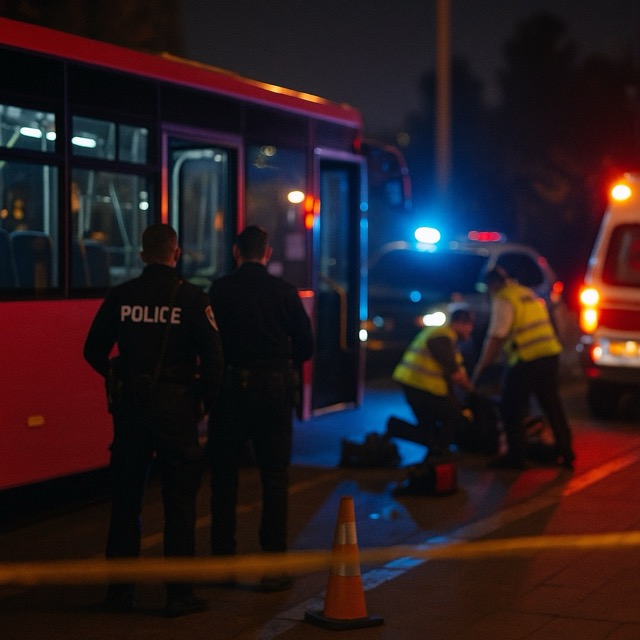
Six people were killed and at least a dozen were wounded on Monday morning when two Palestinian gunmen opened fire at a crowded bus stop on the northern edge of Jerusalem, near Ramot Junction, in one of the deadliest attacks to hit the city in years. The assailants were shot dead moments later by an off‑duty soldier and armed civilians, according to police and emergency services.
Israeli officials identified the attackers as young men from the occupied West Bank. Video from passing cars captured commuters diving behind concrete barriers and buses grinding to a halt as bursts of automatic fire echoed through the junction. Paramedics described a chaotic scene of triage as they worked to stabilize multiple victims with gunshot wounds.
The attack struck at the heart of Jerusalem’s morning rush. Witnesses said the gunmen first sprayed the bus platforms and, according to police reports, also fired into a bus before they were neutralized. Hospitals said several of the wounded remained in serious condition.
Within hours, Prime Minister Benjamin Netanyahu vowed that Israel would “apprehend whoever aided and dispatched them” and promised stronger measures in the West Bank. Security forces ringed villages north of Jerusalem and carried out raids around Ramallah, while troop deployments were reinforced across central arteries leading into the city.
But it was the political fallout that reverberated most sharply. Bezalel Smotrich, Israel’s far‑right finance minister and a key power broker in the governing coalition, declared that the Palestinian Authority (PA) should “disappear from the map”—a call widely interpreted as an open push to dismantle the self‑rule body established under the Oslo Accords. The comment followed weeks of annexation talk and settlement expansion plans, and drew condemnation from Palestinian officials and alarm from diplomats who warn such rhetoric narrows already‑fading pathways to de‑escalation.
For the PA, led by 89‑year‑old President Mahmoud Abbas, the Jerusalem bloodshed marked what officials privately called their darkest day since the Gaza war exploded in October 2023. The presidency issued a statement condemning the targeting of civilians and denouncing all forms of violence and terrorism, a position Abbas has maintained for years despite deepening public anger over continued Israeli military operations, settlement growth, and the humanitarian catastrophe in Gaza.
That dual pressure—far‑right Israeli calls to erase the PA on one side, and Palestinian street fury at perceived PA impotence on the other—has pushed the West Bank’s fragile political architecture to the brink. Within Fatah, Abbas’s aging movement, younger cadres are increasingly outspoken about succession and legitimacy. In several northern towns where Israeli raids have intensified, local leaders say the PA’s security forces struggle to deploy, fearing clashes not only with the army but also with armed groups and angry residents.
In Jerusalem, the far‑right’s demands hardened within minutes of the attack. Coalition partners called for sweeping punitive steps: home demolitions for the attackers’ families, mass arrests, the stripping of residency rights from supporters of armed groups, and expanded raids on weapons workshops in the northern West Bank. Human rights organizations warned that such measures, some already routine, risked further inflaming a population living under military occupation and collective closures.
The bus‑stop shooting also fed into a broader regional escalation. In Gaza, the Israeli military increased strikes amid talk of a new ground maneuver; along the northern frontier, exchanges of fire with Hezbollah persisted. Diplomats from Europe and the Gulf condemned the Jerusalem attack, even as they pressed Israel to rein in civilian harm in Gaza and the West Bank and to reopen channels for a cease‑fire and hostage‑release agreement with Hamas.
Netanyahu’s rhetoric signaled a government under intense domestic pressure. For months, relatives of hostages and anti‑government protesters have accused the prime minister of prolonging the war for political survival. The Jerusalem killings, coming after a summer of rising tensions in the West Bank and a renewed push by cabinet hardliners to formalize annexation, are likely to deepen the coalition’s reliance on far‑right partners who reject a two‑state outcome and openly advocate permanent Israeli sovereignty over most of the territory.
Smotrich’s escalation fits that trajectory. In recent weeks he has unveiled maps and proposals to extend Israeli law over large swaths of the West Bank, leaving Palestinian population centers as isolated enclaves. His attack on the PA—long vilified by Israel’s hard right as an incubator of incitement—seeks to shift the conflict’s center of gravity away from Gaza and toward a final showdown over the West Bank’s future. For Palestinian officials, the timing felt pointed: just as Abbas tried to restate opposition to attacks on civilians, Israel’s finance minister amplified calls to make the very institution he heads across the table a political non‑entity.
Ordinary Israelis, meanwhile, recoiled at another morning shattered by gunfire. At the Ramot junction, parents searched for children who had not answered phones; bus drivers stood in small circles, quietly replaying the sequence of shots. “You live with the fear in the background,” said one commuter as forensic teams documented casings. “But when it reaches your stop, your bus, there’s nothing abstract about it.”
In the West Bank, Palestinians braced for the familiar pattern of post‑attack operations: closures, checkpoints, nighttime raids. Shopkeepers in several villages reported shortages after main roads were abruptly sealed. Aid groups warned that another round of movement restrictions would complicate the delivery of food and medical supplies and could stoke fresh confrontations.
After two years of unbroken crisis, the political compass appears frozen between maximalist visions and collapsing institutions. The PA’s condemnation of the Jerusalem killings may curb international rebuke for a day; it will not quiet younger Palestinians who see their leadership as both powerless and out of touch. Nor will Smotrich’s calls erase the reality that dismantling the PA would leave Israel with direct responsibility for millions of Palestinians, a costly and combustible scenario the security establishment has long warned against.
By nightfall, the Ramot platforms had been scrubbed and reopened, buses once again pulling in on schedule. The human toll—six lives lost, families wrecked, a city on edge—could not be so easily tidied away. If anything, the morning’s bloodshed laid bare the region’s unsparing equation: without a horizon that restores political legitimacy in the West Bank and guarantees security for Israelis and freedom for Palestinians, each new act of violence becomes not an aberration, but a grim rehearsal for the next.


 The Tower Post