New family trust gives eldest son voting control of Fox and News Corp as three siblings take cash — preserving the empire’s conservative line.
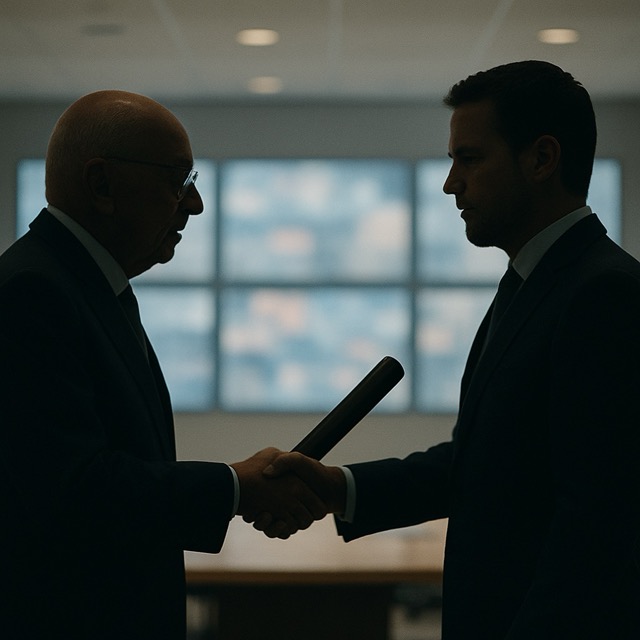
Rupert Murdoch has resolved the most consequential family dispute in modern media, striking a $3.3bn deal to buy out three of his adult children and install his eldest son, Lachlan Murdoch, as the undisputed steward of the clan’s global news and entertainment holdings. The settlement ends years of friction over the future of Fox Corp and News Corp, and all but guarantees that the group’s outlets — from Fox News in the U.S. to The Australian and the Wall Street Journal — will continue to hew to a conservative editorial line under Lachlan’s control.
Under the agreement announced this week, siblings James Murdoch, Elisabeth Murdoch and Prudence MacLeod will each receive roughly $1.1bn and relinquish their remaining influence over the family’s stakes in Fox and News Corp. Their exit is financed in part by the sale of tens of millions of Class B voting shares across the two companies, and the creation of a new family trust designed to consolidate authority with Lachlan while also providing for his younger half-sisters, Grace and Chloe.
The structure matters. The new trust is expected to hold about one‑third of the voting stock in each company and, crucially, vests voting control with Lachlan alone until at least 2050, according to people familiar with the accord. That change replaces a previous arrangement dating to the late 1990s in which the four older children — Prudence, Elisabeth, Lachlan and James — would have shared decision‑making power upon their father’s death. The result removes the possibility that a trio of more moderate siblings could combine to outvote Lachlan and redirect the companies’ strategy and tone.
The buyout also draws a line under a messy legal saga that played out last year in a Reno, Nevada, courtroom. Rupert Murdoch, now 94, sought to alter the terms of an irrevocable trust established after his 1999 divorce from Anna dePeyster, an attempt that a judge rejected in December. That rebuke opened the way for settlement talks that have now culminated in a clean handover: Lachlan retains and formalizes control; his siblings take cash and step aside.
For the businesses, the immediate implications are continuity and clarity. Fox News — still the top‑rated U.S. cable news channel — will keep a leadership line‑of‑sight to Lachlan, who serves as Fox’s executive chair and News Corp’s chair. Boards at both companies endorsed the resolution, and Rupert Murdoch will remain chairman emeritus. Advisers say the deal should dampen boardroom uncertainty that has dogged the group since the 2019 split between 21st Century Fox (sold to Disney) and the stand‑alone Fox Corp and News Corp that remained.
Politically, the outcome preserves the status quo that has defined the Murdoch imprint on public life for decades. In the U.S., Fox News’ conservative prime‑time lineup remains a gravitational force inside Republican politics; in the UK and Australia, Murdoch titles routinely shape tabloid and broadsheet debate. That ecosystem will remain intact under Lachlan, who has long been seen as ideologically closer to his father than his siblings — particularly James, who publicly criticized the family’s newspapers in 2020 for their coverage of climate change.
The new governance also places constraints on any future counter‑move by the departing trio. People briefed on the deal say the agreement bars them and their affiliates from acquiring additional stock in either company. Meanwhile, the trust that anchors Lachlan’s control will be funded in part by the sale of roughly 31 million voting shares from the old trust, according to company disclosures. A portion of those sales — priced at a modest discount to market — helped raise more than a billion dollars to help finance the settlement, with the balance delivered through additional transactions and trust assets.
If the mechanics are intricate, the strategic thrust is simple: take succession risk off the table. The Murdochs have long operated with a dual‑class share structure that concentrates voting power. The new trust, coupled with the siblings’ cash‑out, reduces the chance of a sudden governance pivot or sale that could have reoriented Fox’s and News Corp’s politics, portfolio or pace of investment. For shareholders and newsroom leaders alike, the message is that the empire will continue largely as it is — with Lachlan as its single center of gravity.
There are still open questions. The companies face the same structural headwinds as the rest of media: advertising softness, the shift from linear TV to streaming, and the relentless rise of platforms that intermediate audiences. At News Corp, robust earnings from Dow Jones, book publishing at HarperCollins and Australia’s REA Group have offset pressure on newspapers — but not eliminated it. At Fox, live sports and news remain sturdy franchises even as cord‑cutting erodes the traditional cable bundle.
Inside the family, the settlement may prove durable precisely because it aligns incentives. James, Elisabeth and Prudence have transformed uncertain, hard‑to‑unlock control rights into liquid wealth. Lachlan, for his part, gains unequivocal authority and a longer runway to pursue deals, defend the companies from activist agitation, and steer editorial posture without the specter of a sibling veto. Rupert, who remains a presence as chairman emeritus, secures what he has described privately for years: an orderly transfer to the child who shares his editorial instincts.
The symbolism is not lost on Hollywood or on Capitol Hill. The decades‑long tug‑of‑war over one of the world’s most influential media machines has ended with a consolidation of control under a single heir. That outcome echoes the fictional Roys of HBO’s “Succession,” but with a decidedly Murdoch twist: the solution preserves not just the corporate shell but the ideology that animates it.
In practical terms, the next milestones are incremental. The share sales that fund the payouts will be staged over several months. The trust vehicle will be constituted and begin exercising voting rights in the annual meeting cycles, making explicit what was once implicit: Lachlan’s word is the last word. For employees across Fox News, the Wall Street Journal, The Times and The Australian, that means the center of power is clear — and unlikely to shift soon.
For rivals and regulators, clarity cuts both ways. A settled Murdoch empire is a formidable competitor in news, sports and lifestyle media, and a persistent actor in politics on three continents. Yet with control risk resolved, a future strategic re‑shuffle — a sale, a merger, a spin‑off — becomes easier to prosecute should markets or technology demand it. Lachlan now owns the timeline.
After years of palace intrigue, the business case is straightforward. The Murdochs have swapped uncertainty for certainty, and debate for decision. Whatever one’s view of the empire’s influence, the succession battle is over. The elder Murdoch has decided who will hold the keys — and made sure the vehicle keeps pointing in the same direction.
Sources: Reuters (Sept. 9, 2025); Financial Times FirstFT (Sept. 9, 2025); Axios (Sept. 8, 2025); The Guardian (Sept. 9, 2025).



 The Tower Post