One in five of roughly 80,000 applicants passes strict vetting; online booking opens after eligibility checks for refugees who arrived under EU temporary protection.
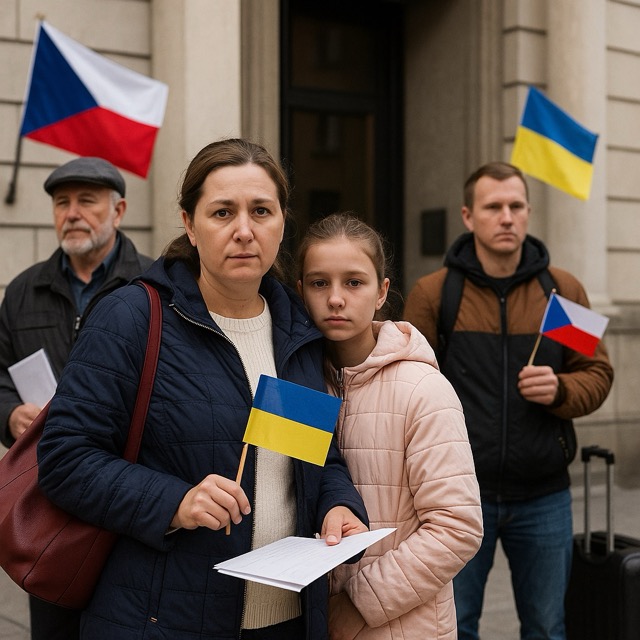
Czechia has granted long‑term residence to 15,000 Ukrainians, selecting about one in five from roughly 80,000 people who applied, the Interior Ministry said as it opened the next phase of the program on September 8. Those deemed eligible can now register online and book appointments with immigration authorities to provide biometrics and collect their permits. The pathway is aimed at refugees who have been living in the country under temporary protection since Russia’s full‑scale invasion of Ukraine.
The acceptance rate underscores how high the bar is for a coveted five‑year card at a moment when Czechia still hosts one of the largest Ukrainian communities anywhere in the EU. The bloc’s Temporary Protection regime—which grants the right to live and work—was extended by EU governments to March 4, 2027. At the end of June, Czechia counted about 378,000 people under temporary protection, the highest ratio in the EU at roughly 34.7 per 1,000 residents (Eurostat; Council of the EU).
ONE IN FIVE CLEARS THE BAR
Interior Ministry figures indicate that only about 15,000 applicants currently meet the strict income, housing and insurance conditions. Officials have emphasized security vetting and verified identity, along with evidence of stable self‑sufficiency and legal accommodation. Advocacy groups note that the government‑set income threshold and a ban on recent humanitarian benefits excluded many otherwise well‑integrated families. In Prague alone, more than one‑fifth of the successful applicants reside, reflecting where job opportunities and integration services are most concentrated.
WHAT THE NEW PERMIT CHANGES
For those who qualify, the special long‑term residence brings a multi‑year horizon and administrative stability beyond the year‑to‑year renewals associated with temporary protection. Holders keep unrestricted access to the labor market and can sign longer leases or mortgages with greater certainty; employers, too, gain predictability for workforce planning. Unlike temporary protection, however, the long‑term status generally does not entitle holders to most non‑insurance social benefits and, according to practitioners, does not automatically issue a Czech birth number (rodné číslo), which some banks and service providers still request.
HOW THE PROCESS WORKS
The ministry’s rollout relies on online self‑service. Applicants who already received confirmation that they passed eligibility checks can log in to the ministry portal, select an available time, and complete the process in person at regional offices. Officials advise bringing a valid travel document, proof of insurance and accommodation, and any documents that confirm household composition. Because demand is concentrated in the largest cities, booking slots may appear in waves; authorities say new appointments will be released as capacity allows.
A SYSTEM UNDER PRESSURE—AND AN ECONOMY THAT BENEFITS
Czechia’s per‑capita intake remains the EU’s highest, a point of national pride for many and a logistical squeeze for municipalities. Government data show that, since 2022, the state spent roughly CZK 62.5 billion on support for refugees while taxes and social contributions paid by Ukrainians reached CZK 55.5 billion by early 2025—nearly balancing the ledger and, in 2023, turning positive. Employment among refugees has grown steadily as the labor market absorbs workers in industry, services, and healthcare.
WHY MANY MISSED OUT
The eligibility criteria were designed to prioritize people who are self‑sufficient, insured in the public system, and continuously resident for at least two years. A clean criminal‑record check is required for adults. For multi‑person households, income thresholds rise with each dependent, and all members must express interest and meet conditions. NGOs warn that single‑parent families and those in low‑wage sectors struggle to reach the income bar even when employed full‑time, particularly outside Prague and Brno.
WHAT HAPPENS TO THE REST
Those who did not qualify—or have yet to be assessed—keep their temporary protection, which remains valid across the EU at least until March 2027. They can live and work under the same core rights, and may still transition later if they meet the criteria. Separately, people can pursue existing pathways such as standard employment permits, family reunification, or study visas through the Foreigners’ Police, depending on individual circumstances.
HOW TO PREPARE IF YOU QUALIFY
• Book the earliest possible appointment through the official portal; availability changes as offices add capacity.
• Check that your travel document is valid through the date of card pickup and that your public health insurance coverage is continuous.
• Bring proof of accommodation (registered address), employment/income documentation, and—if relevant—children’s Czech school attendance confirmations.
• If your situation changed since expressing interest (new job, change of household), bring updated evidence and be ready to explain it at the counter.
WHAT TO WATCH NEXT
Capacity at immigration offices will determine how fast approved applicants receive cards. The Interior Ministry is expected to publish more granular data on acceptance rates by region and household type. At the EU level, governments are debating a coordinated ‘exit strategy’ from temporary protection once conditions allow, including how to transition willing refugees into national residence systems without overloading asylum offices. In the meantime, Czechia’s new long‑term pathway is shaping who will put down roots—and where.
KEY NUMBERS
• Applicants for long‑term residence in Czechia: ~80,000.
• Approved so far: ~15,000 (~19%).
• Share of approved living in Prague: 20%+.
• People from Ukraine under temporary protection in Czechia (June 2025): ~378,000; 34.7 per 1,000 residents—the EU’s highest ratio.
• EU temporary protection now runs until March 4, 2027.
• State spending on refugee support since 2022: CZK 62.5 billion; estimated tax/social contributions by Ukrainians by early 2025: CZK 55.5 billion.
Sources and context
Eurostat (data extracted 5 Aug. 2025); Council of the EU press release (13 June 2025); Expats.cz/ČTK (8 Sept. 2025); Radio Prague International (23 Feb. 2025); UNHCR Protection Brief (June 2025); PICUM case study (June 2025).
 The Tower Post